
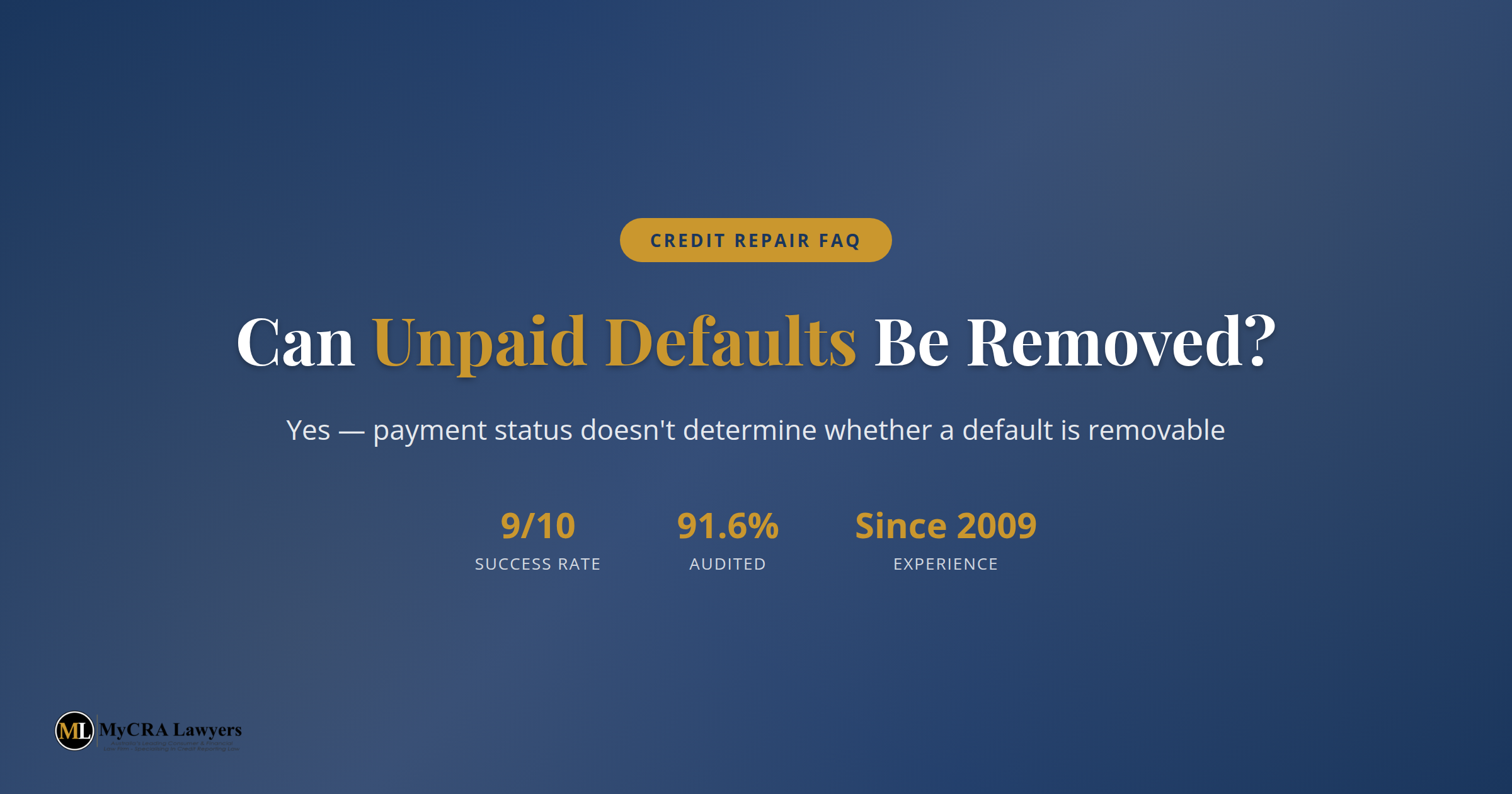
One of the most common questions we receive at MyCRA Lawyers is whether an unpaid default can be removed from a credit file. Many Australians assume that because they haven’t paid the debt, the default listing is permanent and unchallengeable. The good news? That assumption is wrong.
The key to understanding unpaid default removal lies in recognising that credit repair focuses on the listing process, not whether the underlying debt has been paid. This distinction opens up removal possibilities that many people don’t realise exist.
The Short Answer: Yes, Unpaid Defaults Can Be Removed
Let’s be direct: unpaid defaults can absolutely be removed from your credit file. The payment status of the debt is often irrelevant to whether the default listing itself was lawfully created.
Here’s why: credit repair lawyers don’t argue about whether you owed the money. Instead, we examine whether the creditor followed all the legal requirements when listing the default. If they didn’t—and they frequently don’t—the listing can be challenged and removed regardless of payment status.
Why Payment Status Doesn’t Determine Removability
Under Australian credit reporting law, creditors must follow specific procedures before listing a default on your credit file. These requirements include:
1. Proper Notice Requirements
Before listing a default, the creditor must send you a written notice giving you at least 14 days to address the debt or enter into a payment arrangement. This notice must contain specific information prescribed by law, including clear statements about the consequences of non-payment.
2. Timing Compliance
There are strict timelines for when defaults can be listed. For example, there’s a maximum period after the debt becomes overdue within which the default notice must be sent, and another timeline between notice and listing. Errors in timing can invalidate the listing.
3. Documentation Standards
The creditor must maintain proper records of the default process, including proof of sending notices and the content of those notices. Many creditors fail to keep adequate documentation, which can be grounds for removal.
4. Amount Accuracy
The default amount listed must be accurate. Listing an incorrect amount—whether too high or too low—can constitute grounds for challenging the listing.

How Legislative Errors Lead to Removal
When MyCRA Lawyers reviews a default listing, we audit the entire process the creditor followed. We’re looking for legislative errors or omissions—places where the creditor failed to comply with their legal obligations.
Common findings include:
- Notice never received — sent to wrong address, not sent at all, or sent by incorrect method
- Insufficient notice period — less than the required 14 days provided
- Missing required information — notice didn’t contain all legally required content
- Timing breaches — default listed too early or too late relative to notice
- Incorrect creditor details — listing by wrong entity or after debt was sold
- Amount discrepancies — listed amount doesn’t match actual overdue amount
It’s not uncommon to find multiple errors in a single default listing. We’ve seen cases with 14 or more legislative breaches on one listing. Each error strengthens the case for removal.
Our Success Rate: 9 Out of 10 Defaults Removed
At MyCRA Lawyers, our audited success rate for default removal is over 91.6%—that’s approximately 9 out of every 10 defaults we investigate. This high success rate reflects how often creditors fail to follow proper procedures, regardless of whether the underlying debt is paid.
This success rate includes both paid and unpaid defaults. The process we follow is the same either way because we’re examining compliance, not payment.
Have an Unpaid Default?
We can assess whether your default listing has removable errors, regardless of payment status.
or call 1300 667 218
For more information about default listing requirements, see the Office of the Australian Information Commissioner (OAIC) credit reporting guidelines.
The Important Caveat: What Happens After Removal
While unpaid defaults can be removed, there’s an important consideration about what happens afterward. This is where we strongly recommend paying outstanding debts either during or shortly after the removal process.
Why You Should Still Address the Debt
When a default is removed due to procedural errors, the underlying debt doesn’t disappear. The creditor still has the right to pursue payment through other means. Here’s what could happen if the debt remains unpaid:
Court Action: The creditor can file a claim in court for the unpaid debt. If successful, this results in a judgment against you, which:
- Appears on your credit file for five years (potentially longer than the original default)
- Gives the creditor stronger collection powers
- May allow enforcement actions like wage garnishment or asset seizure
Debt Collection: Even without court action, the debt can be pursued through collection agencies, creating ongoing stress and potential further credit impacts.

Your Three Options for Dealing with the Underlying Debt
If you legitimately owed the debt that led to the default, you generally have three options:
Option 1: Pay the Debt as Part of Removal
Many clients choose to pay the debt (often at a negotiated reduced amount) as part of the default removal process. This provides a clean slate—no default listing and no outstanding debt.
Option 2: Arrange a Payment Plan
If you can’t pay in full, negotiating a payment plan with the creditor protects you from court action while you work through the debt. This can be done during or after the removal process.
Option 3: Accept the Risk
Some clients choose not to pay, accepting the risk that the creditor may pursue court action. This might make sense if the debt is very old (approaching limitation periods), the amount is small, or you have reasons to believe the creditor won’t pursue it. However, this is generally the riskiest option.
The Process: From Investigation to Removal
Here’s how the unpaid default removal process typically works:
Step 1: Credit File Review
We obtain your credit reports from all three bureaus (Equifax, Experian, and illion) and identify the defaults to investigate.
Step 2: Document Collection
We request all documentation related to the default from the creditor, including notices sent, proof of delivery, and internal records.
Step 3: Compliance Audit
Our team reviews every aspect of the listing process against legislative requirements, identifying any breaches or errors.
Step 4: Removal Request
When errors are found, we compile a comprehensive list of legislative breaches and formally request removal from both the creditor and the credit bureau.
Step 5: Follow-Through
If initial requests are unsuccessful, we escalate through appropriate channels until resolution is achieved.

Why Professional Legal Assistance Matters
While individuals can attempt to dispute defaults directly, professional legal assistance significantly improves outcomes for several reasons:
- Technical knowledge — Understanding the specific legislative requirements creditors must meet
- Document interpretation — Identifying subtle errors that non-specialists would miss
- Creditor relationships — Knowing which contacts and approaches work with specific creditors
- Legal weight — Correspondence from lawyers is treated more seriously than individual disputes
- Escalation pathways — Knowing when and how to escalate if initial requests fail
Conclusion
The belief that unpaid defaults can’t be removed is a myth that keeps many Australians trapped with damaged credit files unnecessarily. The reality is that credit repair focuses on whether the creditor followed proper procedures, not on whether you paid the debt.
With over 91.6% of defaults we investigate being removed, the statistics clearly show that creditors frequently fail to comply with their legal obligations. These procedural errors create opportunities for removal regardless of payment status.
If you have an unpaid default on your credit file, don’t assume it’s permanent. The listing process may contain errors that make it removable—and finding out is the first step toward regaining control of your credit future.
Ready to Investigate Your Default?
Don’t let an unpaid default hold you back. Our specialist lawyers can assess your listing and advise on removal prospects.
📞 1300 667 218 | Australia-wide service
Images: Stock photos via Unsplash


Leave A Comment