
Updated 6 October 2026. By Graham Doessel.
Lenders see every hard enquiry you trigger. A few applications are normal. A cluster of payday, BNPL or car-yard checks in a short window can drag assessments down and trigger auto-declines. Soft checks (including you pulling your own free report) are different. Some enquiries may be removable if they were unauthorised, duplicated or listed incorrectly; ordinary shopping enquiries usually are not. Start with free reports from both bureaus every three months, then decide what is worth disputing.
Hi, I’m Graham. I’ve watched good, honest Australians walk into Credit Prison one “just checking” application at a time. The bank declines the home loan. The broker shrugs. Nobody told them the enquiry trail mattered as much as the defaults.
What is a credit enquiry?
A credit enquiry (credit check) is when a credit provider accesses your credit reporting information to assess an application. Under the Privacy Act 1988 Part IIIA framework, those footprints can sit on your file for years and other lenders can see them.
Australia now has two mainstream consumer credit reporting bodies: Equifax and Experian. Experian absorbed illion’s consumer bureau; from 1 April 2026 an Experian report includes data previously held separately by illion. Pull both files. Lenders do not all read the same bureau.
Hard enquiries
Hard enquiries happen when you apply for credit and the lender checks your file as part of that assessment. Mortgages, personal loans, credit cards, car finance, store cards and many BNPL products leave hard footprints. Other credit providers can see them. For the full process, see our guide on how to remove a default from your credit file.
Soft enquiries
Soft enquiries generally do not behave like lender application checks on your scorecard. Checking your own file, some pre-qualification processes, and certain permitted background checks sit in this bucket. Accessing your own credit reporting information should not look like a lender enquiry. More: checking your credit score won’t lower it.
When do enquiries become a problem?
Lenders use recent enquiry volume as a risk signal. Patterns that look like rate-shopping desperation or payday churn hurt more than a single home-loan check with a broker who lodges once.
There is no magic number in the Privacy Act that says “four equals decline”. Policy engines differ. As a practical rule of thumb many brokers still watch for:
- Several hard enquiries in the last six months
- A pile-up across twelve months, especially mixed with payday or high-cost credit brands
If your Equifax file looks quiet and your Experian file looks busy (or the reverse), that alone can explain a surprise decline. Compare both.
How long do enquiries stay on your credit file?
Consumer credit enquiries are commonly retained for five years under credit reporting retention rules. Paying out a loan does not wipe the enquiry that was made when you applied. Time and lawful correction are the usual exits, not wishful thinking.
Which enquiries may be removable?
Lawful removal turns on compliance and accuracy, not embarrassment. Candidates we often audit:
- Unauthorised checks (you did not apply / did not consent)
- Duplicate or incorrectly recorded enquiries
- Wrong identity match (someone else’s application sitting on your file)
- Enquiries that do not meet disclosure rules under Part IIIA / the Credit Reporting Code
Ordinary hard enquiries from applications you actually made are usually not removable just because you regret them. For the service pathway see enquiry removal and our cornerstone credit repair lawyers Australia.
Practical steps before your next application
- Get free Equifax and Experian reports (every three months under OAIC guidance; also after a refusal within 90 days).
- List every hard enquiry from the last two years: who, when, product type.
- Stop fresh applications (including “just looking” car yards and BNPL) until the strategy is clear.
- Tell your broker the full enquiry trail before they lodge.
- Dispute only what has a real compliance or accuracy angle, or get a free analysis first.
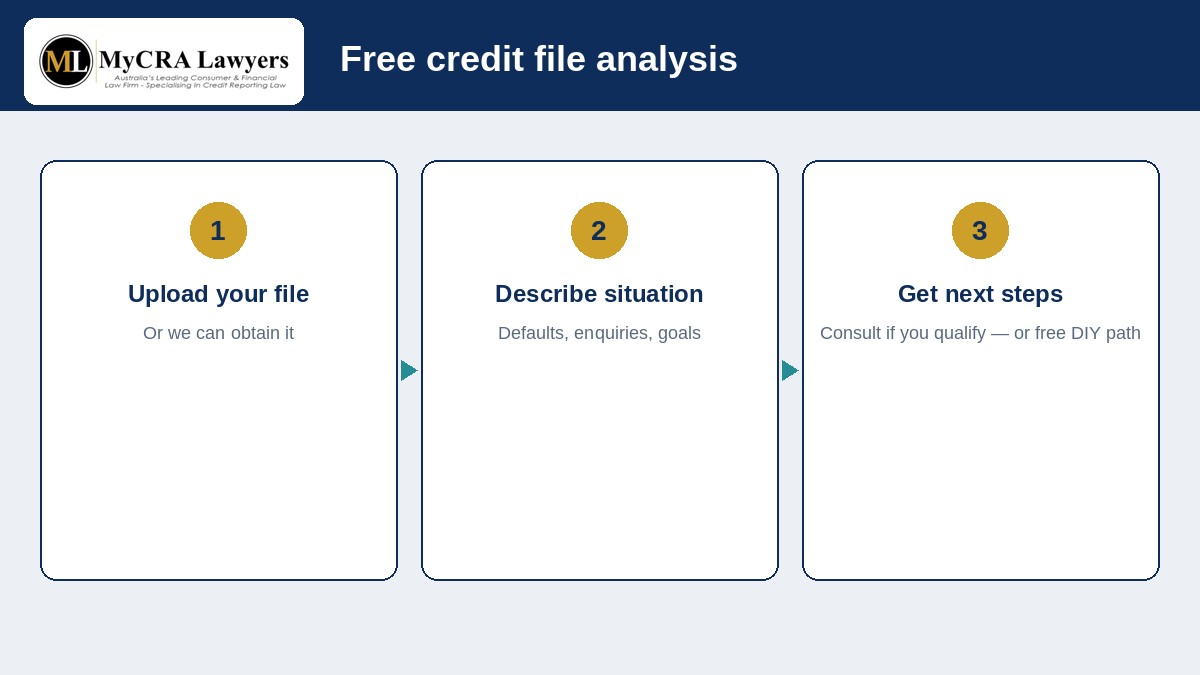
Free credit file analysis: upload the file that shows the problem at app.fixmybadcredit.com.au. Walkthrough: free credit file analysis.
When MyCRA gets involved
We review Equifax and Experian information, then audit enquiries, defaults, judgments and RHI for Privacy Act and Credit Reporting Code issues. On consumer defaults accepted after initial assessment, our success rate is 91.6%, independently audited by a chartered accountant. Our own records show 29.4% of defaults are removed within 7 days. Fixed fees quoted before you start. From time to time we run a Money Back Guarantee offer on listings with certain creditors. Which creditors it covers changes, so ask us if one is running. We explain how our process works before you commit to anything.
Don’t spend another month stuck in Credit Prison. Call our credit repair lawyers on 1300 667 218 or book a 15-minute intro call at https://mycralawyers.com.au/15min-credit-repair-intro-call/ . If we think your chances are low, we’ll tell you straight.
Hard enquiries vs soft checks
Hard enquiries land when you apply for credit and a lender asks a bureau for a full assessment. Soft checks, including you pulling your own free Equifax or Experian report,sit in a different bucket and should not behave like a lender application. The practical risk is clustering: several hard checks in a short window look like stress or rate-shopping chaos to automated panels.
Car yards, payday lenders and BNPL providers are frequent enquiry factories. A “pre-approval chat” that still triggers a hard pull is still a hard pull. Ask before anyone clicks submit.
What “too many” looks like in practice
There is no single magic number published in law. Brokers and lenders apply overlays. Five short-term credit enquiries in eight weeks can hurt more than one home-loan check. If you are two months from lodging a mortgage, freeze discretionary applications and clean anything that is actually wrong first.
- Map every enquiry on both bureau PDFs
- Note dates, creditor names and product types
- Flag anything you did not authorise or do not recognise
- Leave ordinary shopping enquiries alone unless strategy says otherwise
Unauthorised or incorrect enquiries may be removable. See enquiry removal. Ordinary applications you made usually remain for the reporting period.
Before you refinance or switch lenders
Pull free reports every three months (OAIC). Run a free credit file analysis if the PDF is noisy. Tell the broker the enquiry story up front so they do not “just try another panel” into a worse cluster.
FAQ
Do soft enquiries hurt my score?
Soft enquiries are generally not treated like lender application checks. Accessing your own free credit report should not create a hard enquiry.
How many credit enquiries is too many?
It depends on the lender’s policy engine, the brands involved and how recent the cluster is. Payday and repeated short-term credit checks usually hurt more than a single broker-managed home loan enquiry.
Can MyCRA remove every enquiry on my file?
No. We target unauthorised, incorrect or non-compliant listings. Applications you made that were listed correctly usually stay.
Should I check Equifax and Experian?
Yes. Both. From 1 April 2026 Experian includes former illion consumer data. Free access is available every three months.
Will enquiries drop off automatically?
Retention periods run their course unless a listing is corrected earlier because it was wrong or non-compliant.
This is general information, not legal advice. Lender policies and bureau products change. Liability limited by a scheme approved under Professional Standards Legislation.
MyCRA Lawyers | Australia-wide | 1300 667 218 | Contact form | PO Box 169, Aspley QLD 4034

Leave A Comment