
Updated 7 October 2026. By Graham Doessel.
A default may be removable from your Equifax or Experian file if the creditor did not follow the Privacy Act 1988 Part IIIA, the Privacy (Credit Reporting) Code, or (for consumer credit) the National Credit Code notice rules. Paying the debt does not wipe the listing by itself. Start with free reports from Equifax and Experian, check the notices and amounts, dispute in writing, then escalate to AFCA or the OAIC if needed. A specialist credit repair law firm audits the listing process when DIY stalls.
Hi, I’m Graham Doessel. Since 2009 I’ve watched good, honest Australians get stuck in what I call Credit Prison: a default that can sit on the file for five years and knock back home loans, car finance and even some rentals. A lot of people think the only way out is to pay up and wait. That is not how the law works. If the creditor skipped a required step, the listing itself can be the problem.
This guide walks through the legal pathway in plain English. It is general information, not advice for your specific file.
What is a default on an Australian credit file?
A consumer default is a listing a credit provider (or their agent) places with a credit reporting body when they say you have fallen behind on a consumer credit account. Under the credit reporting rules, a consumer default generally must be at least $150 and at least 60 days overdue before it can be listed, and other notice requirements apply.
Defaults show on files held by Australia’s three main credit reporting bodies:
Lenders do not all use the same bureau. That is why your scores can disagree, and why you should pull both files before you dispute anything. More on that in our guide to credit repair lawyers in Australia.
Can you remove a default if you still owe the money?
Yes, sometimes. Removal turns on whether the listing was compliant, not on whether the underlying debt is paid.
If the creditor failed to send the right notices, used a stale address, listed the wrong amount, listed too early, or otherwise breached Part IIIA or the Credit Reporting Code, you may have grounds to seek correction or removal. Paying can still make sense for other reasons (stopping collection, reducing judgment risk), but payment alone does not delete a compliant default. We explain that myth more in paying a debt won’t fix your credit file.
Our default removal work, and our unpaid default removal page, both start with that compliance audit.
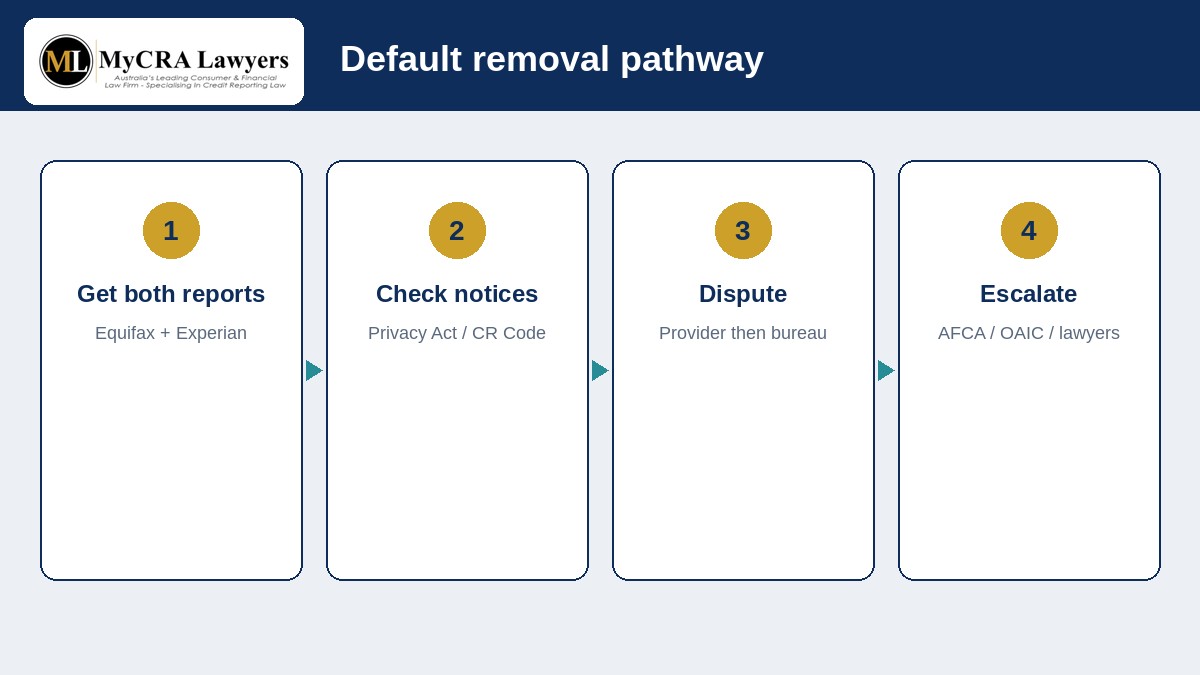
Step 1: Get your files from Equifax and Experian
Under the Privacy Act you can request access to your credit reporting information. As a practical starting point:
- Request a free report from each bureau (you can usually get a free report every three months, and after a credit refusal).
- Save PDFs. Screenshot portals if they expire.
- Note every default: creditor name, amount, listed date, account number, and which bureau shows it.
Do not apply for new credit while you are cleaning the file unless you must. Extra enquiries can make the score worse while you are mid-dispute. Checking your own file is not the same as a lender enquiry. See checking your credit score won’t lower it. We explain the scoring side in how credit enquiries affect your credit score.
Step 2: Check whether the listing met the legal thresholds
For a consumer default, work through a checklist. Exact rules sit in the Privacy Act Part IIIA, the Credit Reporting Code, and (for many regulated loans) the National Credit Code.
Ask:
- Was the amount at least $150?
- Was the account at least 60 days overdue when listed?
- Did you get prior notice that information might be disclosed to a credit reporting body (often discussed by practitioners by reference to section 6Q style notice requirements)?
- Was there a further notice period (commonly a 14-day style notice) before listing?
- Did Section 88 National Credit Code default notice requirements apply to that credit contract, and if so were they followed?
- Was the notice sent to your correct address on the creditor’s records?
- Does the listed amount match what you actually owed at the relevant time?
Changed address is a classic failure point. If you told the creditor you moved and they kept writing to the old place, that fact matters. We cover notices in more detail in Did you receive a default notice?.
Step 3: Dispute with the credit provider first
Write to the creditor (and copy the relevant credit reporting body if the bureau’s process asks you to). Keep it factual:
- Identify the listing (bureau, date, amount, account).
- State what you say went wrong (missing notice, wrong address, wrong amount, listed too early, not your account, and so on).
- Attach evidence (change-of-address emails, bank statements, hardship letters, ID theft reports).
- Ask for the listing to be corrected or removed and for a written response.
Credit providers and CRBs have set timeframes under the Credit Reporting Code to investigate. Diary them. If they stonewall or reject without dealing with your evidence, escalate.
Step 4: AFCA (and when OAIC fits)
If the credit provider is an AFCA member (most banks, many lenders and collectors are), you can lodge a complaint with the Australian Financial Complaints Authority at no cost to you as the consumer. AFCA can look at whether the firm followed the rules and whether the outcome is fair in the circumstances.
The Office of the Australian Information Commissioner (OAIC) handles privacy and credit reporting privacy complaints. AFCA is often the practical first escalation for financial firm conduct. OAIC is the regulator path for credit reporting privacy issues. Some matters travel both routes over time.
Escalated matters often take 60 to 120 days or longer. That is normal. It is still free for consumers to try.
Step 5: Know what DIY can do, and when a lawyer adds value
DIY works when the error is obvious and the creditor is cooperative: wrong person, clear duplicate, obvious amount error, documented hardship that was ignored.
A law firm adds value when:
- The creditor digs in and ignores your evidence
- Notices are missing or disputed and you need a structured audit
- There are multiple defaults across bureaus
- A home loan or refinance deadline is close and the file needs a coordinated approach
- You want someone who can escalate with legal letters rather than scripted “credit repair” emails
MyCRA Lawyers is a Queensland Law Society regulated incorporated legal practice. Credit reporting law is what we do. On consumer defaults we accept after initial assessment, our independently audited success rate is 91.6%, and 29.4% of those accepted matters resolved within 7 days. Many resolve within about 30 days. AFCA or OAIC escalations take longer. We quote a fixed fee in writing before you commit, and selected consumer default work carries a Money Back Guarantee on the published terms.
We will tell you if your chances look low. That is part of the job.
What usually cannot be “wished away”
A fully compliant default on a debt that was yours, correctly noticed, correctly timed and correctly reported, generally stays for the allowed retention period (for consumer defaults, typically five years from the date of the default listing, subject to the Credit Reporting Code). Serious credit infringements and some other listing types have their own rules. Fraud and identity theft are different: those listings should not be there if they are not yours.
If your situation is identity theft, start with the bureaus’ ban processes and IDCARE, then dispute the fraudulent listings.
Getting out of Credit Prison the lawful way
I use the Credit Prison metaphor because that is how it feels: five years of hard labour for a listing that sometimes should never have been made. Early release is not about shouting at collectors. It is about proving the sentence was unlawful in the first place, using the Privacy Act, the Credit Reporting Code and the National Credit Code.
If you want a second pair of eyes on your three files, book a 15-minute credit repair intro call or call 1300 667 218. Email docs@mycralawyers.com.au with your reports if you already have them.
Free help is also available: free bureau reports, free AFCA complaints, OAIC privacy complaints, and the National Debt Helpline on 1800 007 007 for budgeting and hardship guidance. If you want the detail first, read how it works.
FAQ
Do I have to pay the default before it can be removed?
Not necessarily. Payment status and listing compliance are different questions. An unpaid default may still be removable if the listing process breached the rules. We still often recommend dealing with the underlying debt so you are not trading a default for a judgment later.
How long does default removal take?
Some accepted matters resolve in days. Our figures show 29.4% of accepted consumer defaults resolved within 7 days. Others take weeks. AFCA or OAIC pathways commonly run 60 to 120 days or more.
Which credit bureau should I check?
Both current bureaus: Equifax and Experian. (Former illion consumer data sits with Experian from 1 April 2026.) Defaults do not always appear on both, and lenders pick different bureaus.
Can MyCRA remove every default?
No. We only proceed where we see a credible compliance issue after assessment. If chances look poor, we say so. No ethical firm should promise a guaranteed removal.
Is this the same as a debt agreement or bankruptcy?
No. Credit repair through compliance disputes is not a Part IX debt agreement and not bankruptcy. Those are separate formal options with their own credit consequences. Get advice before signing either.
This is general information, not legal advice. Your rights depend on your contract, the listing dates, the notices you received and the evidence on your file. For advice about your situation, contact a solicitor. Liability limited by a scheme approved under Professional Standards Legislation.
MyCRA Lawyers | Australia-wide | 1300 667 218 | docs@mycralawyers.com.au | Book a 15-minute intro call

Leave A Comment