
Names and identifying details in this case study have been changed to protect our client’s privacy.
Alex was nearly done building his home. He just needed a bit more money to finish.
His family had promised to help with a large sum within six to eight months, once they sold a property. Banking on that, Alex maxed out his credit cards and took out a personal loan of around $30,000 to keep the build moving.
Then the family property sold for less than expected. The money never came. Alex was left with debts he couldn’t service, and a default of roughly $34,000 from his bank’s collections arm went onto his file.
What the default was doing
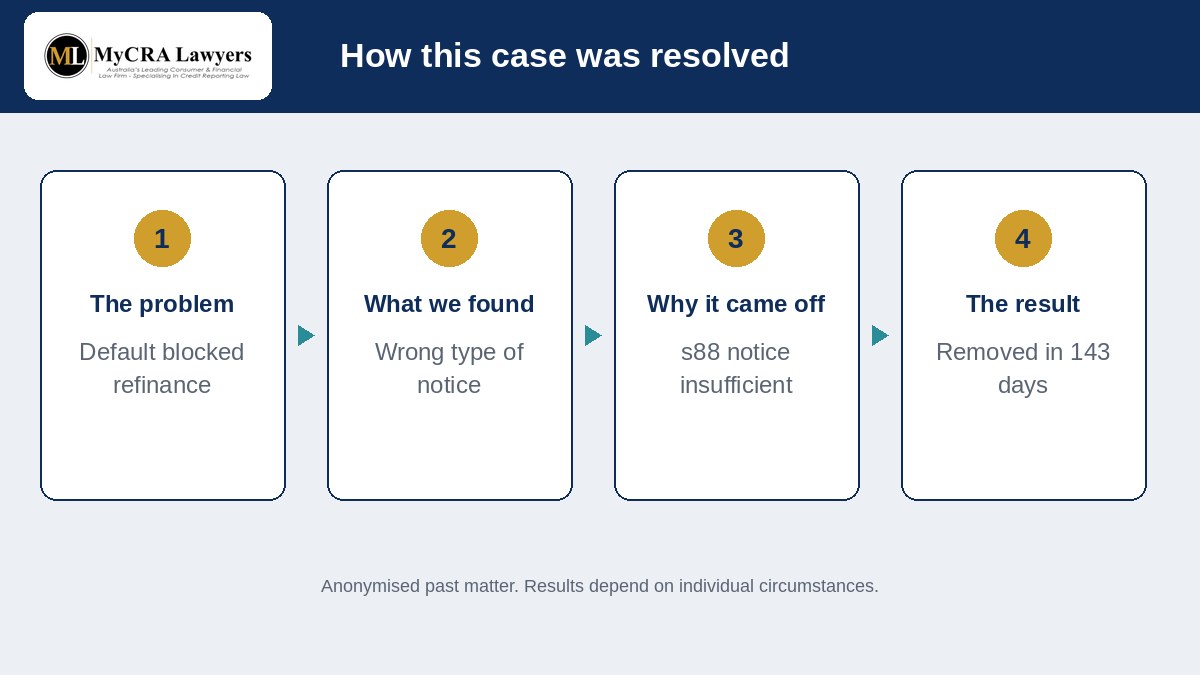
He needed to refinance. With that default sitting there, no lender was going to touch it.
What we found
We asked for the documents behind the default, including the default notice. For a regulated credit contract, the National Credit Code requires a specific default notice before the lender can take enforcement action, and it sets out what that notice has to contain.
The bank didn’t give us that notice. Instead, it argued that the separate notice it sent under the Privacy Act’s credit reporting rules was good enough.
It isn’t. They’re different notices, under different laws, for different purposes.
Why it came off
This one took persistence. The bank was slow to supply documents, citing a heavy workload. We kept disputing the notice, pointing to the specific requirements in the National Credit Code that its notice didn’t meet. In the end, the bank agreed to remove the default.
The result
We started on 4 January. The default came off on 26 May, 143 days later. Alex could go ahead and apply to refinance.
What this means for you
Creditors sometimes treat notices as interchangeable. The law doesn’t. If a large default rests on a notice that doesn’t meet the legal requirements, that can be enough to get it removed. Our credit repair lawyers read those notices line by line.
This is a past matter. Names and identifying details have been changed to protect our client’s privacy.
Results depend on individual circumstances. Every credit file is different, and a past result doesn’t guarantee the outcome of your matter. This case study is general information, not legal advice.
Don’t spend another month stuck in Credit Prison. Call our credit repair lawyers on 1300 667 218 or book a 15-minute intro call at https://mycralawyers.com.au/15min-credit-repair-intro-call/ . If we think your chances are low, we’ll tell you straight.
MyCRA Lawyers | Australia-wide | 1300 667 218 | docs@mycralawyers.com.au | Book a 15-minute intro call

Leave A Comment