
Updated 7 October 2026. By Graham Doessel.
Five years is the usual lifespan, but it is not always the end of the story. Paying the debt does not shorten that retention period by itself. Early removal may be possible if the listing breached the Privacy Act 1988 Part IIIA, the Privacy (Credit Reporting) Code, or related notice rules. Serious credit infringements and some other listing types follow different clocks.
Hi, I’m Graham. When someone calls us in a panic about a home loan knock-back, the first question is almost always: “How long am I stuck with this?” Five years in Credit Prison is a long sentence. The second question matters more: “Does it have to stay that long?” Sometimes the answer is no, but only when the law says the listing should not have been made the way it was.
How long does a consumer default stay?
Under Australia’s credit reporting framework, consumer credit default information is generally retained by credit reporting bodies for five years from the date of the default information. That clock is about the listing, not about the day you finally paid.
So if a default was listed on 1 March 2024, the usual retention runs toward early 2029, subject to the Credit Reporting Code rules as they apply to that information type. Always check the dates on your actual Equifax and Experian reports. Bureaus can present paid status differently, but paid status alone does not equal deletion. For the full process, see our guide on how to remove a default from your credit file.
For a deeper walk through of timeframes and listing limits, see our article on legal timeframes for listing a default.
Paid vs unpaid: why the status line confuses people
Your report might show a default as paid, unpaid, or partially paid. That status is useful information for lenders. It is not a delete button. We explain the scoring side in how credit enquiries affect your credit score.
- Unpaid default: the creditor says the amount was outstanding when listed (and may still be).
- Paid default: the debt was later paid or settled, but the historical default information can remain for the retention period.
Lenders still see that a default occurred. A paid default is often less damaging than an unpaid one for some credit decisions, but it is still a default. If you are planning a home loan, talk to your broker about how each lender treats aged paid defaults. Our default removal page covers both paid and unpaid scenarios.
We also wrote specifically about why paying the debt won’t fix your credit file by itself.
Serious credit infringements and other listings
Not every negative mark is a standard consumer default.
- Serious credit infringements (sometimes discussed alongside clearouts in older industry language) have their own reporting and retention rules under the Privacy Act and Credit Reporting Code.
- Court judgments are different again. They are public record information with their own retention and removal pathways (including setting aside in court). See our judgment removal service page.
- Repayment history information (RHI) is a monthly payment profile, not a default. Late RHI marks have different retention and dispute issues. See repayment history information.
- Enquiries stay for a shorter period than defaults (commonly up to five years for finance enquiries, depending on type) and affect scoring differently.
If you are unsure which listing type you are looking at, get the full files from both bureaus (Equifax and Experian) and read the labels carefully. Our cornerstone guide to credit repair lawyers in Australia maps the main listing types.
Can a default come off sooner than five years?
Yes, in two broad situations:
- Correction or removal for non-compliance or inaccuracy. If the information is wrong, out of date in the Code sense, or was listed without required notices and processes, you can seek correction under the Privacy Act and Credit Reporting Code. That can mean removal before the five-year mark.
- The retention period ends. The bureau should stop presenting the default information when the Code retention period expires.
There is no general “good behaviour” discount that shaves years off a compliant default because you paid early or completed a course. Creditors sometimes agree commercially to request removal, but you should not count on goodwill. The durable pathway is compliance and accuracy.
What does not reset the clock
A few myths we hear every week:
- “I paid it yesterday, so it should disappear tomorrow.” Payment updates status. It does not erase history.
- “If I pay a collection agency a settlement, Equifax has to delete it.” Settlement terms might include a request to update or remove, but only if that is agreed and actioned. Get it in writing.
- “A new loan approval wipes old defaults.” Approvals do not purge old listings.
- “One bureau deleted it, so both are clean.” Listings can differ across Equifax and Experian. Confirm each file. (Former illion data is now on Experian from 1 April 2026.)
How lenders think about age
Brokers know that a two-year-old paid default is not assessed the same way as a fresh unpaid default. Policy varies by lender, product and overall file strength (income, LVR, other credit). Age helps. Clean removal helps more when the listing was non-compliant.
If a broker deal is on the line, speed and accuracy matter. That is often when people stop DIY and ask a law firm to audit the notices properly.
Practical timeline if you dispute
Rough expectations (your matter may differ):
- DIY dispute with creditor/CRB: often weeks, depending on investigation periods in the Credit Reporting Code.
- Accepted legal matters at MyCRA: many resolve within about 30 days. On consumer defaults accepted after initial assessment, our success rate is 91.6%, independently audited by a chartered accountant. Our own records show 29.4% of defaults are removed within 7 days.
- AFCA or OAIC escalation: commonly 60 to 120+ days.
Free options remain available the whole time: free credit reports, free AFCA complaints for eligible firms, OAIC privacy complaints, and the National Debt Helpline on 1800 007 007.
Credit Prison with a calendar on the wall
Five years is the standard sentence for a compliant consumer default. Early release is not a favour. It is what happens when the paperwork behind the listing does not meet Australian credit reporting law.
If you want us to check whether your default is stuck for the full term or challengeable now, call 1300 667 218, reach us through our contact form, or book a 15-minute credit repair intro call. Fixed fees are quoted in writing. From time to time we run a Money Back Guarantee offer on listings with certain creditors. Which creditors it covers changes, so ask us if one is running. If we think your chances are low, we will tell you straight.
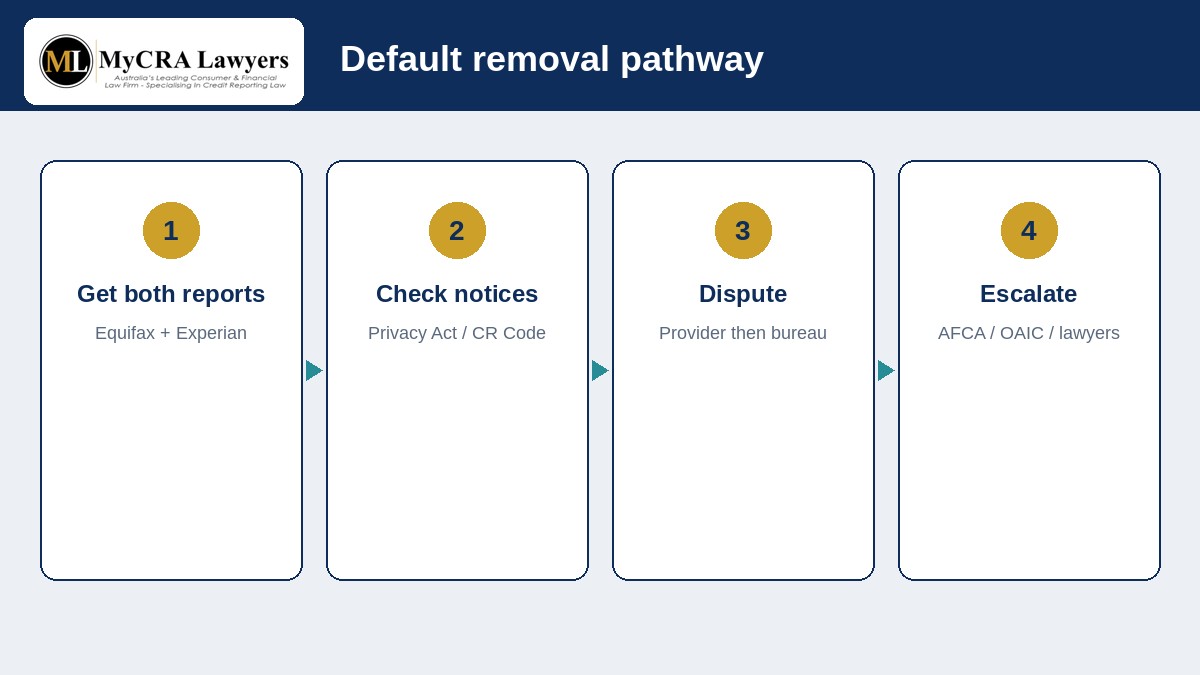
Pull free Equifax and Experian consumer credit reports every three months (OAIC) so you can see list dates and paid status before you apply or dispute. Our credit repair process is set out in plain English.
FAQ
How long does a default stay if I pay it in full?
Usually still up to five years from the listing date, unless it is removed earlier for a compliance or accuracy reason, or a specific written agreement leads to a bureau update.
Does a default fall off automatically after five years?
Credit reporting bodies should cease to disclose consumer default information when the Credit Reporting Code retention period ends. Still check both files around that date. Do not assume one bureau’s view equals both.
Can hardship arrangements shorten the retention period?
Hardship help can stop further damage and may affect what can be listed going forward. It does not automatically delete an existing compliant default. A default listed while a hardship process was mishandled can raise separate compliance questions.
Is a five-year-old default the same as a fresh one to lenders?
Often not. Many credit policies treat aged defaults more gently than recent ones, especially if paid. Policies differ. Ask your broker.
Should I wait it out or dispute now?
If you have evidence of notice failures, wrong amounts, wrong person, or other Code issues, disputing sooner is usually better than waiting, especially before a home loan. If the listing looks fully compliant and you have no leverage, waiting may be the honest answer. Assessment sorts which is which.
This is general information, not legal advice. Retention rules and dispute outcomes depend on the information type, dates and evidence. Speak to a solicitor about your file. Liability limited by a scheme approved under Professional Standards Legislation.
MyCRA Lawyers | Australia-wide | 1300 667 218 | Contact form | Book a 15-minute intro call

Leave A Comment