
Updated 7 October 2026. By Graham Doessel.
A court judgment on your credit file is a different animal from a default. It can block mainstream lending for years. Options usually include negotiating consent with the plaintiff, applying to set the judgment aside where the court process went wrong, and then correcting the credit reporting listing once the court record changes. Paying the debt alone does not always clear the bureau listing. Get both free credit reports every three months, read the judgment details carefully, then decide the pathway, DIY court steps, or a specialist credit repair law firm for the file side.
Hi, I’m Graham. Judgments are one of the fastest ways into Credit Prison. People often find them only when a broker declines a home loan. By then the settlement clock is ticking and panic takes over. Slow down. Get the facts on the file first.
What is a court judgment on a credit file?
A judgment is a court decision about a debt dispute. Credit reporting bodies can hold and disclose certain public-record style information, subject to Privacy Act Part IIIA and the Privacy (Credit Reporting) Code retention rules. Consumer judgments commonly remain disclosable for years (often discussed as a five-year window, confirm the dates on your actual report).
Australia’s consumer credit bureaus are now Equifax and Experian (Experian absorbed illion; from 1 April 2026 Experian reports include former illion consumer data). A judgment may appear on one or both. Check both.
Service page: judgment removal. Framework: credit repair lawyers Australia.
Judgment vs default
- Default: credit provider listing under credit reporting rules (notices, amount thresholds, timing).
- Judgment: court outcome that may then appear in credit reporting information.
You do not fix a judgment with the same letter template you use for a telco default. Mixing them up wastes months. If you are wondering whether to wait it out, read how long a default stays on your credit file.
Common pathways (general information)
1. Negotiate with the plaintiff
Sometimes the creditor will agree to support setting aside or to update status after payment or a settlement. Any agreement should be clear in writing. A deed prepared properly protects you from vague “we’ll see” promises.
2. Apply to set aside (where available)
If you did not get proper notice of the claim, or other procedural problems exist, courts in some circumstances can set a default judgment aside. Rules differ by state and court. This is court procedure, not a bureau form. Get advice if the facts are messy or deadlines are close. For the full process, see our guide on how to remove a default from your credit file.
3. Correct the credit listing after the court record changes
Once the judgment is set aside, satisfied, or otherwise updated, the credit reporting information needs to follow. That means working the credit provider / CRB correction pathways under the Privacy Act and Credit Reporting Code. Keep certified court documents.
What usually does not work
- Paying and assuming the bureau listing vanishes automatically
- Ignoring Equifax because Experian looks clean (or the reverse)
- Template “delete my judgment” emails with no court documents
- Waiting until exchange of contracts on a property purchase
Practical first week
- Download free Equifax and Experian reports (every three months; also after a recent credit refusal).
- Note court, case number, plaintiff, amount, and dates exactly as shown.
- Gather any notices, statements of claim, or emails you still have.
- Ask your broker which lenders on their panel will even consider a file with a judgment.
- Book a free analysis or intro call before you lodge a fresh home-loan enquiry trail.
Free analysis: app.fixmybadcredit.com.au.
When MyCRA gets involved
We audit judgments alongside defaults, enquiries and RHI for compliance issues, and we coordinate the credit-file side of removals where the law allows. On consumer defaults accepted after initial assessment, our success rate is 91.6%, independently audited by a chartered accountant. Our own records show 29.4% of defaults are removed within 7 days. Fixed fees quoted in writing. Selected matters include a Money Back Guarantee on the published terms. See how a MyCRA file runs from first call to removal.
Don’t spend another month stuck in Credit Prison. Call our credit repair lawyers on 1300 667 218 or book a 15-minute intro call at https://mycralawyers.com.au/15min-credit-repair-intro-call/ . If we think your chances are low, we’ll tell you straight.
Judgment vs default: why the pathway differs
A default is credit reporting information listed by a credit provider under Privacy Act / CR Code rules. A court judgment is a court outcome that can also appear in credit reporting. Paying a judgment, setting it aside, or negotiating consent orders is court work first; bureau correction usually follows the court record. Mixing the two strategies wastes months.
Common options (general information)
- Negotiate payment or consent arrangements with the plaintiff
- Apply to set aside where service or process went wrong
- Once the court record changes, seek correction of the credit reporting listing
- Plan lending around realistic court and bureau timelines
State procedures differ. This is not a DIY court kit. Service pages: judgment removal and the credit repair lawyers Australia cornerstone.
Evidence pack for a judgment file
Keep the judgment copy, affidavits of service if you have them, payment receipts, settlement deeds, and both Equifax and Experian PDFs. Note whether the judgment amount and parties match what the bureau shows. Identity mismatches matter here as much as on defaults.
Putting it into practice this month
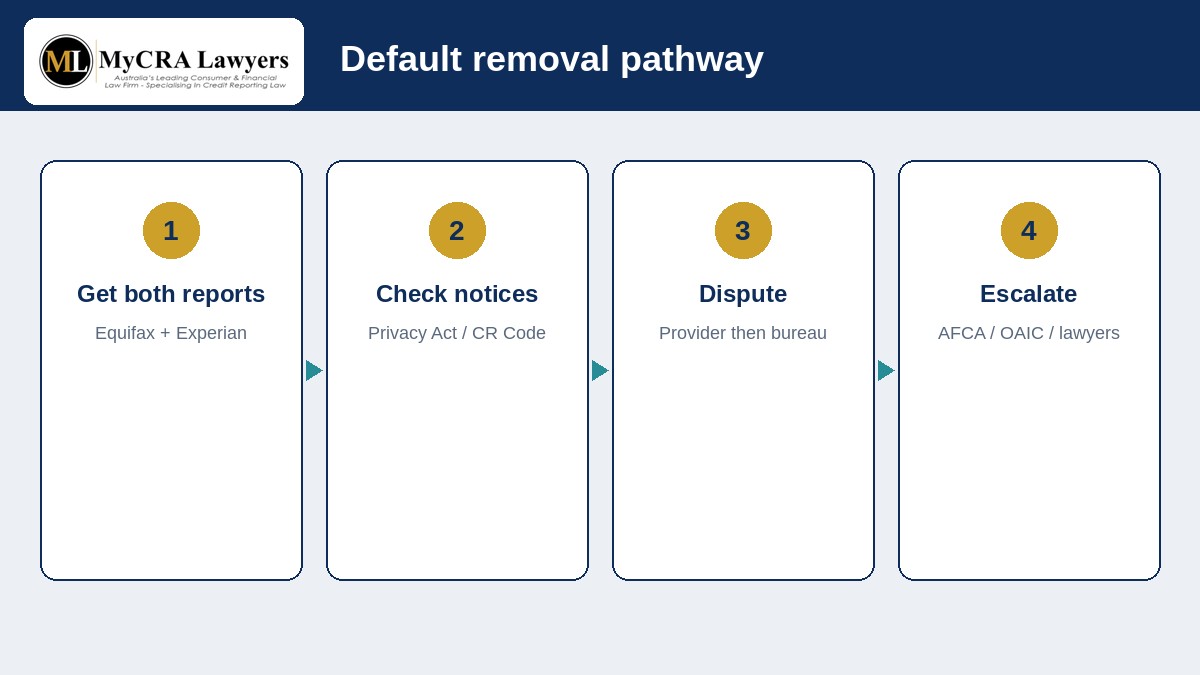
Start with both free Equifax and Experian consumer credit reports. Under OAIC guidance you can access a free consumer credit report from each credit reporting body once every three months, and you should also ask about free access after a credit refusal or after a correction. Save the PDFs. Compare identity details, defaults, serious credit infringements, judgments, enquiries and repayment history information side by side.
Next, write a dated chronology for anything that looks wrong: notices received or not received, hardship emails, payments, address changes, and collector contact. Send a clear written dispute to the credit provider that disclosed the information, attach your evidence, and diary the response timeframes under the Privacy (Credit Reporting) Code. Use the bureau dispute process where required. If the firm is an AFCA member and internal dispute resolution fails, AFCA is free for eligible consumers. OAIC pathways may fit some credit reporting privacy complaints. The National Debt Helpline on 1800 007 007 remains available for budgeting and hardship conversations.
If a broker deadline is close, a judgment or clearout is involved, or the creditor contests the facts, get a legal triage rather than spraying new hard enquiries across lenders. Email docs@mycralawyers.com.au, call 1300 667 218, or book a 15-minute intro call. Read the full framework on our credit repair lawyers Australia cornerstone. On consumer defaults accepted after initial assessment, our success rate is 91.6%, independently audited by a chartered accountant. Our own records show 29.4% of defaults are removed within 7 days. Fixed fees in writing. Selected matters include a Money Back Guarantee on published terms. Postal address: PO Box 169, Aspley QLD 4034.
FAQ
Does paying a judgment remove it from my credit file?
Not automatically. Payment may change status, but removal or correction still depends on the court record and credit reporting rules. Confirm both bureau files.
Is a judgment the same as a default?
No. Different legal pathways. Treat them separately.
How long does a judgment stay on a credit file?
Retention is governed by the Credit Reporting Code / Privacy Act rules for that information type. Check the dates printed on your Equifax and Experian reports rather than relying on forum folklore.
Can I DIY a set-aside application?
Some people do. Court forms and evidence rules are unforgiving. If you were not served properly or the amount is wrong, get advice early.
Do I need both Equifax and Experian reports?
Yes. Listings can differ. Experian now includes former illion consumer data from 1 April 2026.
This is general information, not legal advice. Court procedures differ by jurisdiction. Liability limited by a scheme approved under Professional Standards Legislation.
MyCRA Lawyers | Australia-wide | 1300 667 218 | docs@mycralawyers.com.au | PO Box 169, Aspley QLD 4034



Leave A Comment