
Updated 15 November 2026. By Graham Doessel.
Short answer
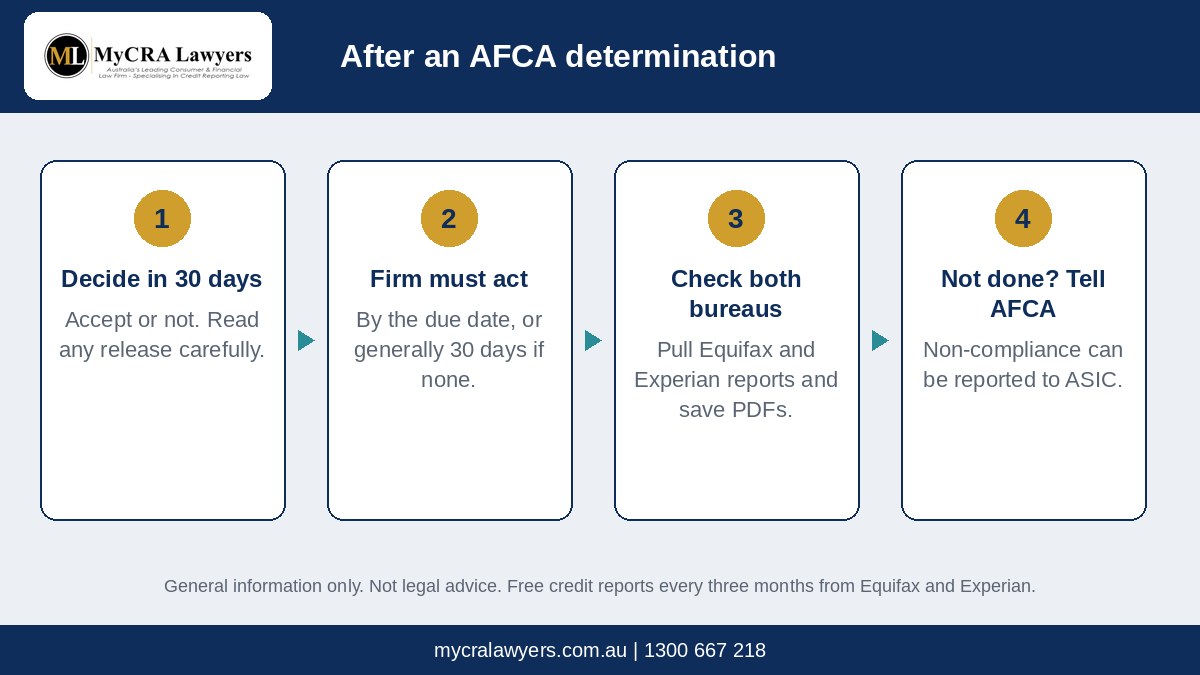
An AFCA determination is the final decision in an AFCA complaint. For credit complaints (anything that isn’t superannuation), it binds both sides only if you accept it within 30 days of receiving it. Once you accept, the financial firm must do what the determination requires by the due date. For a credit listing, that usually means asking Equifax and/or Experian to remove or correct the information. Where no due date is set, AFCA generally expects the firm to act within 30 days of your acceptance. If you don’t accept, neither side is bound and you keep your right to go to court. The firm can only challenge an accepted determination through the courts, on limited grounds. Either way, check both of your credit reports afterwards. Don’t assume the bureau records changed just because the decision went your way.
Hi, I’m Graham. The AFCA part gets most of the attention: lodging, waiting, answering the firm’s response. But the outcome that matters to a client is a clean file in time for the loan they’re trying to get. We have seen good outcomes stall because nobody checked whether the bureau records actually changed. This guide covers what happens after the determination arrives.
If you are still earlier in the process, start with how AFCA complaints about credit defaults work and AFCA complaint timelines.
Where does a determination fit in the AFCA process?
Most AFCA complaints never reach a determination. Here is the usual path:
- Internal dispute resolution (IDR) with the lender or collector.
- Registration and referral. AFCA registers the complaint and refers it back to the firm for a final chance to resolve it.
- Case management. AFCA looks for an agreed outcome through negotiation or conciliation.
- Preliminary assessment. If the complaint doesn’t settle, AFCA may give its view on the merits. The parties are usually given 30 days (seven days for fast-track complaints) to say whether they accept it or want a determination.
- Determination. A written decision with reasons, plus any remedy, made by an ombudsman or a panel.
Many credit listing complaints settle at stage 2 or 3, when the firm reviews its notices and decides the listing can’t be defended. When a complaint reaches a determination, it is usually because the firm disputes the facts or the law.
What does accepting a determination mean?
Under AFCA’s Rules, a determination on a non-superannuation complaint is final and binds both parties if you accept it within 30 days of receiving it. If you accept:
- the financial firm must take the steps in the determination by the due date it sets
- the complaint is normally resolved on those terms, and
- the firm may ask you to sign a release from liability. AFCA’s Rules require that release to be limited to, and consistent with, the matters the determination dealt with.
Read any release before signing it. If it seems to go further than the determination, for example by covering other accounts or other claims, raise that with AFCA or get advice. Once you have accepted a determination, going to another forum about the same issue is difficult.
The determination went your way. How do you make sure the listing changes?
A determination doesn’t change your credit report. The firm has to tell the credit reporting bureau to correct or remove the information, and the bureau has to process that request. Close the loop yourself:
- Diary the due date. If the determination sets no due date, AFCA generally treats 30 days after your acceptance as a reasonable time for the firm to act.
- Ask for written confirmation that the firm has sent the correction to each bureau that holds the listing.
- Pull both reports. Australians can get a free credit report from Equifax and from Experian every three months. Save the PDFs as proof of the before and after.
- Check every related entry. A removed default can leave behind related late marks, a duplicate listing from a collector, or an enquiry tied to the same account.
- Tell AFCA if the firm doesn’t comply. AFCA treats a failure or refusal to carry out a determination seriously and can report it to ASIC.
If a broker is waiting on you, send them the determination and the updated reports together. A lender wants to see the clean file, not only the decision.
What if the determination went against you?
If AFCA decides against you, you aren’t bound by the decision. You keep your legal rights, including the right to go to court. Before you go further:
- Read the reasons closely. They often show which piece of evidence decided the case, such as proof that notices went to your last known address.
- Weigh cost against benefit. ASIC notes that court action may not be worth it for small complaints. For many people, the honest choice is to let a lawful listing run out its retention period while rebuilding everything else on the file.
- Look at the rest of the file. Losing on one default doesn’t mean every listing is correct. Other entries may have separate problems.
- Don’t assume the OAIC is a second round. The OAIC can decline to investigate a matter another body has already dealt with. Get advice before treating it as an appeal.
What if only part of your complaint succeeded?
Split outcomes are common. AFCA might find the amount listed was wrong and order a correction, but decide the default itself can stay. Or it might award compensation for poor complaint handling without removing anything. Read each part of the remedy separately, then check that each correction appears on both bureaus. A corrected amount still matters. A smaller or accurately dated listing can change how a lender views the file.
Can the financial firm appeal the determination?
Not in the usual sense. AFCA states that apart from the courts, a determination can’t be appealed. A firm that disagrees with a determination you have accepted can only go to court, on limited grounds. In practice, most firms simply carry out the determination.
How long after a determination does a listing come off?
There is no single number. It depends on the due date in the determination, how quickly the firm sends the correction, and how fast each bureau processes it. Plan on checking within a few weeks of the due date. Don’t lodge a new loan application until both Equifax and Experian show the change, or you risk adding a credit enquiry to a file that still looks unchanged.
What mistakes should you avoid after AFCA?
- Letting the 30-day acceptance window pass while you think it over
- Signing a release that covers more than the determination
- Assuming one bureau’s update means the other has changed too
- Applying for credit the same week the determination arrives
- Throwing away the complaint file. Keep it in case the listing ever comes back.
How can MyCRA Lawyers help?
If you have an AFCA determination and the listing hasn’t changed, or you have lost and want an honest view on what’s left, send us the determination, both bureau reports and your timeline. We will tell you whether to chase compliance, look at other listings, or plan a wait-out.
MyCRA Lawyers is a specialist credit repair law firm. Have your Equifax and Experian report PDFs ready and reach us through our contact form, call 1300 667 218 or 07 3124 7133, or book a 15-minute credit repair intro call. Postal: PO Box 169, Aspley QLD 4034. We quote fixed fees in writing after we assess the file, and we will tell you plainly if a listing looks like a wait-out rather than a viable dispute. On consumer defaults accepted after initial assessment, our independently audited success rate is 91.6%. From time to time we run a Money Back Guarantee offer on listings with certain creditors. Which creditors it covers changes, so ask us if one is running. No law firm can promise every listing will come off, and we don’t.
Not ready to talk yet? Pull both free reports and start with a free credit file analysis at app.FixMyBadCredit.com.au. For the bigger picture of how listings are challenged, read our credit repair lawyers Australia guide.
Frequently asked questions
How long do I have to accept an AFCA determination?
For non-superannuation complaints, a determination binds both parties if you accept it within 30 days of receiving it. If you don’t accept it in that time, neither party is bound.
Does an AFCA determination automatically remove the default from my credit file?
No. The financial firm has to tell the credit reporting bureau to correct or remove the information. Check your Equifax and Experian reports afterwards to confirm the change was made.
What if the lender doesn’t follow the determination?
Tell AFCA. AFCA treats a failure or refusal to carry out a determination seriously and can report it to ASIC.
Can I go to court if I lose at AFCA?
Yes. If you don’t accept the determination, you keep your legal rights, including going to court. Weigh the cost and the strength of your evidence first, and get advice.
Can the lender appeal an AFCA determination?
Only through the courts, on limited grounds. Apart from the courts, a determination can’t be appealed.
General information only. Not legal advice for your circumstances. Liability limited by a scheme approved under Professional Standards Legislation.





Leave A Comment