
Updated 16 November 2026. By Graham Doessel.
Short answer
If you trade as a sole trader, the business isn’t a separate legal person, so business debts are your personal debts. Equifax and Experian keep both consumer and commercial credit information, and lenders often look at both when you apply. Whether credit was taken out for personal or for business purposes matters. The consumer default rules in Part IIIA of the Privacy Act apply to consumer credit, while business-purpose credit is generally commercial credit and is handled under different rules. Court judgments from business disputes are public record and can appear on your file. Personal guarantees for a company’s debts can expose you too. Separately, the ATO can report a business’s overdue tax debt to credit reporting bureaus once it meets set thresholds. Check your free consumer reports every three months, and ask the bureaus what commercial information they hold about you and your ABN.
Hi, I’m Graham. Small business owners often tell us they kept the business and personal sides separate, and then a lender declines their home loan over a supplier dispute from three years ago. For sole traders and many small partnerships, there was never a legal wall between the two. Even company directors can be pulled in through personal guarantees. Here is how business debt reaches your file, and when a listing may be challengeable.
We have written before about commercial defaults and small business risk. This guide focuses on what lenders see when they assess you.
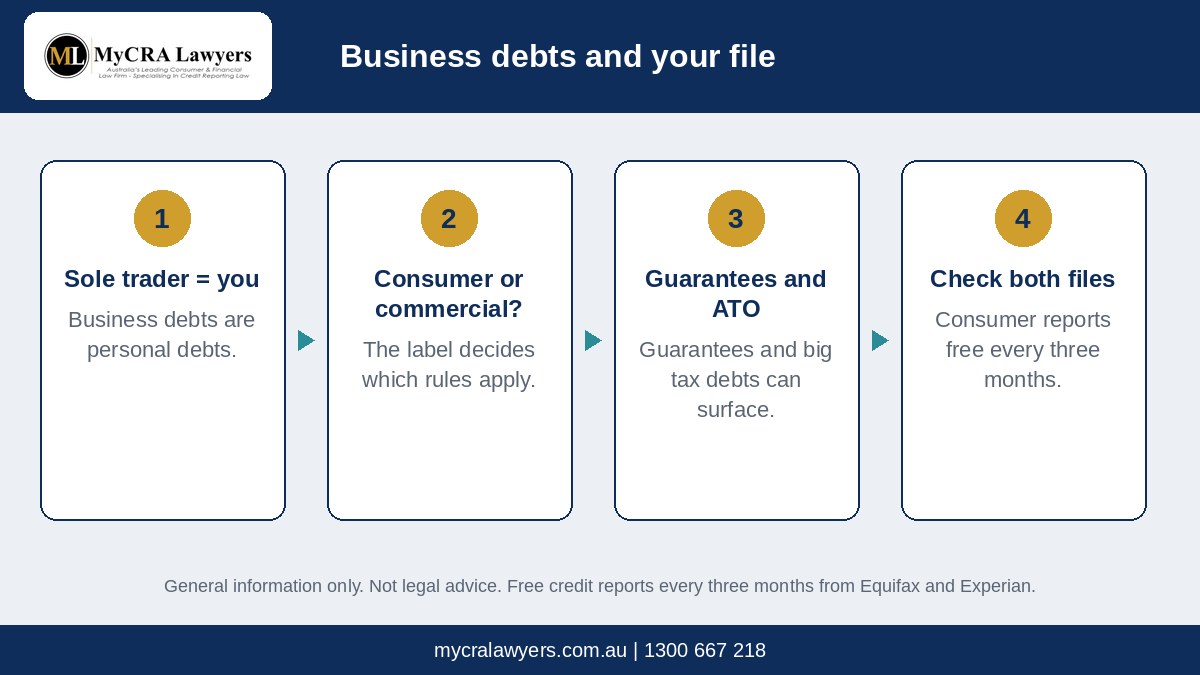
Are a sole trader’s business debts personal debts?
Yes. A sole trader and the business are the same legal person. An ABN and a business name don’t create a separate entity. Supplier accounts, equipment finance, a business credit card in your name and any unpaid trade debts are all yours.
Partnerships work much the same way for each partner. A company (Pty Ltd) is a separate legal entity, so company debts are generally the company’s. The big exceptions are personal guarantees and director penalty notices.
Consumer or commercial credit: why does the label matter?
Australian credit law draws a line between consumer credit (mainly for personal, domestic or household purposes) and commercial credit (for business purposes). The label affects:
- which lending rules applied when the credit was arranged
- whether Part IIIA’s consumer default rules apply, including the 60-day, $150 and written notice requirements in section 6Q
- where the information sits: on your consumer credit report, on a commercial file, or both
Problems arise when the label is wrong. A business-purpose debt might be listed as if it were a consumer default. Or a genuinely personal loan might be recorded in a way that skips consumer protections. Either can be grounds for a correction request. We have had commercial default matters resolved even after an initial knock-back. One example is this commercial default removed despite an OAIC refusal. Each file turns on its own facts.
What business-related information can a lender see when it checks you?
Depending on the bureau, the product and your consent, a lender assessing you personally may see:
- consumer defaults and repayment history on accounts in your own name
- commercial credit enquiries made when you applied for business finance
- commercial payment defaults reported by trade creditors
- court judgments, including those from business disputes
- personal insolvency information, such as bankruptcy or a debt agreement
- business names and company directorships linked to you
Mortgage and car lenders often ask for consent to check commercial information when you are self-employed. One unpaid trade account can therefore matter to a home loan.
What about personal guarantees for a company’s debts?
Many directors personally guarantee leases, equipment finance or supplier accounts. If the company doesn’t pay, the creditor can pursue you under the guarantee. That can lead to demands, court proceedings and a judgment against you personally. Where a guarantee covers consumer credit, the Privacy Act has specific guarantor default rules, including written notice and other recovery steps before listing. Guarantees of business credit are handled differently.
Keep copies of every guarantee you have signed. When a company winds down, check which guarantees are still live.
Can the ATO report your business tax debt?
Yes, in limited circumstances. The ATO can disclose a business’s tax debt to credit reporting bureaus if the business:
- has an ABN and isn’t an excluded entity
- has at least $100,000 of tax debt that is more than 90 days overdue
- isn’t effectively engaging with the ATO to manage the debt
The ATO sends a notice of its intention to disclose first, and the business generally has 28 days to pay or engage, for example by agreeing a payment plan. If you get that letter, act on it. A tax debt report on your business’s commercial file is far easier to prevent than to explain to a lender afterwards.
How do you check your personal and business credit information?
- Request your free consumer credit report from Equifax and from Experian. You can do this every three months. illion’s consumer bureau has been absorbed into Experian, so those are the two to check.
- Ask each bureau what commercial information it holds about you and your ABN. Business credit reports are usually separate products from the free consumer report.
- Check that the identity details match you: name, date of birth, addresses and business names. Mixed files are common where family members share a name or a business. See mixed credit files.
When can a business-related listing be challenged?
Every file is different, but these situations come up often:
- A company debt listed against you personally when you never signed a guarantee
- Business-purpose credit listed as a consumer default, or the reverse
- No proper notices before a consumer default was listed
- A disputed invoice listed while the dispute was still open
- A debt paid or settled before the listing date
- Information about another person with a similar name or a shared business
Court judgments follow a different path from defaults. Our judgment removal page explains the options.
How can you protect your personal file while you trade?
- Keep business and personal accounts in clearly separate names where your structure allows it.
- Record the purpose of each credit facility when you apply.
- Put disputed invoices in writing straight away, and keep the trail.
- Talk to the ATO early if tax debt is building up.
- Check your consumer reports every three months, and your commercial information before any big application.
How can MyCRA Lawyers help?
Self-employed and hitting walls with lenders? Send us both consumer reports, any commercial report you have, and a short note on how the debt arose. We will tell you whether the listing is challengeable and what it would involve.
MyCRA Lawyers is a specialist credit repair law firm. Have your Equifax and Experian report PDFs ready and reach us through our contact form, call 1300 667 218 or 07 3124 7133, or book a 15-minute credit repair intro call. Postal: PO Box 169, Aspley QLD 4034. We quote fixed fees in writing after we assess the file, and we will tell you plainly if a listing looks like a wait-out rather than a viable dispute. On consumer defaults accepted after initial assessment, our independently audited success rate is 91.6%. From time to time we run a Money Back Guarantee offer on listings with certain creditors. Which creditors it covers changes, so ask us if one is running. No law firm can promise every listing will come off, and we don’t. Commercial matters are assessed case by case.
Not ready to talk yet? Pull both free reports and start with a free credit file analysis at app.FixMyBadCredit.com.au. For the bigger picture of how listings are challenged, read our credit repair lawyers Australia guide.
Frequently asked questions
Do sole trader business debts show on my personal credit file?
They can. A sole trader and the business are the same legal person. Defaults, judgments and enquiries connected to business debts in your name can appear on your consumer file, on your commercial file, or on both.
Is a company debt my personal debt?
Generally not, because a company is a separate legal entity. If you signed a personal guarantee, the creditor can pursue you under it, and that can lead to a court judgment against you personally.
Can the ATO report my business tax debt to credit bureaus?
Yes, if your business has an ABN, isn’t an excluded entity, has at least $100,000 in tax debt more than 90 days overdue, and isn’t effectively engaging with the ATO. The ATO sends a notice first, and you generally have 28 days to act.
Do the consumer default rules apply to business loans?
The section 6Q consumer default rules apply to consumer credit. Business-purpose credit is generally commercial credit and is handled under different rules, so how a debt was classified can be a key issue in a dispute.
Can MyCRA Lawyers help with commercial defaults?
We assess commercial matters case by case. Our published 91.6% success rate applies to consumer defaults accepted after initial assessment, not commercial files.
General information only. Not legal advice for your circumstances. Liability limited by a scheme approved under Professional Standards Legislation.

Leave A Comment