
Updated 16 November 2026. By Graham Doessel.
Short answer
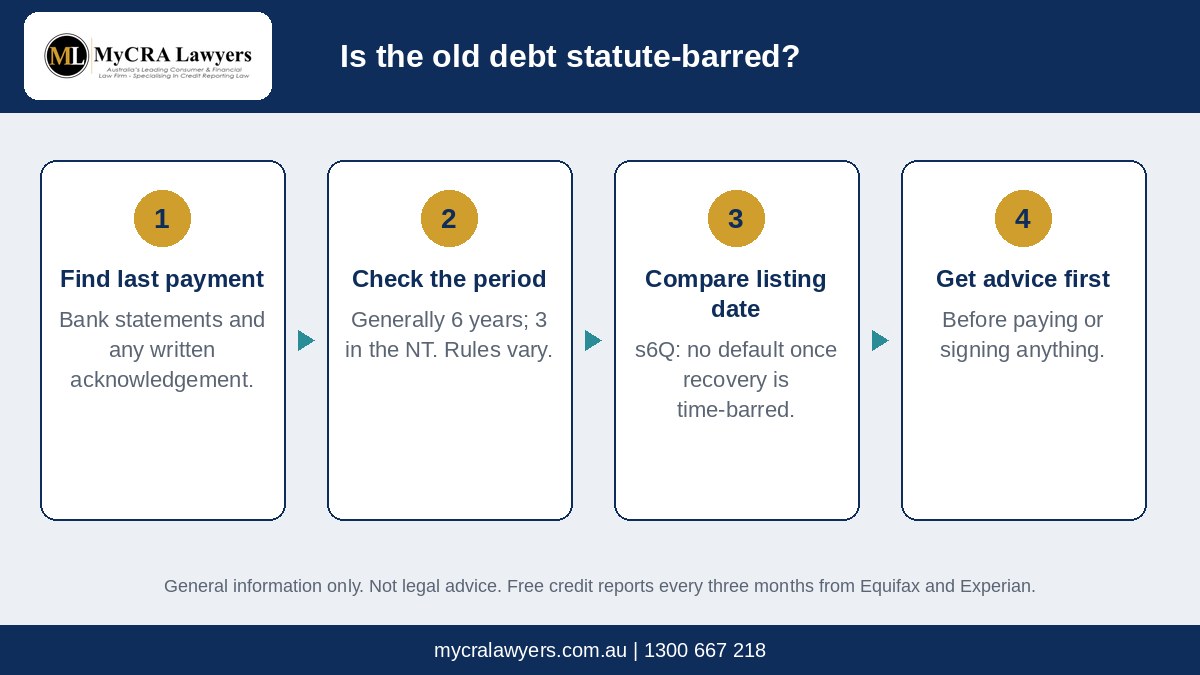
Under section 6Q of the Privacy Act, a debt can only be listed as a default if the credit provider is not prevented by a statute of limitations from recovering it. So a debt that was already statute-barred when it was listed shouldn’t have been listed at all. Limitation periods are set by each state and territory. Most give six years and the Northern Territory gives three, usually counted from your last payment or written acknowledgement of the debt. The rules on restarting the clock differ between jurisdictions. A default that was lawfully listed while the debt could still be recovered stays for the usual five years, even if the debt becomes statute-barred later. Pull your free Equifax and Experian reports (available every three months) and compare the listing date with your last payment date before you pay or sign anything about a very old debt.
Hi, I’m Graham. A common story: someone moves interstate, an old phone or credit card account gets forgotten, and years later a collector rings about a debt they barely remember. Sometimes a default appears on their credit file not long after that call. People assume that if the debt is real, the listing must be lawful. That isn’t always true. Timing matters, and it matters a lot with old debts.
This is general information. Limitation law is technical and varies across Australia, so get advice on your own dates before you act.
What is a statute-barred debt?
A limitation period is the time a creditor has to start court proceedings to recover a debt. Once it has passed, the debt is called statute-barred. In most places the creditor can no longer successfully sue for it, although the debt may still exist in a moral or technical sense. In New South Wales, the limitation legislation goes further and treats the right to recover as extinguished once the period ends.
A debt doesn’t become statute-barred just because it is old and you have ignored it. The question is when the creditor’s right to sue arose and whether anything restarted the clock.
How long are limitation periods for debts in Australia?
For ordinary contract debts such as credit cards, personal loans, phone plans and utility accounts:
- Most states and territories: generally six years
- Northern Territory: generally three years
The clock usually starts from the date the creditor could first sue, which is often linked to your last payment or the date of default. In some jurisdictions, a part payment or a signed written acknowledgement of the debt can restart the period. Others treat things differently, especially once the period has already run out. Court judgments have separate, longer limitation periods.
If you are unsure, the National Debt Helpline (1800 007 007) and community legal centres can help you work out the dates for free.
Can a statute-barred debt be listed as a default?
No, not lawfully. Section 6Q of the Privacy Act defines default information. One of the conditions is that the credit provider is not prevented by a statute of limitations from recovering the overdue amount. The same condition applies to guarantor defaults. The other conditions still apply too:
- the payment is at least 60 days overdue
- the amount is $150 or more
- the required written notices were given
This isn’t just theory. The Privacy Commissioner has previously found a credit provider in breach for listing a debt that was already statute-barred, and for failing to fix the listing after it realised.
So if a default appears for a debt whose limitation period had already expired, there is a strong basis to ask for correction. Our default removal page explains how compliance-based challenges work.
What about a default listed before the debt became statute-barred?
This is where people get caught. The test applies when the default is listed. If a default was properly listed while the debt was still recoverable, it doesn’t disappear when the limitation period later expires. It stays for the normal five years from listing, just like any other default. See how long a default stays on your credit file.
For example, a listing made two years after your last payment would usually be well inside a six-year limitation period. A listing made seven years after your last payment, with no payment or acknowledgement in between, deserves a much harder look.
Can a debt collector relist an old debt?
Old debts are often sold or assigned to collectors. A new owner can try to collect, but it doesn’t get a fresh limitation period just because it bought the debt. Watch for these warning signs:
- a default listed by a collector years after you stopped paying the original creditor
- the same debt appearing twice, once under the original lender and once under the collector
- a listing date that looks recent for an account you closed long ago
Any of these is worth querying in writing. Our guide on debts assigned to collectors covers the wider risks.
What can collectors still do with a statute-barred debt?
The debt collection guideline published by the ACCC and ASIC says collectors must not mislead you about the legal status of a debt. That includes implying that a statute-barred debt can still be enforced in court. A collector may still contact you and ask for payment, but standard contact rules apply. Our article on debt collector harassment and your rights explains those limits.
How can you check whether an old listing may be statute-barred?
Build a short timeline before you talk to anyone:
- Get both free reports, from Equifax and Experian. Note the listing date, the creditor, the amount and the account reference.
- Find your last payment on the account, using bank statements if you can.
- Note any written acknowledgement you signed or sent, such as an email agreeing to a payment plan.
- Note where you lived when the contract was made and where you live now, because that can affect which law applies.
- Compare the listing date with the limitation period that probably applies.
If the dates are close, don’t guess. A borderline limitation question is exactly where a legal assessment is worth having.
Should you pay a statute-barred debt?
That’s your choice, and some people want to settle old debts for personal reasons. Just understand the effects first:
- In some jurisdictions, a part payment or written acknowledgement may restart the limitation period.
- Paying a debt that has a lawful default listed will usually update the status to paid. It won’t delete the listing. See paid vs unpaid defaults.
- If the default was unlawful because the debt was already statute-barred, paying it doesn’t make the listing lawful, but it can complicate the conversation.
Get advice before you sign anything or agree to a payment plan over the phone.
How can MyCRA Lawyers help?
If an old debt has turned up on your file and the dates look wrong, send us both bureau reports along with your last payment details and any letters from the collector. We will check the listing against the section 6Q conditions and the notice rules.
MyCRA Lawyers is a specialist credit repair law firm. Have your Equifax and Experian report PDFs ready and reach us through our contact form, call 1300 667 218 or 07 3124 7133, or book a 15-minute credit repair intro call. Postal: PO Box 169, Aspley QLD 4034. We quote fixed fees in writing after we assess the file, and we will tell you plainly if a listing looks like a wait-out rather than a viable dispute. On consumer defaults accepted after initial assessment, our independently audited success rate is 91.6%. From time to time we run a Money Back Guarantee offer on listings with certain creditors. Which creditors it covers changes, so ask us if one is running. No law firm can promise every listing will come off, and we don’t.
Not ready to talk yet? Pull both free reports and start with a free credit file analysis at app.FixMyBadCredit.com.au. For the bigger picture of how listings are challenged, read our credit repair lawyers Australia guide.
Frequently asked questions
Can a statute-barred debt appear on my credit file?
It shouldn’t be listed as a default. Section 6Q of the Privacy Act requires that the credit provider is not prevented by a statute of limitations from recovering the amount. A default listed after the limitation period had already expired may be challengeable.
How long is the limitation period for debts in Australia?
For ordinary contract debts it is generally six years in most states and territories and three years in the Northern Territory. The start date and the rules on restarting the clock vary, so check your own dates.
Does a default come off when the debt becomes statute-barred?
No. If the default was lawfully listed while the debt was still recoverable, it stays for the usual five years from listing.
Can paying part of an old debt restart the limitation period?
In some jurisdictions a part payment or written acknowledgement can restart it. The rules differ across Australia, so get advice before you pay or sign anything about a very old debt.
Can a debt collector list a default years after I stopped paying?
A collector that buys a debt doesn’t get a fresh limitation period. If a default appears long after your last payment, compare the dates and ask for correction if the debt was statute-barred when it was listed.
General information only. Not legal advice for your circumstances. Liability limited by a scheme approved under Professional Standards Legislation.


Leave A Comment