
Updated 26 October 2026. By Graham Doessel.
AFCA is free for consumers, but a thin complaint folder wastes months. If a credit provider or collector will not fix a non-compliant default on Equifax or Experian, the Australian Financial Complaints Authority is often the next step, after you have given the firm a fair chance through internal dispute resolution (IDR).
Hi, I’m Graham. Credit Prison rarely ends because someone yelled louder. It ends when the file, the notices, and the law line up. AFCA is built for that kind of evidence, not for vibes.
When AFCA is the right forum
AFCA can hear many disputes about credit and debt collection from member firms. Typical credit-file issues include disputed defaults, notice failures, hardship mishandling, and incorrect repayment history information. Check membership on AFCA’s site before you lodge. Not every trader is in the scheme.
AFCA is usually not the first call. Credit reporting rules expect you to raise the issue with the credit provider (and often the bureau) first. Keep those letters and portal screenshots. They become your chronology.
IDR first: build the paper trail
- Write to the credit provider that listed the information. State what is wrong and what you want corrected.
- Attach identity proof, account evidence, hardship emails, returned mail, and both bureau PDFs.
- Diary the response timeframes under the Privacy (Credit Reporting) Code and any IDR policy the firm publishes.
- If the answer is a shrug, or the clock runs out, prepare AFCA.
Our default removal guide and the default removal service page explain the compliance checklist. The full framework sits in credit repair lawyers Australia.
What evidence actually moves an AFCA complaint
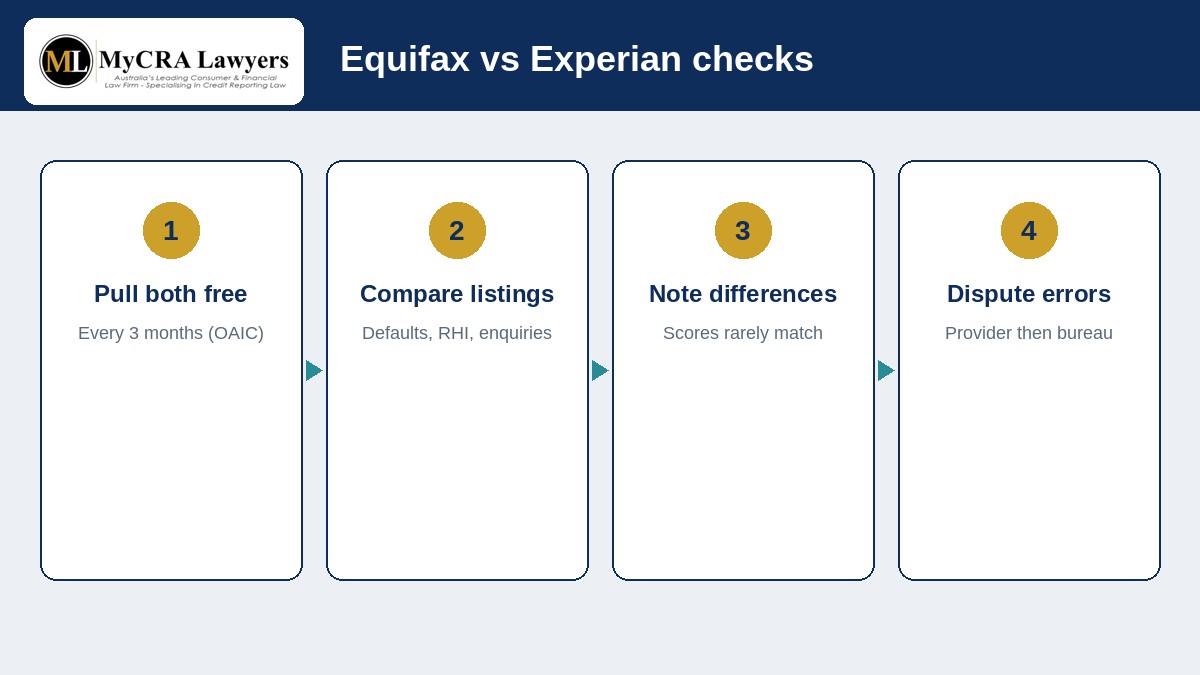
- Both free Equifax and Experian reports (every three months under OAIC guidance)
- Default notices and envelopes if you still have them
- Proof of address at the relevant dates
- Hardship requests and responses
- Payment records and settlement letters
- Your IDR complaint and the firm’s written response
AFCA is not a second credit score appeal. Panel members look for process failures and unfairness within their rules. Paying the debt still does not automatically wipe a listing, compliance does.
Realistic timelines
IDR can take weeks. AFCA registration, negotiation, and determination can stretch into months, especially if the firm contests facts. Some accepted defaults resolve in days when the creditor concedes early. Escalations do not. If a broker has a settlement date next month, say so up front, and plan parallel options. Creditors have to help fix their own errors, as set out in creditor obligations to correct credit file mistakes.
AFCA vs OAIC vs a credit repair lawyer
AFCA: free financial firm complaints for members. Good for many consumer credit disputes.
OAIC: privacy and credit reporting complaints where the Privacy Act pathway fits better.
A specialist law firm: when membership is missing, facts are contested, notices are technical, or lending deadlines need a managed strategy. MyCRA Lawyers quotes fixed fees in writing. On consumer defaults accepted after initial assessment, our success rate is 91.6%, independently audited by a chartered accountant. Our own records show 29.4% of defaults are removed within 7 days. From time to time we run a Money Back Guarantee offer on listings with certain creditors. Which creditors it covers changes, so ask us if one is running.
How to lodge without sabotaging yourself
- One clear narrative, dated, with exhibits labelled
- Ask for a specific outcome (correction, removal, apology letter, whatever fits)
- Do not bury AFCA in fifty screenshots with no index
- Keep applying for random credit while the complaint runs, that usually makes the file worse
Book a file review if the firm digs in
Have both PDFs ready and reach us through our contact form, call 1300 667 218, or book a 15-minute intro call. If AFCA alone is enough, we will say so. Free options still matter: bureau access, AFCA, OAIC, and the National Debt Helpline on 1800 007 007.
Postal: PO Box 169, Aspley QLD 4034.
Building an AFCA-ready chronology
AFCA decision-makers read stories in dates. Write a one-page timeline: account opened, hardship asked, notices claimed, default listed, IDR lodged, responses received. Attach Equifax and Experian PDFs, notices, and payment proof as numbered exhibits. Ask for a specific outcome. If you are wondering whether to wait it out, read how long a default stays on your credit file.
Do not lodge fifty unsorted screenshots. Do not keep applying for credit while the complaint runs.
What AFCA is not
It is not a second score appeal. It is not automatic default deletion. It is a free forum for many disputes with member firms after IDR. Non-members need other pathways.
Companion: AFCA vs OAIC.
Putting it into practice this month
Start with both free Equifax and Experian consumer credit reports. Under OAIC guidance you can access a free consumer credit report from each credit reporting body once every three months, and you should also ask about free access after a credit refusal or after a correction. Save the PDFs. Compare identity details, defaults, serious credit infringements, judgments, enquiries and repayment history information side by side.
Next, write a dated chronology for anything that looks wrong: notices received or not received, hardship emails, payments, address changes, and collector contact. Send a clear written dispute to the credit provider that disclosed the information, attach your evidence, and diary the response timeframes under the Privacy (Credit Reporting) Code. Use the bureau dispute process where required. If the firm is an AFCA member and internal dispute resolution fails, AFCA is free for eligible consumers. OAIC pathways may fit some credit reporting privacy complaints. The National Debt Helpline on 1800 007 007 remains available for budgeting and hardship conversations. Our credit repair process is set out in plain English.
If a broker deadline is close, a judgment or clearout is involved, or the creditor contests the facts, get a legal triage rather than spraying new hard enquiries across lenders. Reach us through our contact form, call 1300 667 218, or book a 15-minute intro call. Read the full framework on our credit repair lawyers Australia cornerstone. On consumer defaults accepted after initial assessment, our success rate is 91.6%, independently audited by a chartered accountant. Our own records show 29.4% of defaults are removed within 7 days. Fixed fees in writing. From time to time we run a Money Back Guarantee offer on listings with certain creditors. Which creditors it covers changes, so ask us if one is running. Postal address: PO Box 169, Aspley QLD 4034.
FAQ
Is an AFCA complaint free?
Yes for eligible consumers complaining about AFCA members. The firm pays scheme costs. You still invest time assembling evidence.
Do I need a lawyer to use AFCA?
No. Many people lodge themselves. A lawyer helps when the legal issues are technical, the creditor is aggressive, or you need a broader strategy across court and credit reporting.
Can AFCA force a bureau to delete a default?
AFCA deals with the financial firm. Corrections often flow to Equifax and Experian once the provider updates the disclosure. Outcomes depend on the determination and the facts.
What if the collector is not an AFCA member?
Check membership carefully. Non-members may need other pathways: OAIC, court, or direct legal demand.
Should I pay the debt before complaining?
That is a commercial decision separate from listing compliance. Paying does not automatically remove a default. Get advice if you are unsure.
General information only. Not legal advice for your circumstances. Liability limited by a scheme approved under Professional Standards Legislation.

Leave A Comment