
Updated 19 November 2026. By Graham Doessel.
Short answer
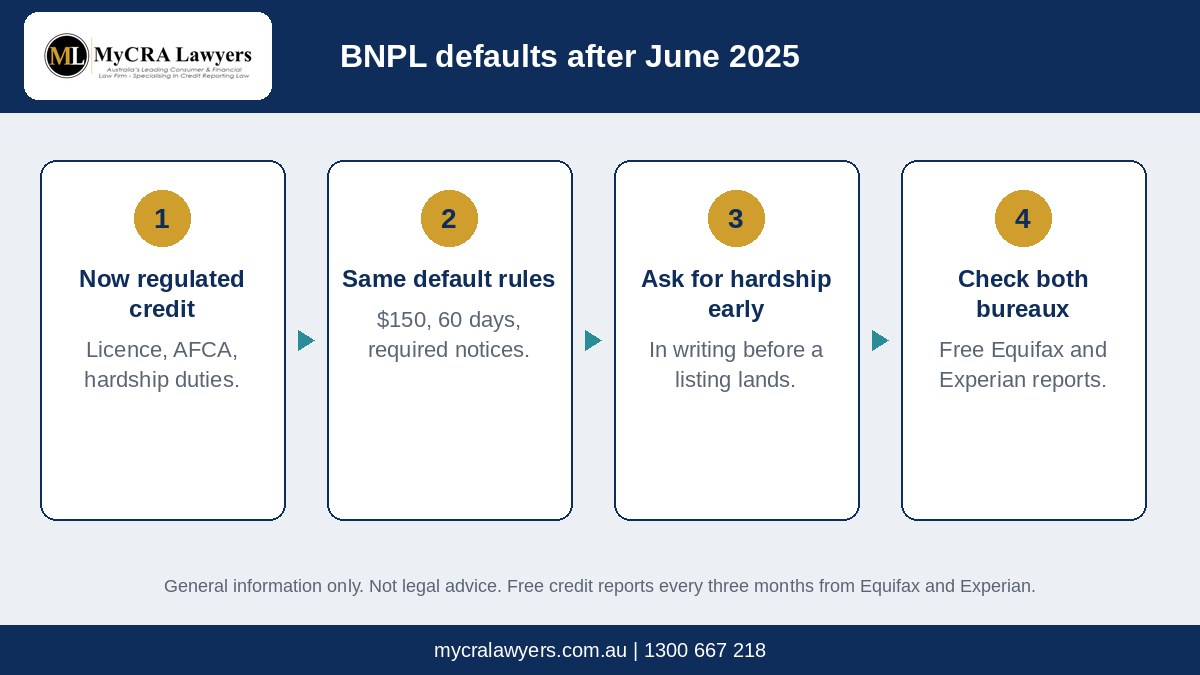
From 10 June 2025, buy now pay later (BNPL) contracts in Australia are generally treated as regulated credit. Most fall under the “low cost credit contract” rules. Providers need an Australian credit licence, must belong to AFCA, and must consider hardship. Missed BNPL payments can lead to default notices and, after the usual Privacy Act and CR Code steps, a default on your Equifax or Experian file, typically for five years. BNPL applications and accounts can also leave enquiries and consumer credit liability information. Pull both free reports every three months, and do not ignore small overdue balances just because the purchase felt casual.
Hi, I’m Graham. For years people treated Afterpay-style accounts like a shopping app, not like a credit card. Then a missed payment turned into collection activity, and sometimes a listing. Since mid-2025 the law has caught up with that reality. BNPL is credit. The credit file treats it that way.
This guide explains what the reforms mean for your Equifax and Experian reports, how a BNPL default can be listed, and what to do if one is already there. For the broader BNPL picture, see BNPL and your credit file.
What changed for BNPL from 10 June 2025?
Parliament extended the National Consumer Credit Protection Act and the National Credit Code to BNPL contracts. ASIC’s guidance on low cost credit contracts (RG 281) sets out how many of those products must be handled. In plain terms:
- BNPL providers generally need an Australian credit licence
- they must be members of AFCA
- they must consider financial hardship requests
- responsible-lending style obligations apply, with modified rules available for some low cost contracts
- first defaults in payment trigger prescribed default notices that must point people to help, including the National Debt Helpline
The shopping-cart feel of BNPL did not disappear. The legal label did.
Can a BNPL missed payment become a credit default?
Yes, if the account is consumer credit that can be reported and the provider follows the default-information rules. Broadly, for a consumer credit default the overdue amount generally needs to be at least $150, overdue for at least 60 days, and the provider must send the required written notices to your last known address before listing. Those are the same foundations explained by the OAIC for repayment history and defaults.
A BNPL balance that feels small can still clear the $150 threshold once fees and multiple missed instalments are added. Do not assume “it was only a pair of shoes” means it cannot be listed.
What else from BNPL can show on Equifax or Experian?
- Enquiries: when a provider checks your file; enquiries generally stay five years. See how long credit enquiries stay.
- Consumer credit liability information: open accounts and limits under comprehensive credit reporting.
- Repayment history: where the provider reports it, late marks can sit for two years.
- Defaults and payment information: a listed default generally stays five years; paying later updates the status but does not wipe the five-year clock.
Providers do not all report the same way or to both bureaux. That is why you check Equifax and Experian, not one app score. Illion’s consumer bureau has been absorbed into Experian.
What should you do if a BNPL account is slipping?
- Contact the provider early and ask about a hardship arrangement in writing. While a hardship request is being assessed, a default generally cannot be listed, and there is a short buffer after a refusal, see defaults during hardship.
- Keep screenshots and emails of balances, due dates and any promises to pause collection.
- Update your address and email so notices actually reach you.
- Pull both free reports: Australians can get a free credit report every three months from each bureau.
- Call the National Debt Helpline on 1800 007 007 if the budget is the real problem. Free financial counselling beats stacking another BNPL account to cover the last one.
How do you challenge a BNPL default that looks wrong?
Work through the same questions we use for other consumer defaults:
- Was the amount at least $150 and at least 60 days overdue when listed?
- Were the section 6Q and section 21D(3)-style notices sent, separately, to your last known address, with the required timing?
- Was a hardship request on foot when the default was listed?
- Is the debt yours, or is it a mixed-file / identity problem?
- Has the provider produced the contract and the default trail if you asked?
Start with the provider’s internal dispute resolution. If that fails, AFCA is free for eligible consumers complaining about member firms. Credit-reporting privacy complaints can also go to the OAIC in some cases. Our default removal page explains how we assess consumer default files.
Should you keep using BNPL while you repair your file?
Often the safer path is to pause new BNPL accounts until existing ones are current and your reports are clean. Multiple BNPL lines can look like credit-seeking, add enquiries, and create more chances of a small default. If you need a purchase plan, one well-managed account is usually better than three apps with overlapping due dates.
Before a home loan or car loan, a free credit file analysis at app.FixMyBadCredit.com.au can show whether BNPL lines, enquiries or an older default are what brokers will see first.
How do BNPL defaults interact with other credit on your file?
A BNPL default rarely sits alone. People who miss instalments often also have credit-card late marks, a recent enquiry burst, or an older telco listing. Lenders read the pattern. Clearing or correcting one BNPL line helps most when the rest of the file is stabilising at the same time.
If you are juggling several BNPL apps, list every due date in one calendar and switch off new merchandising credit until the arrears are gone. Stacking a fresh BNPL account to cover an old one is how small balances become a five-year problem. Where the provider is licensed, AFCA membership also means you have a free external dispute option after internal dispute resolution – use it if the hardship or listing response is inadequate.
How can MyCRA Lawyers help?
If a BNPL default or enquiry is sitting on your Equifax or Experian report, send us both PDFs and the provider’s letters. We will map the notices and hardship timeline and tell you whether there is a viable consumer dispute.
MyCRA Lawyers is a specialist credit repair law firm. Have your Equifax and Experian report PDFs ready and reach us through our contact form, call 1300 667 218 or 07 3124 7133, or book a 15-minute credit repair intro call. Postal: PO Box 169, Aspley QLD 4034. We quote fixed fees in writing after we assess the file, and we will tell you plainly if a listing looks like a wait-out rather than a viable dispute. On consumer defaults accepted after initial assessment, our independently audited success rate is 91.6%. From time to time we run a Money Back Guarantee offer on listings with certain creditors. Which creditors it covers changes, so ask us if one is running. No law firm can promise every listing will come off, and we don’t.
Not ready to talk yet? Pull both free reports and start with a free credit file analysis at app.FixMyBadCredit.com.au. For the bigger picture of how listings are challenged, read our credit repair lawyers Australia guide.
Frequently asked questions
Can Afterpay-style BNPL put a default on my credit file?
Yes. Since BNPL became regulated credit, missed payments can lead to default notices and, after the usual listing rules, a default on Equifax or Experian.
Does paying a BNPL default remove it straight away?
Paying updates the listing to show it was paid. The default information is generally still retained for five years from when the bureau collected it.
Do BNPL providers have to consider hardship?
Licensed BNPL providers must consider financial hardship requests under the credit regime. Ask in writing and keep the reply.
Will opening several BNPL accounts hurt a home loan?
It can. Extra enquiries, open limits and any late marks or defaults all form part of what lenders read. Space applications and keep accounts current.
Where do I complain about a BNPL provider?
Use the provider’s internal dispute process first. AFCA is free for eligible consumers if the firm is a member. Some credit reporting privacy issues go to the OAIC.
General information only. Not legal advice for your circumstances. Liability limited by a scheme approved under Professional Standards Legislation.

Leave A Comment