
Updated 19 November 2026. By Graham Doessel.
Short answer
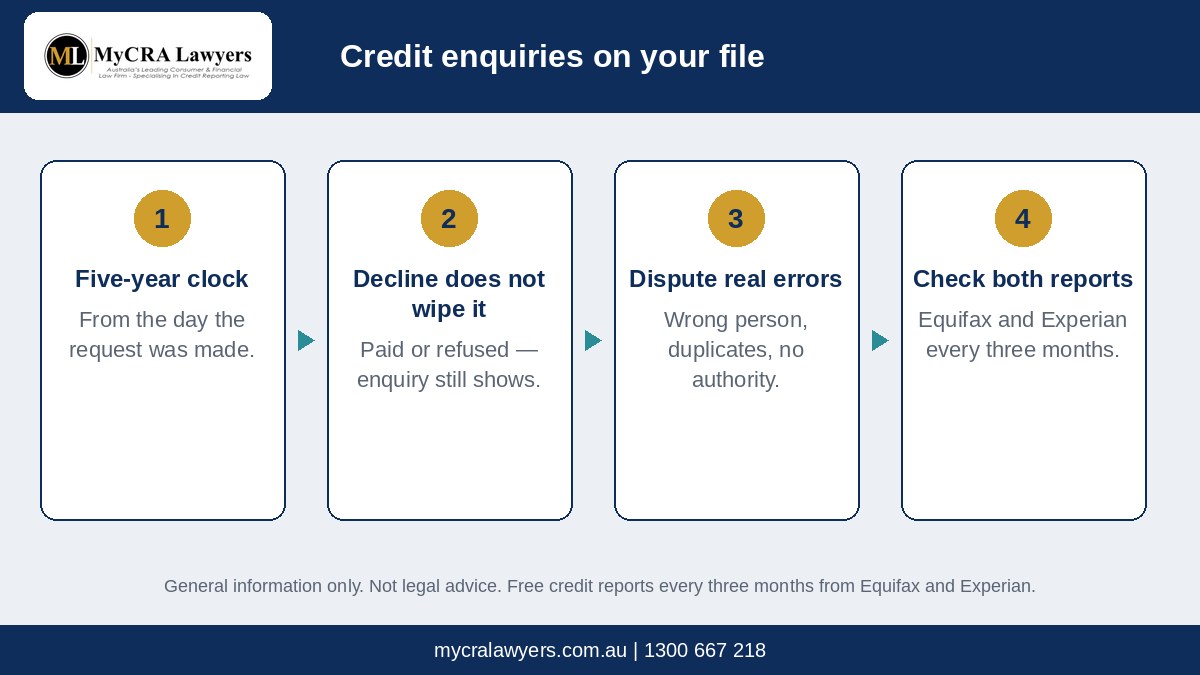
Under the Privacy Act 1988, a consumer credit enquiry (an information request) is generally kept for five years from the day the request was made. Paying out a loan or getting declined does not wipe it early. Soft checks that do not leave an enquiry for credit assessment are different from hard enquiries that lenders see. Enquiries are not “removed” just because they are old; they drop off when the retention period ends. Early correction is usually about wrong identity, duplicate listings, or an enquiry that should never have been made. Check both of your free Equifax and Experian reports every three months so you know what is actually there.
Hi, I’m Graham. When someone opens their credit report for the first time, the enquiry list is often the surprise. Five car-yard checks in a weekend. A BNPL signup they forgot. A broker run that looks like three applications. Then the next question is always the same: how long do these stay, and can any of them come off?
This guide covers retention, what lenders actually read, and when a dispute is realistic. It sits alongside our earlier article on when credit enquiry removal is possible and how many credit enquiries are too many.
How long does a credit enquiry stay under Australian law?
According to the OAIC and section 20W of the Privacy Act, information about an information request is retained for five years starting on the day the request is made. That is the same ballpark as many defaults and court judgments, and longer than repayment history (two years) or financial hardship information (one year).
A Treasury review of the credit reporting framework has recommended shortening enquiry retention to two years. Until Parliament changes the Act, five years is still the rule. Do not assume a proposal is already law.
What is the difference between a hard enquiry and a soft check?
People use “hard” and “soft” loosely. What matters on your Equifax or Experian consumer report is whether an information request was recorded for credit assessment. Those are the enquiries other lenders can see when you apply.
Checks you make on your own file, many identity or marketing-style checks, and some account-management looks do not leave the same footprint. Report layouts differ between bureaux, so read the legend. The illion consumer bureau has been absorbed into Experian, so Equifax and Experian are the two consumer reports to pull.
Does getting declined or paying out the loan clear the enquiry?
No. An enquiry records that someone asked about your credit information on a particular day. Whether the application was approved, declined, withdrawn or later paid out does not change the retention clock. The enquiry is about the request, not the outcome.
That is why stacking applications in a short window hurts more than people expect. Each new request can sit there for years, even if every lender said no.
When can an enquiry come off before five years?
Early removal is about whether the enquiry was accurate and permitted, not about how inconvenient it looks. Common correction angles include:
- Wrong person or mixed file: the enquiry belongs to someone with a similar name or an old address mix-up. See fixing a mixed credit file.
- Duplicates: the same application appears more than once without a proper reason.
- No authority: you did not apply and did not authorise the check.
- Process failures: in limited cases, how the enquiry was made does not match what the law or the CR Code required.
“I wish I hadn’t applied” is not a correction ground. Neither is “it lowered my score”. Start with the organisation that made the enquiry, in writing, and ask the bureau to correct it if the provider agrees or if the data is wrong.
What do lenders actually do with a long enquiry list?
Lenders and brokers read pattern and timing as much as the raw count. Several enquiries in a few weeks can look like credit-seeking. Older, spaced-out enquiries matter less once repayment history is clean. Brokers often prefer one well-prepared application over five speculative ones, the same point we make in how credit enquiries affect your credit score.
Your bureau score is only one input. Many credit decisions turn on the listings, the repayment grid and your income and expenses. That is why a clean file with a few old enquiries can still get through, while a high score with a recent default or a burst of applications can stall.
How should you manage enquiries before a home loan or car loan?
- Pull both free reports: Australians can get a free credit report from Equifax and from Experian every three months. Save the PDFs.
- List every enquiry in the last 12–24 months and note which ones you recognise.
- Dispute only the ones with a real error: identity, duplicate, or no authority.
- Pause new applications until you have spoken to a broker or the lender about the best single path.
- Space necessary checks: if you must apply, make it one prepared application, not a weekend of dealership runs.
Before you apply, a free credit file analysis at app.FixMyBadCredit.com.au can flag whether enquiries are the main issue or whether something heavier is sitting on the file.
What if the organisation will not correct a wrong enquiry?
Use the credit provider’s or broker’s internal dispute resolution process first. If that fails and the firm is an AFCA member, the Australian Financial Complaints Authority is free for eligible consumers. Some credit-reporting privacy issues go to the OAIC. Our guide to AFCA vs OAIC for credit reporting disputes explains which forum usually fits.
If money stress is driving the applications, the National Debt Helpline (1800 007 007) offers free financial counselling before you take on more credit.
How can MyCRA Lawyers help?
If your enquiry list looks wrong, duplicated or tied to applications you never made, send us both Equifax and Experian PDFs and a short note on which lines you dispute. We will tell you what looks like a correction case and what is simply waiting out the five years.
MyCRA Lawyers is a specialist credit repair law firm. Have your Equifax and Experian report PDFs ready and reach us through our contact form, call 1300 667 218 or 07 3124 7133, or book a 15-minute credit repair intro call. Postal: PO Box 169, Aspley QLD 4034. We quote fixed fees in writing after we assess the file, and we will tell you plainly if a listing looks like a wait-out rather than a viable dispute. On consumer defaults accepted after initial assessment, our independently audited success rate is 91.6%. From time to time we run a Money Back Guarantee offer on listings with certain creditors. Which creditors it covers changes, so ask us if one is running. No law firm can promise every listing will come off, and we don’t. For listing work beyond enquiries, see our default removal service page.
Not ready to talk yet? Pull both free reports and start with a free credit file analysis at app.FixMyBadCredit.com.au. For the bigger picture of how listings are challenged, read our credit repair lawyers Australia guide.
Frequently asked questions
How long do credit enquiries stay on an Australian credit file?
Generally five years from the day the information request was made, under the Privacy Act retention rules summarised by the OAIC. Proposals to shorten that period are not law until the Act is changed.
Does a declined application remove the enquiry?
No. The enquiry records that a credit check was requested. Approval, decline or later payout does not clear it early.
Can I remove an enquiry just because I regret applying?
Regret is not a correction ground. Early removal usually needs an error such as wrong identity, a duplicate, or an enquiry made without authority.
Do Equifax and Experian show the same enquiries?
Not always. Lenders and brokers do not all enquire with both bureaux. Check both free reports every three months.
Will checking my own credit report leave an enquiry lenders can see?
Accessing your own free consumer report is not the same as a lender’s credit-assessment enquiry. Read each bureau’s legend if you are unsure what a line means.
General information only. Not legal advice for your circumstances. Liability limited by a scheme approved under Professional Standards Legislation.





Leave A Comment