
Updated 18 November 2026. By Graham Doessel.
Short answer
When a default is removed or reaches the end of its five-year retention period, first confirm it has gone from both Equifax and Experian. You can get a free report from each every three months. Keep the written confirmation of the removal. Your score is recalculated from what’s left, so other items such as late repayment marks, enquiries or judgments still count. Rebuild by paying every account on time (a payment more than 14 days late can be reported as missed), avoiding bursts of credit applications, trimming unused limits, and keeping your identity details consistent. Wait until both reports show the change before you apply for a major loan. If the default ever reappears, dispute it straight away and include your removal letter.
Hi, I’m Graham. Seeing a default come off is a relief. It’s the moment people feel they’re finally out of Credit Prison. But the next six to twelve months decide whether the file stays clean. We’ve seen people celebrate by applying for three cards in a week and undo much of the benefit. Here is how to keep the gain.
How do you confirm the default has actually gone?
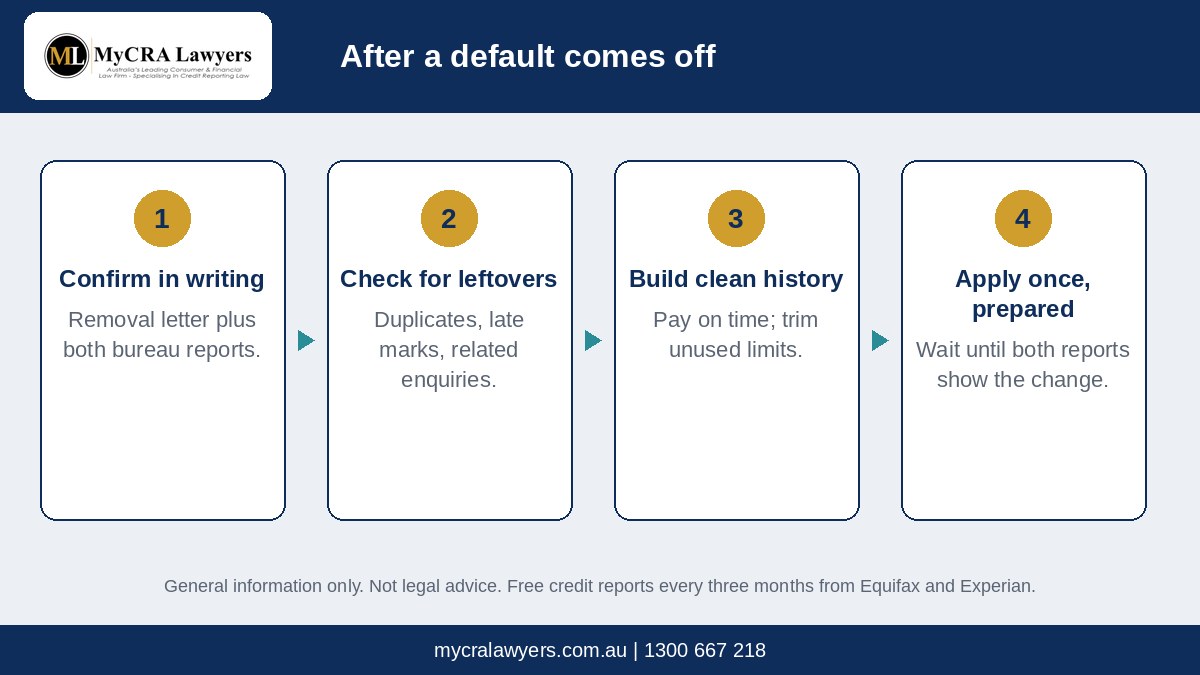
- Get written confirmation from the credit provider, or the outcome letter from AFCA or the bureau, showing which listing was removed and from which bureau.
- Pull both reports. Order your free reports from Equifax and Experian. illion’s consumer bureau has been absorbed into Experian, so those two are the ones to check.
- Look for leftovers. A collector’s duplicate of the same debt, related late marks, or an old enquiry tied to the account.
- Save the PDFs. File them with the removal letter. If the listing ever reappears, that is your evidence.
If the listing reached the end of its retention period rather than being removed, check that it has actually dropped off. Information should not be kept and shown past its retention period.
Why didn’t your score jump as much as you expected?
A credit score summarises everything left on the file. If you still have recent late repayment marks, several enquiries or another listing, the score may only improve modestly. Each bureau also uses its own scoring model, so Equifax and Experian scores rarely match. See why Equifax and Experian scores differ.
More importantly, lenders don’t approve loans on the bureau score alone. They read the listings, the repayment history and your finances. A removed default changes what they read, and that often matters more than the number.
What does rebuilding mean under comprehensive credit reporting?
Under comprehensive credit reporting, your file shows positive information as well as negative: which accounts you have, their limits, and month-by-month repayment history for the last two years. Rebuilding means adding months of on-time payments to that history until the recent pattern looks steady.
No product can “boost” a file instantly. It takes consistent behaviour over time.
Which habits help most in the first six months?
- Pay on time, every time. Set up direct debits for at least the minimum. A payment more than 14 days late can be reported as missed.
- Keep one or two well-managed accounts rather than many lightly used ones.
- Reduce unused limits. Lenders often assess serviceability on the full limit, so a large unused credit card limit can count against you.
- Keep your details current. Update your address with every lender, telco and utility when you move. Missed notices are a common route to new defaults.
- Check both reports every three months. It’s free, and you’ll catch new errors early.
Which moves set you back?
- A burst of applications. Several enquiries in a short period can look like credit-seeking. See how many credit enquiries are too many.
- Stacking BNPL accounts. BNPL is now regulated credit, and applications and accounts can appear on your file. See BNPL and your credit file.
- Ignoring small bills. Phone and utility debts of $150 or more can become defaults. See telco and utility defaults.
- Paying anyone who promises a “score boost”. If something sounds too good to be true, read credit repair myths first.
What if the default comes back?
Re-reporting does happen occasionally, for example after a debt is sold or a lender’s systems are migrated. If a removed default reappears:
- Write to the credit provider and the bureau straight away, attaching your removal confirmation.
- Ask them to remove it and confirm in writing.
- Escalate to AFCA, which is free for eligible consumers, or to the OAIC if it isn’t fixed.
This is why the paperwork matters. A clear removal letter usually makes the second round quick.
When should you apply for a home loan or car loan again?
There’s no single rule, but these steps help:
- Wait until both reports show the removal.
- Build a few months of clean repayment history if there were recent late marks.
- Talk to a broker before you apply. Brokers know which lenders suit files with recent history. See our credit file checklist before a home loan.
- Make one well-prepared application rather than several speculative ones.
Before you apply, a free credit file analysis at app.FixMyBadCredit.com.au can check for anything else on the file that might need attention.
How can MyCRA Lawyers help?
If a default has come off but your file still isn’t where it needs to be, or a removed listing has reappeared, send us both bureau reports and your removal paperwork. We will tell you what is left to do.
MyCRA Lawyers is a specialist credit repair law firm. Have your Equifax and Experian report PDFs ready and reach us through our contact form, call 1300 667 218 or 07 3124 7133, or book a 15-minute credit repair intro call. Postal: PO Box 169, Aspley QLD 4034. We quote fixed fees in writing after we assess the file, and we will tell you plainly if a listing looks like a wait-out rather than a viable dispute. On consumer defaults accepted after initial assessment, our independently audited success rate is 91.6%. From time to time we run a Money Back Guarantee offer on listings with certain creditors. Which creditors it covers changes, so ask us if one is running. No law firm can promise every listing will come off, and we don’t.
Not ready to talk yet? Pull both free reports and start with a free credit file analysis at app.FixMyBadCredit.com.au. For the bigger picture of how listings are challenged, read our credit repair lawyers Australia guide.
Frequently asked questions
How long does it take for a removed default to disappear from my credit report?
It depends on when the credit provider sends the correction and how quickly each bureau processes it. Check both Equifax and Experian reports and keep the removal confirmation.
Will my credit score go up straight away after a default is removed?
The score is recalculated from what is left on your file. Other items such as late payments, enquiries or other listings can limit the improvement, and each bureau scores differently.
What is the fastest way to rebuild credit in Australia?
There is no instant fix. Pay every account on time, avoid bursts of applications, reduce unused limits, keep your details current and check both reports every three months.
Can a removed default come back?
It can occasionally be re-reported, for example after a debt is sold. Dispute it straight away with the credit provider and the bureau and include your removal confirmation.
Should I apply for a loan as soon as the default is removed?
Wait until both reports show the change. Talk to a broker first so you make one well-prepared application.
General information only. Not legal advice for your circumstances. Liability limited by a scheme approved under Professional Standards Legislation.








Leave A Comment