
Updated 8 October 2026. By Graham Doessel.
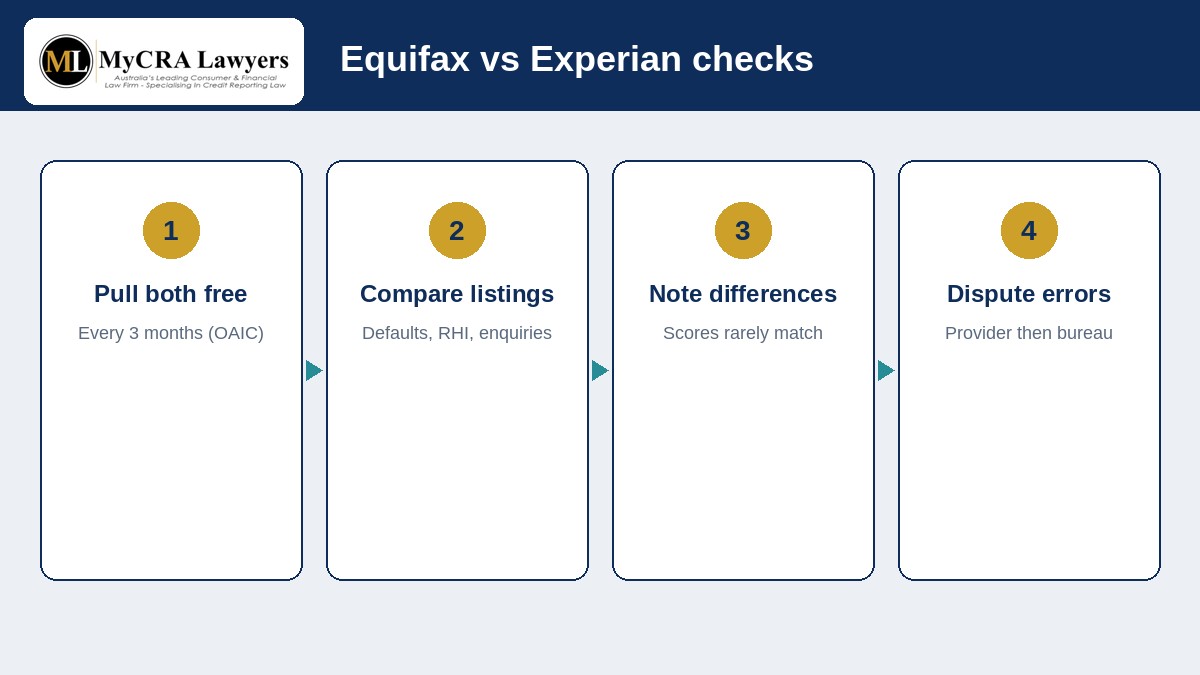
Pull Equifax and Experian and you will almost never see matching scores. Experian completed its acquisition of illion in September 2024, and from 1 April 2026 the two consumer credit bureaus operate as one Experian credit reporting body. An Experian report from that date includes data previously held separately by illion. Equifax and Experian still hold different files and use different score models, so your numbers will often disagree. Get both reports (free every three months), compare defaults, enquiries and personal details, then fix errors on the bureau where they appear.
Hi, I’m Graham. I still meet people who obsess over one app score and ignore the other file. Then a bank pulls a different bureau and the dream home loan dies in a day. Credit Prison is bad enough without fighting the wrong scoreboard.
Who are Equifax and Experian now?
| Bureau | Background | What consumers need to know in 2026 |
|---|---|---|
| Equifax | Formerly Veda / Veda Advantage | Still Australia’s largest consumer credit bureau. Widely used by major lenders. |
| Experian | Experian Australia; absorbed illion | From 1 April 2026, Experian’s consumer credit report includes information previously held on the old Experian and illion files. |
They remain competitors. They do not share one master database with Equifax. A default, enquiry or late payment mark can appear on one or both, depending on which CRBs each credit provider discloses to.
What happened to illion? Experian bought illion (Credit Data Solutions Pty Ltd) with completion announced on 30 September 2024 (ACCC did not oppose the deal in August 2024). Consumer credit reporting integration took effect on 1 April 2026: if a lender checks an “Experian” report from that date, they are using the combined file. Older lender letters may still say “illion” for a while; that generally means the new Experian report. You no longer need a separate illion consumer report. For the full process, see our guide on how to remove a default from your credit file.
Our credit repair lawyers Australia cornerstone explains how we work across both current bureaus.
Why the scores don’t match
Score differences usually come from a mix of:
- Different data. If Telstra reported a default to Equifax but not to Experian, only Equifax reflects it.
- Different models. Each bureau’s score is its own product. Scales and weightings differ. An “800” on one is not the same as an “800” on another.
- Different update timing. One bureau may show a paid update before the other.
- Different enquiry trails. Payday or BNPL enquiries on one file can drag that score down harder.
- Identity and match issues. Middle names, old addresses and duplicate consumer records create mess.
- The illion merger lag. Some older documents, apps or lender templates still talk about three bureaus or “illion scores”. Treat those as historical. For current applications, compare Equifax vs Experian.
So stop comparing the numbers as if they were temperatures in Celsius. Compare the listings.
How lenders actually use the bureaus
Banks, non-banks, brokers’ panels and fintechs choose their own credit check arrangements. Some pull Equifax only. Some pull Experian (including former illion data). Some use a combination. Broker software often shows which lenders favour which bureau.
That is why a broker might say “you’re fine on Equifax” and still get a decline when the lender’s policy engine reads Experian. Before a major application, review both files with your broker’s lender list in mind.
How to get both reports (including free access)
You have access rights under the Privacy Act 1988 and the Privacy (Credit Reporting) Code. The OAIC confirms a credit reporting body must give you a free consumer credit report once every three months. You can also request a free copy if you have been refused credit within the past 90 days, or if your credit-related personal information has been corrected.
In practice:
- Request your credit reporting information from Equifax and Experian.
- For Experian, use Experian’s consumer order path. That report now includes former illion information. (Older checkyourcredit / illion portals should not be treated as a separate third bureau.)
- Paid products bundle monitoring and scores. They can be convenient, but free access is enough for a cleanup project. See free vs paid credit reports.
Checking your own file is not a lender enquiry and should not behave like one on your report. More detail: checking your credit score won’t lower it.
What to check on each file (side by side)
Make a simple spreadsheet with two columns: Equifax and Experian.
Personal details
– Legal name, aliases, date of birth, licences, employers, addresses
Defaults and other negatives
– Creditor, amount, listed date, paid status
– Judgments, clearouts/SCIs if any
Enquiries
– Who checked, when, consumer vs commercial
Repayment history information (RHI)
– Monthly marks if present
Then mark mismatches. A default on Equifax only is still a problem for Equifax-using lenders. Dispute it with the credit provider and that bureau’s process. Our default removal and enquiry removal pages explain the usual pathways.
Which score should you “improve”?
Improve the file that your target lender reads, by fixing inaccurate or non-compliant listings and by avoiding unnecessary new enquiries. Chasing a vanity score on a monitoring app that your bank never sees wastes energy. We explain the scoring side in how credit enquiries affect your credit score.
If you need help deciding what is worth disputing, that is a big part of our free intro assessment.
Common myths
- “I’ll consolidate to one score.” You cannot merge Equifax and Experian into one number.
- “I still need a separate illion report.” From 1 April 2026, Experian’s consumer report includes former illion data.
- “The highest score is the real one.” The lender’s bureau is the real one for that application.
- “Deleting cookies resets my score.” No.
- “A credit repair company can negotiate a higher score number.” Lawful work targets listings and compliance. Score maths sits with the bureau models.
A simple 30-minute bureau comparison routine
Set a timer. Do this once before any big application:
- Download PDFs from Equifax and Experian on the same day.
- Confirm your name, date of birth and addresses match on both. Fix identity errors first. Wrong matches create wrong scores.
- List every default. Highlight any that appear on only one bureau.
- List enquiries from the last two years. Payday, BNPL and repeated car-yard checks deserve a hard look. Some enquiries may be challengeable if unauthorised or incorrect; many are not. See enquiry removal.
- Note RHI late marks if comprehensive credit reporting data is present. See repayment history information.
- Send the spreadsheet to your broker and ask which lenders on their panel read which bureau.
That routine catches most “why don’t my scores match” mysteries without paying for another monitoring product.
Score apps vs full reports
Mobile apps are handy for trends. They are not a substitute for the full credit reporting information you are entitled to access. Removals and disputes need the listing detail: dates, amounts, creditor names, account references. Screenshots of a three-digit score will not persuade a credit provider or AFCA.
If a monitoring product helped you spot a problem, good. Then get the underlying report and work the dispute properly.
When MyCRA gets involved
We pull or review Equifax and Experian information for clients (including data that previously sat on illion), then audit defaults, judgments, enquiries and RHI for Privacy Act Part IIIA and Credit Reporting Code issues. On consumer defaults accepted after initial assessment, our success rate is 91.6%, independently audited by a chartered accountant. Our own records show 29.4% of defaults are removed within 7 days. Fixed fee, quoted before you start. Selected matters include a Money Back Guarantee on the published terms.
Book a 15-minute credit repair intro call, call 1300 667 218, or email docs@mycralawyers.com.au.
And remember the free rails: free reports every three months, free AFCA complaints for eligible firms, OAIC for privacy complaints, National Debt Helpline 1800 007 007. See how a MyCRA file runs from first call to removal.
Don’t spend another month stuck in Credit Prison. Call our credit repair lawyers on 1300 667 218 or book a 15-minute intro call at https://mycralawyers.com.au/15min-credit-repair-intro-call/ . If we think your chances are low, we’ll tell you straight.
FAQ
Why is my Equifax score higher than my Experian score?
Different data and different models. Check which negative listings appear on each file. That usually explains the gap faster than the score algorithm does. Also remember Experian’s file from 1 April 2026 includes former illion data, so it may look different to an old Experian-only score you remember.
Do I need to dispute with both bureaus?
Dispute the listing where it appears, and with the credit provider who disclosed it. If the same default sits on both, you may need each CRB updated after the provider agrees to correct.
Which bureau do home loan lenders use?
It varies by lender. Ask your broker for the panel you are targeting and check those bureaus first, without ignoring the other.
What happened to illion / Dun & Bradstreet reports?
illion (which many people still remember as Dun & Bradstreet) was acquired by Experian in 2024. From 1 April 2026, consumer credit reporting operates as a single Experian CRB that includes former illion information. Request your Experian report for that combined file.
Can MyCRA work on Experian files too?
Yes. We work across Equifax and Experian.
This is general information, not legal advice. Bureau products and lender policies change. Confirm current free-access rules with each CRB. Liability limited by a scheme approved under Professional Standards Legislation.
MyCRA Lawyers | Australia-wide | 1300 667 218 | docs@mycralawyers.com.au | Book a 15-minute intro call



Leave A Comment