
Updated 20 November 2026. By Graham Doessel.
Short answer
A credit provider does not need a court judgment before listing a consumer credit default. It does need to meet the Privacy Act and CR Code rules: generally at least $150 overdue for 60 days, a written overdue notice, a later written intention-to-list notice sent to your last known address, and timing gaps set out in the Code. If you dispute the debt, ask for the contract, statements and notice trail. Debt buyers and collectors should still be able to show how the amount arose. Missing paperwork does not automatically wipe every listing, but it is often the start of a serious correction case. Check both free Equifax and Experian reports every three months.
Hi, I’m Graham. “Prove you don’t owe it” is one of the oldest traps in collection scripts. The better question is usually the reverse: if a firm wants a five-year default on your file, can it show the debt, the notices and the listing rules were followed? You should not have to disprove a ghost.
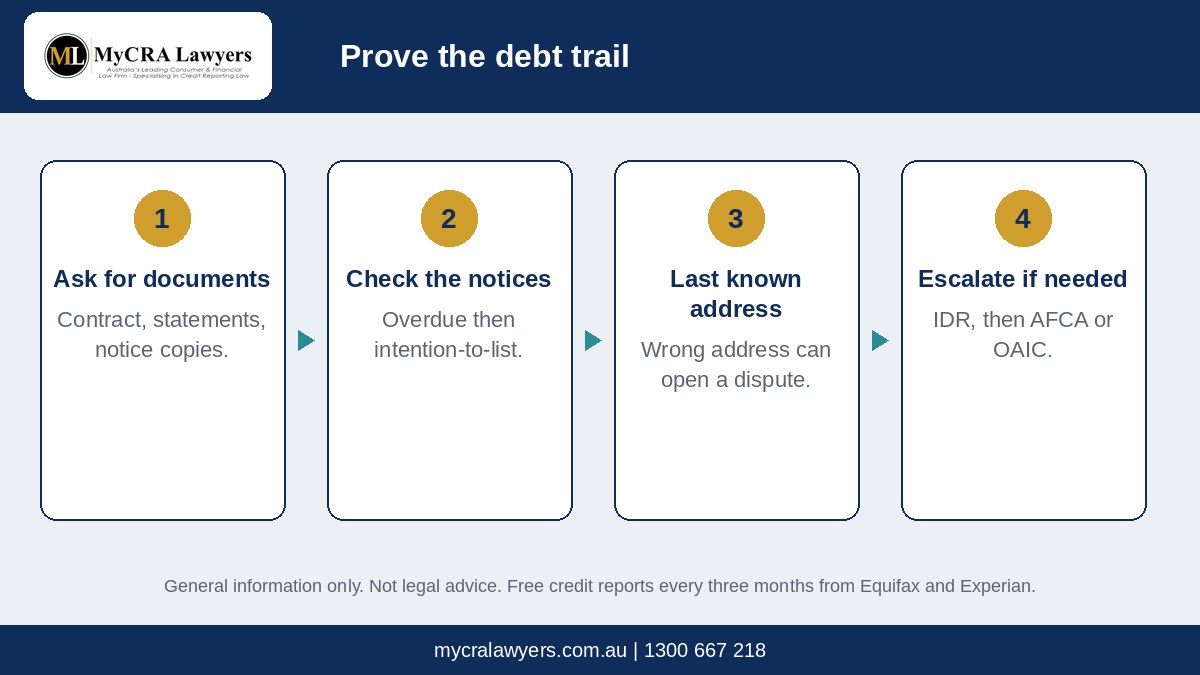
This guide covers what must exist before a consumer default is listed, what to ask for in writing, and how that ties to Equifax and Experian corrections. Related reading: section 88 default notices, default notice requirements and collector-assigned debts.
Do you need a court judgment before a default can be listed?
No. Default information under Part IIIA of the Privacy Act is a credit-reporting concept, not a court order. A judgment is a separate public record that can also appear on a file. Many defaults are listed with no judgment at all. Do not wait for a court date before you take a listing seriously.
What must be true before a consumer credit default is listed?
According to the OAIC and the Privacy Act / CR Code framework, a credit provider listing consumer default information generally needs:
- an overdue payment of at least $150 (or a higher prescribed amount)
- the payment overdue for at least 60 days
- a written notice informing you of the overdue payment and requesting payment (the section 6Q notice)
- a separate later written notice stating the intention to disclose default information to a credit reporting body (the section 21D(3) notice)
- at least 30 days between those two notices
- at least 14 days after the intention-to-list notice before disclosure, and disclosure within three months of that notice
- notices sent to your last known address at the time (email can count if that is how they usually write to you)
- recovery not prevented by a statute of limitations
National Credit Code section 88 default notices matter for enforcement of many regulated credit contracts. They are related but not identical to the credit-reporting notice pair above. Both trails are worth reconstructing when you dispute.
What proof should you ask for in writing?
Send a clear written request to the credit provider or debt buyer and keep a copy. Ask for:
- the original credit contract or account terms
- statements showing how the overdue amount was calculated
- copies of the overdue and intention-to-list notices, with send dates and the address or email used
- any assignment documents if a collector now owns or services the debt
- confirmation of which credit reporting bodies received the default
You are not being difficult. You are checking whether a five-year listing rests on a complete trail. If the firm cannot produce basic documents, say so in the dispute and ask for the listing to be corrected while they investigate.
What about debt buyers who say “just pay”?
Assigned debts are common. The assignee steps into the credit provider’s shoes for many purposes, but it still needs a coherent story: who originated the account, what was overdue, and which notices went where. Our case work often turns on missing contracts or notices that never reached the last known address, themes also covered in dispute letter templates for credit defaults.
Paying a collector “to make it go away” without paperwork can still leave a paid default on file for years. Read why paid defaults still show before you treat payment as removal.
How do guarantor listings differ?
Guarantor default information has its own Privacy Act tests: written notice of the borrower’s default, a request that you pay, at least 60 days since that notice, other recovery steps against you, and recovery not being statute-barred. If you signed a guarantee, do not assume the borrower’s notice trail is enough on its own. See parents as guarantors for the home-loan angle, and keep every notice addressed to you as guarantor.
What practical steps should you take this week?
- Download both free Equifax and Experian reports, available every three months. Illion’s consumer bureau has been absorbed into Experian.
- Diary the listing date, amount and creditor name exactly as shown.
- Request the contract, statements and notice trail in writing.
- Compare the notice addresses with what the creditor had on file when the notices were sent.
- If money stress is the driver, call the National Debt Helpline on 1800 007 007 while the dispute runs.
A free credit file analysis at app.FixMyBadCredit.com.au is a useful first pass if you are not sure whether the listing is the only problem on the file.
Where do you escalate?
Use internal dispute resolution first. AFCA is free for eligible consumers if the firm is a member. The OAIC can handle some credit reporting privacy complaints. Court limitation questions are state- and territory-specific, get advice before you assume a debt is dead.
How can MyCRA Lawyers help?
If a creditor or collector cannot produce the contract and notice trail for a listing on your file, send us both bureau PDFs and whatever letters you have. We will map the proof gaps against the default rules and tell you if a consumer dispute is viable.
MyCRA Lawyers is a specialist credit repair law firm. Have your Equifax and Experian report PDFs ready and reach us through our contact form, call 1300 667 218 or 07 3124 7133, or book a 15-minute credit repair intro call. Postal: PO Box 169, Aspley QLD 4034. We quote fixed fees in writing after we assess the file, and we will tell you plainly if a listing looks like a wait-out rather than a viable dispute. On consumer defaults accepted after initial assessment, our independently audited success rate is 91.6%. From time to time we run a Money Back Guarantee offer on listings with certain creditors. Which creditors it covers changes, so ask us if one is running. No law firm can promise every listing will come off, and we don’t. Start with our default removal overview if you already know which listing is the problem.
Not ready to talk yet? Pull both free reports and start with a free credit file analysis at app.FixMyBadCredit.com.au. For the bigger picture of how listings are challenged, read our credit repair lawyers Australia guide.
Frequently asked questions
Must a creditor prove the debt in court before listing a default?
No. A consumer default can be listed without a judgment if the Privacy Act and CR Code requirements are met. A judgment is a separate kind of record.
What notices are required before a consumer default listing?
Generally a written overdue payment notice and a later separate intention-to-list notice, sent to your last known address, with the CR Code timing gaps between them.
Can I ask a debt collector for the original contract?
Yes. Ask in writing for the contract, statements, notice copies and any assignment documents. Keep their reply.
Does missing paperwork automatically remove a default?
Not automatically. Incomplete proof is often strong dispute material, but outcomes depend on what can be shown and the forum you use.
Should I pay first and argue later?
Get the paperwork and advice first where you can. Paying can update a listing to ‘paid’ without removing it for the five-year retention period.
General information only. Not legal advice for your circumstances. Liability limited by a scheme approved under Professional Standards Legislation.

Leave A Comment