
Updated 20 November 2026. By Graham Doessel.
Short answer
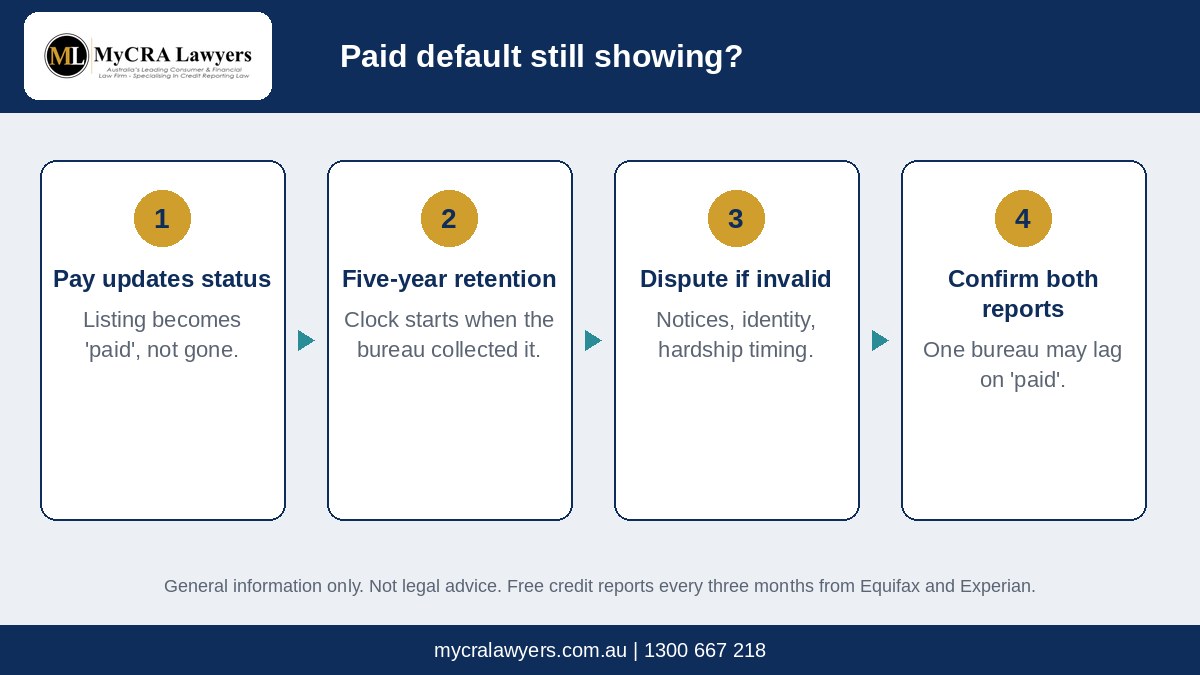
Paying a default does not remove it from your Australian credit file. According to the OAIC, once a default is listed, paying the overdue amount updates the listing to show it was paid, but the information generally stays for five years from when the credit reporting body collected it. “Paid” is better than “unpaid” for many lenders, yet it is still a default. Challenge the listing if the notices, amount, identity or timing were wrong, not merely because you have since cleared the balance. Confirm the status on both free Equifax and Experian reports every three months.
Hi, I’m Graham. One of the most common emails we get starts the same way: “I paid that default three years ago, why is it still there?” The short answer is that Australian credit reporting was never designed to treat payment as a magic eraser. Payment changes the status. Retention is a separate clock.
This guide explains what “paid” means on Equifax and Experian, how long the listing can stay, and when it is still worth disputing. It complements paid vs unpaid defaults and unpaid default removal.
What does a paid default mean on your credit report?
When a credit provider lists default information and you later pay the overdue amount, the provider should report payment information so the file shows the default has been paid. The OAIC puts it plainly: the listing remains, but it is updated to show payment was made.
So a paid default is not the same as “no default”. It is a historical record that an overdue amount of at least $150 was listed after the required notices, and that the amount was later cleared.
How long does a paid default stay?
Under section 20W of the Privacy Act, default information is generally retained for five years from the day the credit reporting body collected it. Payment information relating to that default is kept for the same five-year window tied to the underlying default collection date, not five fresh years from the day you paid.
That is why a default you paid in year two can still be visible in year four. The payment helped. It did not restart or erase the retention period.
Why do lenders still care about a paid default?
Many credit policies treat paid and unpaid defaults differently. An unpaid default often looks worse because it suggests the debt is still live. A paid default shows you cleared it. Brokers still see the original conduct: how large it was, how recent it was, and whether other late marks surround it.
For home loans and car loans, timing matters. A paid default from four years ago with clean repayment history since is a different conversation from a paid default listed six months ago. See what lenders see on your credit file and RHI vs defaults: what brokers check first.
When should you dispute a paid default anyway?
Payment does not cure a listing that should never have been made. Worth a close look when:
- notices went to an address that was not your last known address at the time, see wrong-address defaults
- the amount or dates do not match the section 6Q / intention-to-list trail
- the default was listed while a hardship request was being assessed
- you are the wrong person, or the debt was already statute-barred when listed, see statute-barred debts and your credit file
- you paid, but one bureau still shows unpaid, or the paid marker never arrived
If the only complaint is “I paid it, so take it off”, that alone is usually not a Privacy Act correction ground. The law expects paid defaults to remain for the retention period unless the underlying information is wrong.
What should you check on Equifax and Experian?
- Pull both free reports, Australians can get a free credit report every three months. Illion’s consumer bureau has been absorbed into Experian.
- Confirm whether each default shows as paid or unpaid.
- Note the listing date and the original overdue amount.
- Keep your receipt, settlement letter or bank trail with the PDFs.
- If one bureau is updated and the other is not, write to the credit provider and ask them to correct both.
Is waiting it out sometimes the better call?
Yes. If the notices were valid, the debt was yours, and the listing is already several years old with clean recent repayment history, the practical path may be to wait for the five-year drop-off and rebuild in the meantime. We say that plainly when we assess a file. No firm should pretend every paid default is a removal job.
If a major application is coming up sooner, a free credit file analysis at app.FixMyBadCredit.com.au helps you see whether the paid default is the main obstacle or whether enquiries and late marks matter more.
Where do you escalate if the paid status is wrong?
Start with the credit provider’s internal dispute resolution in writing. If needed, AFCA is free for eligible consumers complaining about member firms. The OAIC handles some credit reporting privacy complaints. Free budget help sits with the National Debt Helpline on 1800 007 007.
What should brokers and borrowers tell each other about paid defaults?
If you are working with a mortgage broker, disclose paid defaults early rather than hoping they will not appear. Brokers can often steer you toward lenders whose policies tolerate older paid listings once repayment history has been clean for a stretch. Surprises on the formal bureau pull waste enquiries and time.
Bring the payment letter, both bureau PDFs and a short timeline to that conversation. The same pack is what we ask for when we assess whether a paid listing is a validity dispute or a wait-out. Honesty about the file almost always beats trying to outrun it.
How can MyCRA Lawyers help?
If a paid default is still blocking a loan, or one bureau never marked it paid, send us both reports plus your payment proof. We will tell you whether the dispute is about status, validity, or simply waiting out the retention period.
MyCRA Lawyers is a specialist credit repair law firm. Have your Equifax and Experian report PDFs ready and reach us through our contact form, call 1300 667 218 or 07 3124 7133, or book a 15-minute credit repair intro call. Postal: PO Box 169, Aspley QLD 4034. We quote fixed fees in writing after we assess the file, and we will tell you plainly if a listing looks like a wait-out rather than a viable dispute. On consumer defaults accepted after initial assessment, our independently audited success rate is 91.6%. From time to time we run a Money Back Guarantee offer on listings with certain creditors. Which creditors it covers changes, so ask us if one is running. No law firm can promise every listing will come off, and we don’t. Consumer default work is assessed under our default removal process.
Not ready to talk yet? Pull both free reports and start with a free credit file analysis at app.FixMyBadCredit.com.au. For the bigger picture of how listings are challenged, read our credit repair lawyers Australia guide.
Frequently asked questions
Does paying a default remove it from my credit file?
No. Paying should update the listing to show it as paid. The default information generally stays for five years from when the bureau collected it.
Is a paid default better than an unpaid one?
Often yes for lender policy, because the debt is cleared. It is still a default and still visible for the retention period.
Can I dispute a default after I have paid it?
Yes, if the listing itself was wrong, for example defective notices, wrong person, hardship timing, or statute-barred recovery. Payment alone is not usually a removal ground.
Why does one bureau show paid and the other unpaid?
Providers do not always update both bureaux at the same speed. Write to the credit provider with proof of payment and ask them to correct each bureau that holds the data.
When does a paid default finally disappear?
When the five-year retention period ends and the bureau stops disclosing it. Check both Equifax and Experian around that anniversary.
General information only. Not legal advice for your circumstances. Liability limited by a scheme approved under Professional Standards Legislation.



Leave A Comment