
Updated 15 November 2026. By Graham Doessel.
Short answer
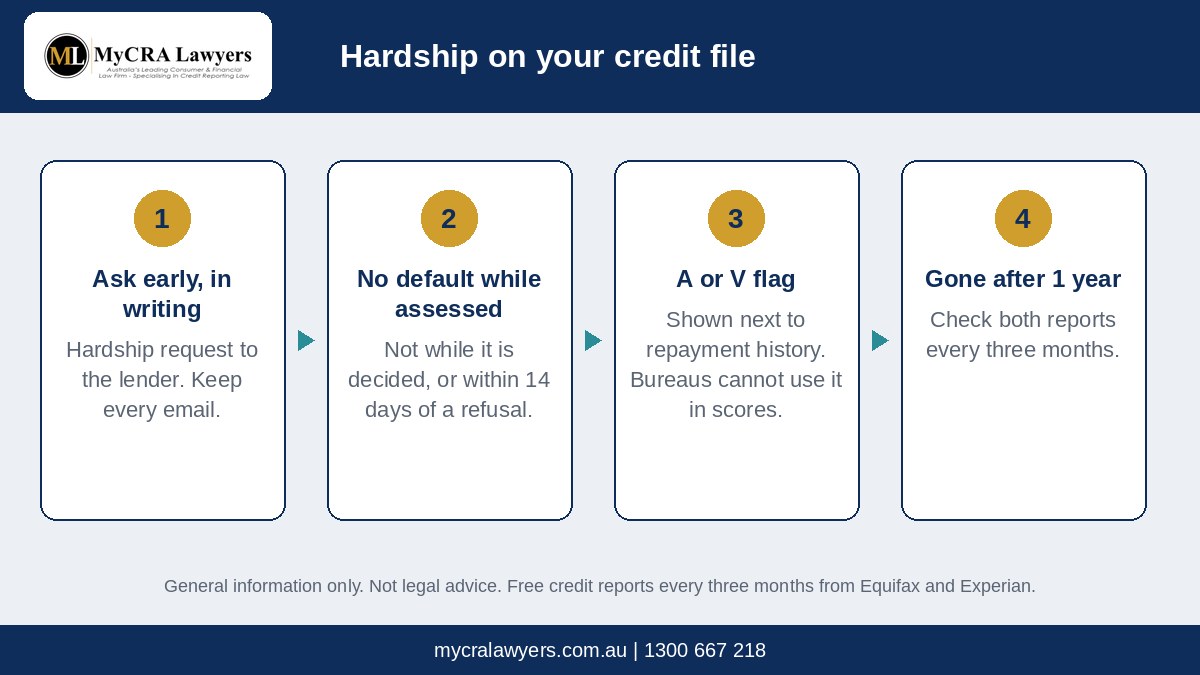
Since 1 July 2022, when you agree a financial hardship arrangement with a lender, the lender must report it to the credit reporting bureaus and it appears next to your repayment history. A temporary arrangement shows as “A” against each month it covers. A permanent change to your loan terms shows as “V” against the month it starts. The flags drop off after one year: for an “A”, one year after the arrangement’s final repayment, and for a “V”, one year after it started. Your report doesn’t say why you needed help, and the bureaus aren’t allowed to use hardship information to calculate your credit score. While a lender is still deciding your hardship request, it generally can’t list a default. Check both of your free Equifax and Experian reports (you can get them every three months) to confirm the reporting is right.
Hi, I’m Graham. A lot of the people who call us did the right thing. Hours were cut, someone got sick, or a business hit a rough patch, and they rang the lender and asked for help instead of going quiet. Then they pulled their credit report and saw letters they didn’t understand. Their next question was whether asking for hardship help had landed them in Credit Prison anyway. Usually it hasn’t. But you do need to read the report properly, because hardship reporting has its own rules and lenders don’t always get them right.
This guide explains what financial hardship information is, how it shows up, how long it stays, and what to do when the reporting looks wrong. It builds on our earlier article on how financial hardship can affect your credit file.
What is financial hardship information?
Financial hardship information (often shortened to FHI) is a marker that a credit provider adds to your repayment history when you have an agreed financial hardship arrangement. It was introduced under Part IIIA of the Privacy Act 1988 and the Privacy (Credit Reporting) Code, and it has applied since 1 July 2022.
Before then, people in genuine hardship often ended up with a run of late-payment marks even though the lender had agreed to reduced payments. The reform was meant to separate “this person was in an agreed arrangement” from “this person simply didn’t pay”.
FHI only appears where comprehensive credit reporting applies, which in practice means consumer credit accounts such as home loans, personal loans, car loans and credit cards with lenders that report repayment history. It sits alongside your repayment history information (RHI). It doesn’t replace it.
What do the A and V flags look like on your report?
Repayment history is a month-by-month grid. According to the OAIC, each month generally shows one of the following:
- 0 or a tick: paid on time, or within 14 days of the due date
- 1 to 7: overdue, with the number showing how many months behind the oldest missed payment is
- A: the month was covered by a temporary hardship arrangement, such as a payment pause or a short-term reduction
- V: a variation arrangement started that month, meaning the loan terms were permanently changed (for example, a longer loan term to lower the repayments)
Equifax and Experian lay their reports out differently, so the same information can look different from one to the other. Read the legend on each report rather than assuming. The illion consumer bureau has been absorbed into Experian, so Equifax and Experian are the two consumer reports to check.
How long does hardship information stay on your credit file?
Hardship information is kept for a shorter time than almost anything else on the file:
- Financial hardship information: one year
- Repayment history (including late marks): two years
- Defaults: five years
- Serious credit infringements: seven years
Here is how the OAIC explains the timing. Say you had a temporary arrangement from July to October. The “A” markers for those months are removed one year after the arrangement’s final repayment. A “V” is removed one year after the variation started.
So handled correctly, a hardship arrangement leaves a light footprint. A default listed because the account was left to slide leaves a five-year one. That gap is the strongest practical reason to ask for help early.
Does a hardship arrangement lower your credit score?
The Credit Reporting Code says credit reporting bodies must not use financial hardship information to calculate your credit score. The A or V marker itself shouldn’t drag the bureau score down.
That doesn’t mean a hardship period has no effect at all:
- Missed payments before the arrangement was agreed can still appear as late marks, and those can affect scoring.
- If you don’t keep to the arrangement, missed payments under it can be reported too.
- A lender reviewing a new application can still see the flag and may ask about it. Lenders make their own credit decisions with their own policies.
If you are applying for a home loan within a year of a hardship arrangement, tell your broker upfront. A short, honest explanation with evidence that things have stabilised usually lands better than a surprise on the file.
Can a default be listed while you are asking for hardship help?
According to the OAIC, if you make a hardship request, the credit provider generally can’t list a default:
- while it is still deciding the request, and
- until 14 days after it tells you it has refused the request.
There is an exception. The lender may be able to list a default if it reasonably believes your request was made on the same basis as one you made in the previous four months.
All the usual default rules still apply too: at least 60 days overdue, at least $150, and the required written notices sent to your last known address. If a default appeared while your hardship request was live, or straight after an arrangement was agreed, the timeline needs a close look. We cover that scenario in default listed during hardship: can you challenge it?
What should you check on Equifax and Experian after a hardship arrangement?
Pull both reports. Under the Privacy Act you can get a free credit report from each bureau every three months. Then work through this list:
- Right months, right letter. Do the A or V markers line up with the dates in your hardship arrangement letter?
- No arrears while you kept to the deal. Under a variation arrangement, repayment history is based on the varied terms. If you made every payment the new terms required, late marks shouldn’t build up.
- Flags dropping off on time. Is any hardship marker more than about a year old?
- No default during assessment. Compare the default listing date with the date you lodged your hardship request and the date the lender gave its decision.
- Same story on both bureaus. Lenders don’t all report to both, and errors are often fixed on one bureau but not the other.
Keep the hardship application, the lender’s written decision and any agreed variation together in one folder. Those documents decide most disputes.
How do you fix incorrect hardship reporting?
Start with the credit provider that reported the information, in writing. Explain what is wrong, attach the arrangement letter, and ask for a correction to be sent to each bureau that holds the data. You can also make a correction request to the bureau directly, and it must consult the provider.
If the lender’s internal dispute process doesn’t fix it, the Australian Financial Complaints Authority (AFCA) is free for eligible consumers complaining about member firms. The OAIC handles some credit reporting privacy complaints. Our guide to AFCA vs OAIC for credit reporting disputes explains which forum usually fits.
If the real problem is the budget rather than the report, the National Debt Helpline (1800 007 007) offers free financial counselling and can help you prepare a hardship request.
When does it make sense to get legal help?
Most simple hardship-flag errors can be fixed with a clear letter. Legal help is worth considering when:
- a default was listed during or soon after a hardship request
- the lender says no request was ever made, but you have emails or call records
- late marks keep reappearing after you were told they would be corrected
- a home loan or refinance is waiting on a clean file
How can MyCRA Lawyers help?
If hardship reporting on your file looks wrong, or a default turned up while you were asking for help, send us both bureau reports, the hardship correspondence and your goal date. We will map the timeline against the notice and hardship rules and tell you whether there is a real dispute.
MyCRA Lawyers is a specialist credit repair law firm. Have your Equifax and Experian report PDFs ready and reach us through our contact form, call 1300 667 218 or 07 3124 7133, or book a 15-minute credit repair intro call. Postal: PO Box 169, Aspley QLD 4034. We quote fixed fees in writing after we assess the file, and we will tell you plainly if a listing looks like a wait-out rather than a viable dispute. On consumer defaults accepted after initial assessment, our independently audited success rate is 91.6%. From time to time we run a Money Back Guarantee offer on listings with certain creditors. Which creditors it covers changes, so ask us if one is running. No law firm can promise every listing will come off, and we don’t.
Not ready to talk yet? Pull both free reports and start with a free credit file analysis at app.FixMyBadCredit.com.au. For the bigger picture of how listings are challenged, read our credit repair lawyers Australia guide.
Frequently asked questions
Will a hardship arrangement show on my credit report?
Yes. Since 1 July 2022, an agreed hardship arrangement on a consumer credit account that reports repayment history appears as an A (temporary) or V (variation) marker next to your repayment history. It stays for one year.
Does my credit report say why I needed hardship help?
No. The report shows only that an arrangement existed and what type it was. It doesn’t record illness, job loss or any other reason.
Does financial hardship information affect my credit score?
Credit reporting bodies aren’t allowed to use financial hardship information to calculate your credit score. Late payments made before or outside the arrangement can still count, and lenders can see the marker when they assess you.
Can a lender list a default while my hardship request is being assessed?
Generally no. According to the OAIC, a credit provider can’t list a default while it is deciding a hardship request, or until 14 days after telling you it has refused it. There is a limited exception for repeat requests made on the same basis within four months.
Is it better to miss payments than ask for hardship help?
Usually not. Late payments stay in repayment history for two years, and an account that tips into default can carry a listing for five years. A hardship marker stays for one year and isn’t used in the bureau score.
General information only. Not legal advice for your circumstances. Liability limited by a scheme approved under Professional Standards Legislation.





Leave A Comment