
Updated 25 November 2026. By Graham Doessel.
Short answer
Sometimes, yes. Under the Privacy Act, a business that supplies goods or services and lets you pay at least seven days later can count as a credit provider for that debt, even if lending isn’t what it does. So a dental payment plan, a vet bill on account or a gym contract billed in arrears can end up as a default. The usual listing rules still apply: generally $150 or more, at least 60 days overdue, and proper written notices first. In practice these debts are often handed to a debt collector, and the collector’s name is what shows up. If you see one on your free Equifax or Experian report (free every three months), ask in writing for the account history and the notices before you pay or argue.
Hi, I’m Graham. People expect banks and phone companies on their credit file. They don’t expect the gym they stopped going to in 2023, or the vet who saved the dog. Then a default turns up under a collector’s name they’ve never heard of, and it takes a few phone calls to work out it’s the old membership.
Can a service business really be a credit provider?
Yes, for the right kind of debt. The Privacy Act’s definition of a credit provider includes banks and lenders, but it also includes any business that supplies goods or services where repayment is deferred for at least seven days. It only counts as a credit provider in relation to that credit. The OAIC’s own examples are telcos and energy and water companies, but the same idea can reach dentists, vets, physios, tradies and gyms.
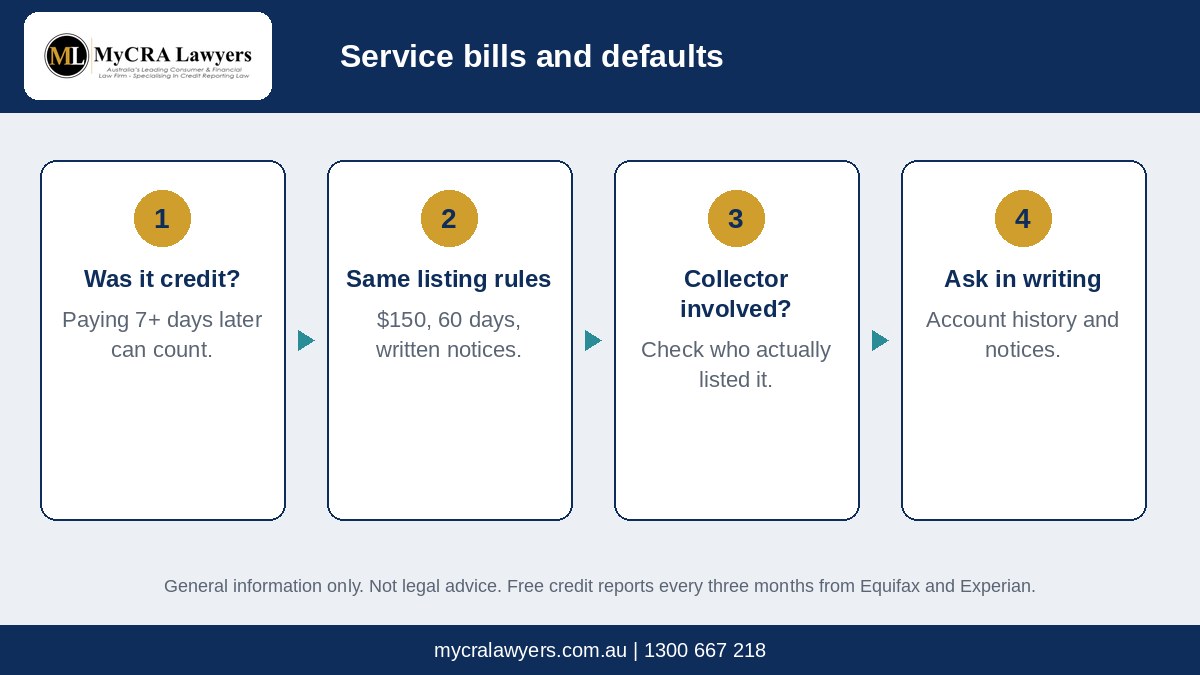
The flip side matters too. If you paid in full before or at the time of the service, there was no credit. A dentist who takes payment on the day isn’t a credit provider for that visit. One who sets up a payment plan over three months may be. The credit reporting rules use a wider idea of credit than the consumer lending laws, so “it wasn’t a loan” doesn’t settle it.
Does a gym membership count as credit?
It depends on how it was billed and what’s owed. A membership paid fortnightly in advance is closer to paying as you go. Unpaid fees after a missed direct debit, a minimum term you didn’t finish, or an exit fee are where debts usually come from, and whether those count as deferred payment depends on the contract.
Many gym disputes are really about cancellation: you cancelled, they say you didn’t. Keep the cancellation email or form. That evidence often matters more than the credit reporting rules.
What has to happen before a default can be listed?
The same core rules apply whether the debt is from a bank or a beauty clinic. In summary, the amount must generally be $150 or more and at least 60 days overdue. The business (or whoever now holds the debt) must have written to you about the overdue amount and asked you to pay, and then given you separate written notice that it intends to list, with time to act. Those notices must go to your last known address or email.
Small businesses often get this wrong, partly because they don’t do it often. Our guide on whether creditors must prove the debt before listing goes through what to ask for. For default basics, see how long a default stays on your credit file.
Who usually lists these debts?
Most dentists and gyms aren’t set up to report to Equifax or Experian themselves. They pass overdue accounts to a debt collector, either as an agent or by selling the debt. That’s why the listing often shows the collector’s name, not the business you dealt with.
When a debt changes hands, the paperwork trail often gets thinner. Our guide on debts assigned to collectors explains what to check, and debt collector harassment and your credit file covers how collectors must behave.
What should you check if a service bill shows up on your file?
- Who listed it, the amount and the date. Match it to the original business.
- Whether it was credit: did you get the service before paying, with time to pay later?
- The account history: what was charged, what you paid, and any fees added later.
- The notices: ask for copies and check the address or email they were sent to.
- Both bureaus: pull your free reports from Equifax and Experian. Australians can get one from each every three months.
A free credit file analysis at app.FixMyBadCredit.com.au is a quick way to see which listings on your file are worth a closer look.
What if the bill itself is disputed?
If you think the work was poor, the fees were wrong or you’d cancelled, raise it with the business in writing and keep a copy. Disputing a bill doesn’t automatically stop a listing, but a written record helps later. Your state or territory fair trading office can help with consumer disputes, and health services may have their own complaints body. Many small service businesses aren’t AFCA members, so for the credit reporting side the OAIC is often the place to complain if the business or collector won’t fix a wrong listing. Our guides on telco and utility defaults and education fee defaults cover similar non-bank debts.
If the bill is part of bigger money worries, the National Debt Helpline (1800 007 007) is free.
How can MyCRA Lawyers help?
If a gym, clinic, vet or tradie debt has turned up on your file, or you can’t even tell which business it came from, send us both Equifax and Experian PDFs. We will tell you whether the listing looks challengeable or whether it’s simply a wait-out.
MyCRA Lawyers is a specialist credit repair law firm. Have your Equifax and Experian report PDFs ready and reach us through our contact form, call 1300 667 218 or 07 3124 7133, or book a 15-minute credit repair intro call. Postal: PO Box 169, Aspley QLD 4034. We quote fixed fees in writing after we assess the file, and we will tell you plainly if a listing looks like a wait-out rather than a viable dispute. On consumer defaults accepted after initial assessment, our independently audited success rate is 91.6%. From time to time we run a Money Back Guarantee offer on listings with certain creditors. Which creditors it covers changes, so ask us if one is running. No law firm can promise every listing will come off, and we don’t. See our default removal service page for how we handle listings.
Not ready to talk yet? Pull both free reports and start with a free credit file analysis at app.FixMyBadCredit.com.au. For the bigger picture of how listings are challenged, read our credit repair lawyers Australia guide.
Frequently asked questions
Can a dentist put a default on my credit file?
It can happen if the dentist provided credit, for example a payment plan or an invoice with time to pay, and the usual default rules are met. Payment on the day of treatment isn’t credit.
Can a gym list a default for unpaid membership fees?
Possibly, depending on how the membership was billed and the contract terms. The debt must still meet the usual listing rules, including amount, time overdue and written notices.
Why does a debt collector’s name appear instead of the business?
Many small businesses pass overdue accounts to a collector or sell the debt. The collector then appears as the listing organisation.
What is the minimum amount for a default listing?
Generally $150 or more, overdue for at least 60 days, with the required written notices given first.
Who do I complain to about a wrong listing from a small business?
Start with the business or collector in writing. If it isn’t fixed, complain to AFCA if they are a member, or to the OAIC for credit reporting privacy issues.
General information only. Not legal advice for your circumstances. Liability limited by a scheme approved under Professional Standards Legislation.





Leave A Comment