
Updated 25 November 2026. By Graham Doessel.
Short answer
If a flood, bushfire or cyclone stops you paying your bills, contact your lenders as early as you safely can and ask for hardship help. An agreed hardship arrangement can be recorded on your credit file as financial hardship information, which stays for 12 months and isn’t used to calculate your credit score. If you couldn’t ask for help sooner because of the disaster itself, the Credit Reporting Code lets a lender backdate the arrangement. It also recognises natural disaster as a circumstance beyond your control that you can raise when asking for a default, late payment or other listing to be corrected. None of this is automatic. Keep records, pull your free Equifax and Experian reports (free every three months) once things settle, and ask for corrections in writing.
Hi, I’m Graham. We’re a Queensland firm and we’ve watched plenty of floods and cyclones roll through. When the water goes down, the last thing anyone wants to think about is their credit file. Months later, when they go to refinance or replace a car, they find late payments or a default from the weeks they were living out of an evacuation centre.
This guide is about protecting your credit file during and after a disaster, and fixing it if the damage is already done.
What happens to your credit file if a disaster stops your repayments?
Missed payments on loans and cards from licensed lenders can show in your monthly repayment history. If a debt of $150 or more stays overdue for 60 days and the creditor sends the required written notices, it can be listed as a default, which stays for five years. A telco or energy bill can go the same way.
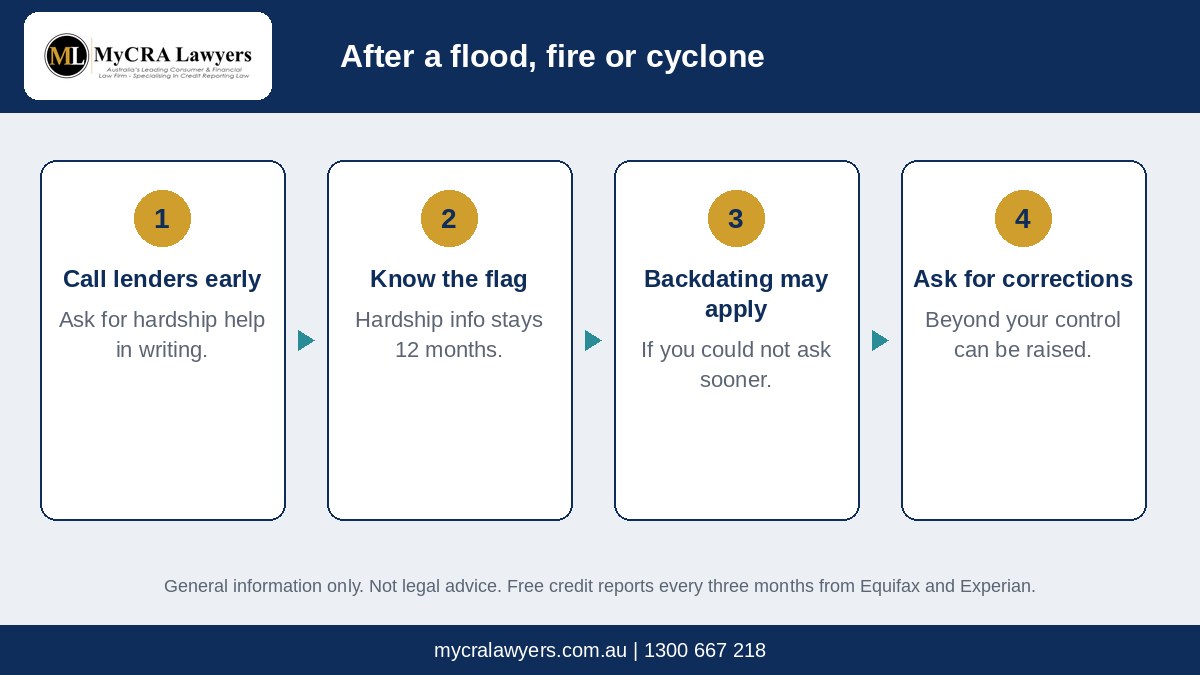
Lenders don’t automatically know you were affected. Some announce disaster relief packages for affected postcodes, but you usually still need to contact them. The sooner you do, the more options you tend to have.
How does a hardship arrangement show on your credit file?
If you and a lender agree to a hardship arrangement, such as a payment pause or reduced repayments, the lender can report financial hardship information alongside your repayment history. That flag stays on your file for 12 months. Repayment history itself stays for two years.
Importantly, financial hardship information isn’t included when a bureau calculates your credit score. Lenders reading your file can still see it, and some will ask about it, but it tells a different story from a string of plain missed payments. Our guide to financial hardship information on your credit file explains how it looks.
Can a hardship arrangement be backdated?
Yes, in some situations. The Credit Reporting Code allows a lender to backdate the start of a hardship arrangement if you couldn’t ask for help earlier because of circumstances beyond your control, such as illness or natural disaster, and the lender is satisfied that’s the case. It can also backdate to the day you first asked if the lender was unreasonably slow to agree.
That matters because backdating can change how the missed months are reported. If you were cut off by floodwater or had lost your home, say so in writing and ask the lender to backdate.
Can disaster-related listings be corrected?
The Credit Reporting Code now specifically names natural disaster, along with domestic abuse, bank error and fraud, as circumstances beyond your control. If a default, payment information, financial hardship information or certain repayment history exists only because of the unavoidable consequences of a disaster, you can ask for it to be corrected on that basis. The lender or bureau has to consider whether the information is inaccurate, out of date, incomplete, irrelevant or misleading, and consult the lender that reported it.
It isn’t a free pass. You’ll need to show the link between the disaster and the missed payments. Our guide to the 30-day rule for credit file corrections explains how the request is handled, and defaults listed during hardship covers a common sticking point.
Who should you contact first?
- Your lenders and utilities. Tell them you’ve been affected and ask, in writing, for hardship help. Do the mortgage and car loan first.
- The National Debt Helpline on 1800 007 007 for free financial counselling. Counsellors can contact creditors for you.
- Your insurer, so the claim is moving while repayments are paused.
- AFCA if a lender refuses reasonable help or handles your request badly. It’s free for consumers.
Ask for any pause or reduction to be confirmed in writing, including how it will be reported to the credit bureaus.
What should you keep for later?
- Dates you were evacuated, cut off or without power or internet
- Insurance claim numbers and assessor letters
- Every email, letter and text to and from your lenders
- Any disaster relief package details your lender published
Once life settles down, pull both free credit reports. Australians can get one free from Equifax and from Experian every three months. Then run a free credit file analysis at app.FixMyBadCredit.com.au so you know exactly what was reported while you were dealing with the clean-up.
How can MyCRA Lawyers help?
If a flood, fire or cyclone left you with late payments or a default you think shouldn’t be there, send us both Equifax and Experian PDFs and a short timeline of what happened. A team member will read the file and tell you what looks worth challenging.
MyCRA Lawyers is a specialist credit repair law firm. Have your Equifax and Experian report PDFs ready and reach us through our contact form, call 1300 667 218 or 07 3124 7133, or book a 15-minute credit repair intro call. Postal: PO Box 169, Aspley QLD 4034. We quote fixed fees in writing after we assess the file, and we will tell you plainly if a listing looks like a wait-out rather than a viable dispute. On consumer defaults accepted after initial assessment, our independently audited success rate is 91.6%. From time to time we run a Money Back Guarantee offer on listings with certain creditors. Which creditors it covers changes, so ask us if one is running. No law firm can promise every listing will come off, and we don’t. For late payments, see our repayment history information service page.
Not ready to talk yet? Pull both free reports and start with a free credit file analysis at app.FixMyBadCredit.com.au. For the bigger picture of how listings are challenged, read our credit repair lawyers Australia guide.
Frequently asked questions
Will a natural disaster automatically protect my credit file?
No. You usually need to contact your lenders and ask for hardship help. Some lenders offer disaster relief packages, but you still need to apply.
How long does financial hardship information stay on my credit file?
Financial hardship information stays for 12 months. Repayment history stays for two years.
Does hardship information lower my credit score?
Financial hardship information is not included in calculating your credit score, although lenders reading your file can still see it.
Can a default from a disaster period be removed?
It may be possible. The Credit Reporting Code recognises natural disaster as a circumstance beyond your control that can support a correction request, but each case depends on the facts and evidence.
Who can help me talk to my lenders after a disaster?
The National Debt Helpline (1800 007 007) offers free financial counselling, and counsellors can contact creditors on your behalf.
General information only. Not legal advice for your circumstances. Liability limited by a scheme approved under Professional Standards Legislation.






Leave A Comment