
Updated 24 November 2026. By Graham Doessel.
Short answer
A thin credit file means there isn’t much on it: few or no accounts and little repayment history. It’s common for young people, people who have always paid cash, and people who have just arrived in Australia, because overseas credit history generally doesn’t carry over to Equifax or Experian. A thin file isn’t a bad file, but it gives lenders less to go on. History builds slowly through accounts with licensed lenders that report monthly repayments. The fastest way to wreck a thin file is a burst of applications or one forgotten bill that turns into a default. Pull your free reports (free every three months) so you know what’s there from day one.
Hi, I’m Graham. Most of my work is helping people whose credit files have too much on them. This one is about the opposite problem. A nurse who’s just moved here from overseas, a 19-year-old after a first car loan, someone who has paid cash their whole life. They apply for credit, get knocked back, and can’t see why when they’ve never missed a payment in their lives.
What does a thin credit file mean?
A credit file is usually created the first time a lender asks a bureau about you, for example when you apply for a phone plan, a credit card or a loan. From then on it collects enquiries, account information and, for some accounts, monthly repayment history. A thin file has very little of that.
Equifax and Experian are the two consumer credit bureaus to check (the illion consumer bureau has been absorbed into Experian). They hold information about credit in Australia. Your credit history from the UK, India, New Zealand or anywhere else generally doesn’t follow you here, although some lenders have their own policies for recent arrivals and may ask for overseas statements.
Why can having no history hold you back?
Lenders like evidence. Without accounts and a repayment record, they’re relying on your income, savings and employment alone. Some will happily do that. Others will cap the amount, ask for a bigger deposit or decline. A bureau may give you a low score, or not enough data for a meaningful score at all.
None of that means you’ve done anything wrong. It just means the file has no story yet. Our guide on credit score vs credit file explains why the file matters more than the number.
What actually builds credit history in Australia?
Under comprehensive credit reporting, licensed lenders such as banks, card issuers and car finance companies report whether you paid on time each month. That repayment history is what shows a lender you can handle credit. Two years of clean history on one or two modest accounts says a lot.
- A low-limit credit card paid in full each month is the classic starting point.
- A small personal or car loan, if you actually need one, builds history too.
- Phone and energy accounts can appear as accounts and can be listed as defaults if unpaid, but most of these providers don’t report monthly repayment history.
- Buy now pay later is generally regulated credit since June 2025 and can show on your file. Use it carefully.
Savings accounts, debit cards and paying bills on time don’t show up as credit history. They still help, because lenders look at your bank statements. See comprehensive credit reporting explained.
Which mistakes turn a thin file into a bad one?
- Applying everywhere at once. Each application can leave an enquiry for five years, and a cluster of them on a thin file looks like desperation. Read how many credit enquiries are too many.
- Payday loans as a first step. They can show up as enquiries and accounts that some lenders don’t like seeing.
- A forgotten final bill. Moving house or leaving a phone plan without settling up is how many first defaults happen. A debt of $150 or more that’s 60 days overdue can be listed once the required notices have been sent. Our guide on telco and utility defaults covers it.
- Someone else’s information on your file. Common names and new addresses can cause mix-ups. See fixing a mixed credit file.
Credit card limits matter too, even on a thin file. Our guide on credit card limits and home loans explains why a big unused limit can hurt.
What’s a sensible first-year plan?
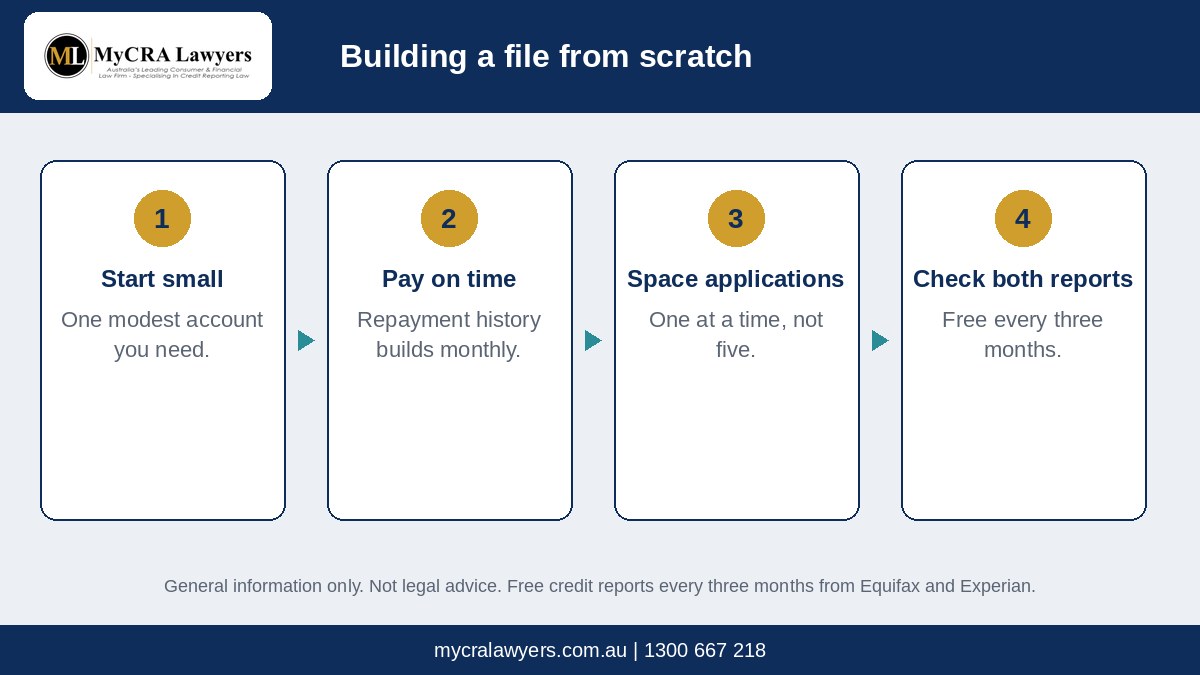
- Pull both free reports from Equifax and Experian. Australians can get one free from each every three months. Check your name, date of birth and address.
- Open one modest account you actually need, with a lender that reports repayment history.
- Set up automatic payments so nothing is ever late.
- Keep your contact details current with every provider, so notices reach you.
- Wait before the next application. Six to twelve months of clean history is worth more than another card.
What if something is already wrong?
If your first look at your file shows a default you didn’t know about, or accounts you never opened, don’t panic and don’t pay anyone who promises a quick fix. Start with a free credit file analysis at app.FixMyBadCredit.com.au and then raise any errors in writing. Our guide to the 30-day rule for credit file corrections explains how long they have to respond. If accounts were opened in your name without your knowledge, a credit ban after identity theft may be the first step. If a lender or bureau won’t fix a genuine error, AFCA (free for consumers) or the OAIC can step in, and if bills are already piling up, the National Debt Helpline (1800 007 007) offers free financial counselling.
How can MyCRA Lawyers help?
If your first look at your credit file has turned up something you don’t recognise, send us both Equifax and Experian PDFs. We will tell you whether it’s an error worth fixing or something that just needs time.
MyCRA Lawyers is a specialist credit repair law firm. Have your Equifax and Experian report PDFs ready and reach us through our contact form, call 1300 667 218 or 07 3124 7133, or book a 15-minute credit repair intro call. Postal: PO Box 169, Aspley QLD 4034. We quote fixed fees in writing after we assess the file, and we will tell you plainly if a listing looks like a wait-out rather than a viable dispute. On consumer defaults accepted after initial assessment, our independently audited success rate is 91.6%. From time to time we run a Money Back Guarantee offer on listings with certain creditors. Which creditors it covers changes, so ask us if one is running. No law firm can promise every listing will come off, and we don’t. For defaults that shouldn’t be there, see our default removal service page.
Not ready to talk yet? Pull both free reports and start with a free credit file analysis at app.FixMyBadCredit.com.au. For the bigger picture of how listings are challenged, read our credit repair lawyers Australia guide.
Frequently asked questions
Does my overseas credit history count in Australia?
Generally not. Equifax and Experian hold information about credit in Australia. Some lenders have their own policies for recent arrivals and may ask for overseas statements.
How long does it take to build a credit history?
There’s no fixed time, but a year or two of on-time repayments on one or two modest accounts with lenders that report repayment history makes a real difference.
Do phone bills build credit history?
Phone and energy accounts can appear on your file and can be listed as defaults if unpaid, but most of these providers don’t report monthly repayment history.
Is it bad to have no credit history?
It isn’t a bad mark, but it gives lenders less to go on. Some may limit the amount, ask for more deposit or decline until you have some history.
How do I check whether I have a credit file?
Request your free credit report from Equifax and from Experian. Australians can get one free from each every three months.
General information only. Not legal advice for your circumstances. Liability limited by a scheme approved under Professional Standards Legislation.


Leave A Comment