
Updated 21 November 2026. By Graham Doessel.
Short answer
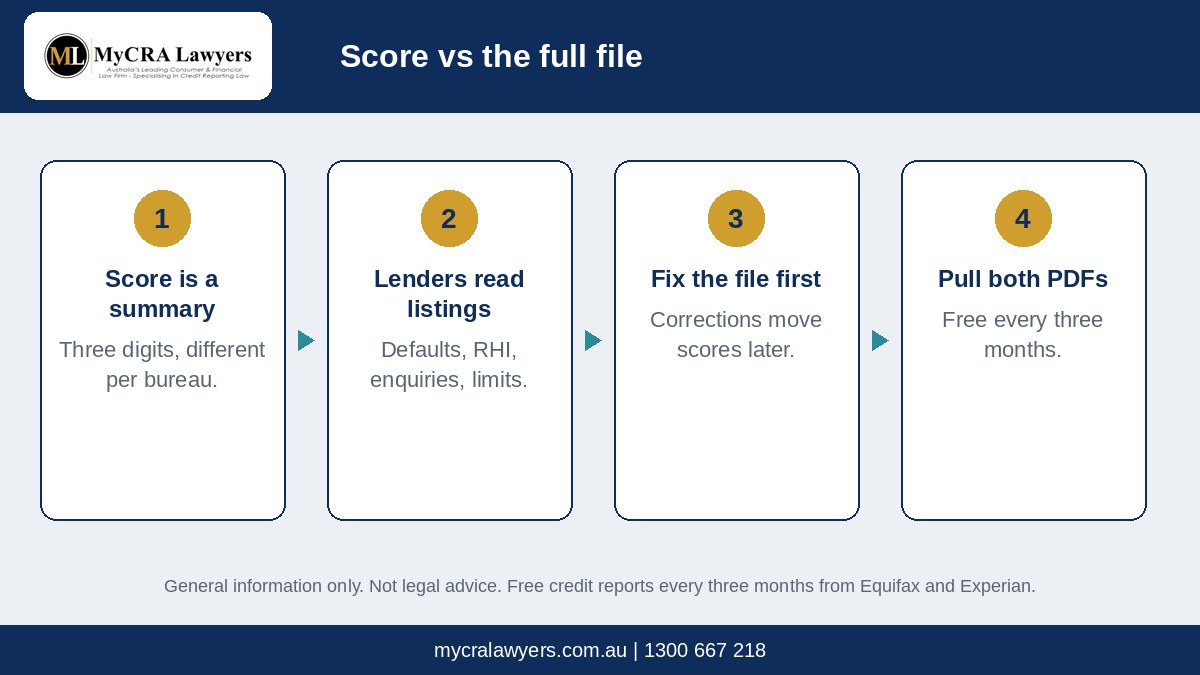
Your credit score is a three-digit summary. Your credit file is the underlying report: accounts, repayment history, enquiries, defaults, judgments and more. Australian lenders and brokers usually read the file (or a bureau extract of it), not your score alone. Equifax and Experian use different models, so scores rarely match. Fixing the file, accurate listings, clean repayment history, fewer fresh enquiries, is what changes lending outcomes. Check both free reports every three months rather than refreshing a score app daily.
Hi, I’m Graham. People ring us proud of a score that jumped twenty points, or devastated because an app went red overnight. Then we open the Equifax and Experian PDFs and find the real story in the listings. The score is a headline. The file is the article.
This guide separates the two, explains what lenders actually assess, and shows where repair work should focus. See also why Equifax and Experian scores differ, score apps vs full reports and what lenders see on your credit file.
What is on an Australian credit file?
Under comprehensive credit reporting, a consumer file can include:
- identity and previous addresses
- consumer credit accounts and limits
- month-by-month repayment history information
- financial hardship flags where an arrangement was agreed
- credit enquiries (information requests)
- defaults and related payment information
- court judgments, bankruptcy and certain other public records
That detail is what a credit officer or broker’s assessor works through. Illion’s consumer bureau has been absorbed into Experian, so the two consumer reports to order are Equifax and Experian. Australians can get a free credit report from each every three months.
What is a credit score?
A score is a bureau’s mathematical summary of selected file data at a moment in time. Each bureau has its own model and scale. A “good” number on one report can sit next to a lower number on the other without either being “wrong”. Score apps may also show educational or Veda-era style ranges that do not match what a particular lender pulls.
Scores are useful as a rough trend. They are a poor substitute for reading the listings.
What do lenders actually read when you apply?
Practices vary, but most serious credit decisions involve some combination of:
- the bureau report or an extract of defaults, enquiries and repayment history
- your application form, income, expenses and living situation
- bank statements and servicing calculators
- the lender’s own policy settings for recent defaults, hardship flags and enquiry bursts
A high score will not save a recent unpaid default that the policy rejects. A modest score can still pass if the file is clean and the serviceability is strong. That is why we keep steering people back to the PDF reports, not the widget.
Why can your score look fine while a loan is declined?
Common file-level reasons include:
- a default that is still within its five-year retention window
- late repayment marks in the last two years
- a cluster of enquiries in a short period
- unused credit limits that hurt serviceability
- mismatched personal details or a mixed file
After a decline, ask for the refusal reasons in writing and pull both reports the same week. Our guides on after a credit refusal and car loan declined walk through that sequence.
Where should credit repair effort go, score or file?
Always the file. Correction work targets inaccurate or improperly listed information: wrong defaults, bad notices, identity mix-ups, enquiry errors. When those items change, scores usually move as a side effect. Products that promise to “boost your score” without fixing the underlying report are the wrong way around, see credit repair myths.
If the listings are accurate and simply ageing out, the job is patience plus clean repayment behaviour, not a miracle score hack.
How should you monitor without obsessing?
- Order both free Equifax and Experian reports every three months and save the PDFs.
- Skim defaults, repayment history and the last 12 months of enquiries first.
- Treat score apps as optional trend tools, not as the source of truth.
- Before a home loan, use a broker and a free credit file analysis at app.FixMyBadCredit.com.au so you fix file issues before the formal application.
- Make one prepared application rather than testing five lenders “just to see”.
Where does free help fit?
If the underlying problem is debt stress rather than a reporting error, the National Debt Helpline (1800 007 007) is the right first call. AFCA and the OAIC are for disputes with firms and some credit reporting privacy issues once you have used internal dispute resolution.
How do score apps confuse the picture?
Score apps are convenient, and many people refresh them the way they check the weather. The risk is mistaking a daily number for a lending decision. Some apps show educational scores, delayed data, or a single bureau only. A lender may pull the other bureau, apply a different scorecard, or ignore the score and read the default table instead.
When an app and a bank seem to disagree, download the official free Equifax and Experian PDFs and compare listings line by line. That usually explains the gap faster than refreshing the app again. If you need a trend line, check the PDFs on a fixed quarterly rhythm rather than daily.
What positive information helps once the negatives are handled?
Under comprehensive credit reporting, months of on-time repayment history are often more persuasive than a short-term score spike. Keep one or two well-managed accounts, pay at least the minimum before the 14-day late window, and avoid opening several new limits at once. Trim unused card limits if serviceability is tight. Those habits rebuild the file the score is trying to summarise.
How can MyCRA Lawyers help?
If your score app and your loan decision tell different stories, send us both Equifax and Experian PDFs. We will read the listings the way a lender does and tell you what actually needs work.
MyCRA Lawyers is a specialist credit repair law firm. Have your Equifax and Experian report PDFs ready and reach us through our contact form, call 1300 667 218 or 07 3124 7133, or book a 15-minute credit repair intro call. Postal: PO Box 169, Aspley QLD 4034. We quote fixed fees in writing after we assess the file, and we will tell you plainly if a listing looks like a wait-out rather than a viable dispute. On consumer defaults accepted after initial assessment, our independently audited success rate is 91.6%. From time to time we run a Money Back Guarantee offer on listings with certain creditors. Which creditors it covers changes, so ask us if one is running. No law firm can promise every listing will come off, and we don’t. Book a 15-minute intro call if you would rather talk it through.
Not ready to talk yet? Pull both free reports and start with a free credit file analysis at app.FixMyBadCredit.com.au. For the bigger picture of how listings are challenged, read our credit repair lawyers Australia guide.
Frequently asked questions
Is a credit score the same as a credit file?
No. The file is the detailed report. The score is a summary number derived from selected data on that file.
Do Equifax and Experian scores match?
Usually not. Each bureau uses its own model and may hold slightly different data.
Can I get a loan with a low score but a clean file?
Sometimes. Lenders read listings, repayment history and serviceability. Policy varies. A broker can advise which lenders suit your file.
Will removing a default raise my score straight away?
The score is recalculated from what remains. Other late marks or enquiries can limit the jump. Confirm the change on both bureau reports.
How often should I check my credit file?
Australians can get a free Equifax report and a free Experian report every three months. That is enough for most people unless you are mid-dispute.
General information only. Not legal advice for your circumstances. Liability limited by a scheme approved under Professional Standards Legislation.





Leave A Comment