

Updated 21 November 2026. By Graham Doessel.
Short answer
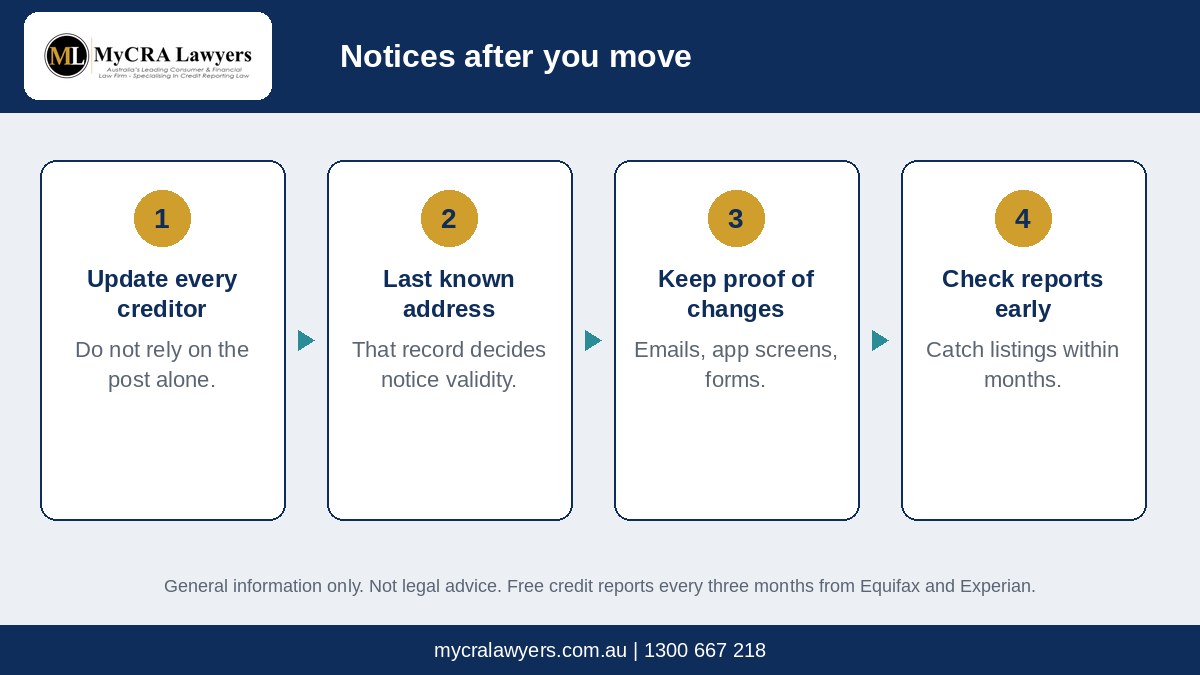
When you move interstate, default and intention-to-list notices still go to your last known address on the creditor’s records at the time they were sent. If you updated your details and they still wrote to the old address, the listing may be open to challenge. If you never told them you moved, notices to the old address often still count. Update every lender, telco and utility when you change states, redirect mail for a period, and pull both free Equifax and Experian reports every three months so a default does not sit unnoticed for years.
Hi, I’m Graham. Interstate moves are one of the quiet ways people end up in Credit Prison. New job, new state, new suburb, and six months later a telco or energy default appears for a bill that followed the old letterbox. The legal question is rarely “did you literally hold the letter in your hand?” It is “what was your last known address when the notices were sent?”
This guide sits next to wrong-address defaults and section 88 default notices. It focuses on the interstate pattern we see often in Queensland, NSW, Victoria and beyond.
What does “last known address” mean?
Under the credit reporting rules summarised by the OAIC, a credit provider is generally taken to have met the notice requirements if it can show the overdue and intention-to-list notices were sent to your last known address at the time of despatch. Email can count when that is how they usually contact you.
Crossing a state border does not create a special exemption. The file does not care that you now live in Brisbane if the creditor still had your Melbourne unit as the current address because nobody updated it.
When is an old-address default worth challenging?
Stronger dispute facts often include:
- you gave the creditor a new address or email before the notices were sent, and they still used the old one
- the creditor’s own portal or app already showed the new details
- mail was returned, or their notes show the address was under review
- identity or mixed-file problems put someone else’s address history on your report
Weaker facts (still worth documenting, but harder to argue) include simply moving and assuming every company would “just know”. The OAIC notes that if notices went to an old address because you failed to update your contact details, the provider is likely to have met the notice requirements.
What should you do before or right after an interstate move?
- List every credit account, telco, utility, BNPL app and insurer and update the address in writing or in-app.
- Turn on email bills where you can, and use an email address you actually read.
- Redirect Australia Post mail for at least a few months.
- Close or final-read utilities at the old property so a final bill does not go unpaid.
- Pull both free credit reports about a month after the move, then again every three months. Equifax and Experian are the two consumer bureaux; illion has been absorbed into Experian.
How do state limitation periods fit in?
How long a creditor can sue for an old debt is a state and territory question. Many jurisdictions use a six-year period for simple contract debts; the Northern Territory is often shorter; New South Wales has its own extinguishment rules. Those periods are not the same as the five-year credit-reporting retention for defaults. Do not assume an interstate move resets either clock. If limitation is part of your dispute, get advice for the relevant jurisdiction, see statute-barred debts and your credit file.
What if the default is already on Equifax or Experian?
- Save both PDFs and note the listing date, creditor and amount.
- Gather proof of when you told the creditor your new address (emails, app screenshots, change-of-details forms).
- Write to the credit provider requesting correction, attaching that proof and asking which address the notices were sent to.
- Ask for copies of the notices and the send record.
- If internal dispute resolution fails, consider AFCA for member firms, or the OAIC for some credit reporting privacy complaints.
Template structure ideas are in our dispute letter guide. For telco and energy patterns specifically, see telco and utility defaults.
Can a default listed after a move still be valid?
Yes. Plenty of interstate-move defaults are listed correctly because the last known address was still the old one. In those cases the practical work is payment status, hardship, or waiting out retention, not a notice challenge. We will say so if that is what the documents show. No listing is worth a false hope.
If cash flow is tight after the move, the National Debt Helpline on 1800 007 007 can help you prioritise bills before another default lands.
Before a loan application in your new state, a free credit file analysis at app.FixMyBadCredit.com.au is a sensible check that nothing followed you quietly onto the file.
Which accounts are most likely to follow you interstate?
In our files, the usual suspects are mobile plans, energy and water at the old rental, BNPL apps tied to an old email, and store cards opened years earlier. Home loans and car loans are updated more carefully because people are still paying them. The quiet accounts are the ones that become defaults.
Before you hand back the keys, ask each utility for a final invoice and a closure confirmation. Photograph the meter if that helps. Keep the moving checklist with your credit-report PDFs so that if a default appears six months later you can show when the account should have ended.
How can MyCRA Lawyers help?
If a default landed after an interstate move and you believe the notices went to an outdated address, send us both bureau reports plus proof of your address update. We will compare the timeline to the last-known-address rules and tell you whether a consumer dispute is realistic.
MyCRA Lawyers is a specialist credit repair law firm. Have your Equifax and Experian report PDFs ready and reach us through our contact form, call 1300 667 218 or 07 3124 7133, or book a 15-minute credit repair intro call. Postal: PO Box 169, Aspley QLD 4034. We quote fixed fees in writing after we assess the file, and we will tell you plainly if a listing looks like a wait-out rather than a viable dispute. On consumer defaults accepted after initial assessment, our independently audited success rate is 91.6%. From time to time we run a Money Back Guarantee offer on listings with certain creditors. Which creditors it covers changes, so ask us if one is running. No law firm can promise every listing will come off, and we don’t. Our default removal page outlines how consumer default assessments work.
Not ready to talk yet? Pull both free reports and start with a free credit file analysis at app.FixMyBadCredit.com.au. For the bigger picture of how listings are challenged, read our credit repair lawyers Australia guide.
Frequently asked questions
Are default notices invalid just because I had moved interstate?
Not automatically. Notices are generally assessed against your last known address on the creditor’s records when they were sent.
What if I updated my address and they still wrote to the old one?
That is stronger dispute material. Keep proof of the update and ask for the notice send records in writing.
Does email count as notice after I move?
It can, if that is how the creditor usually communicates with you. Check the email address they hold for you.
Should I redirect mail when I change states?
Yes, for a period, and update every creditor directly. Redirection is a safety net, not a substitute for changing your details.
Where do I complain if the creditor will not correct an old-address listing?
Use internal dispute resolution first. AFCA is free for eligible consumers if the firm is a member. Some credit reporting privacy issues go to the OAIC.
General information only. Not legal advice for your circumstances. Liability limited by a scheme approved under Professional Standards Legislation.




Leave A Comment