
Updated 23 November 2026. By Graham Doessel.
Short answer
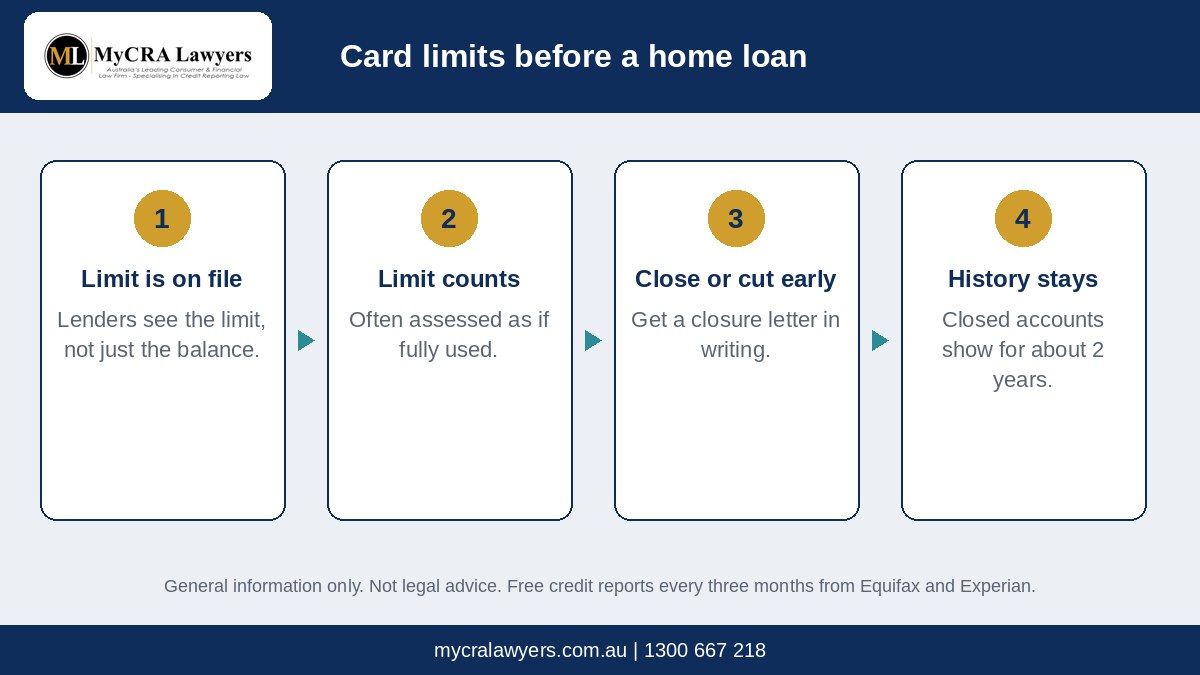
Your credit file records the limit on each credit card, not just what you owe. Many lenders treat that limit as if it could be fully used, so a $20,000 card you never touch can still cut your borrowing power. Closing or reducing unused cards before a home loan often helps the lender’s sums. It won’t wipe your history: a closed account stays on your file for about two years after it ends, and late payments stay for two years from the month they happened. Close cards properly, get it in writing, and check both of your free Equifax and Experian reports (free every three months) to confirm the change has gone through.
Hi, I’m Graham. Picture a credit file with four credit cards on it. Combined limits of $38,000. Combined balance? About $400. The owner thinks that makes them look responsible, and in a way it does. But to a lender’s serviceability calculator, it can look like $38,000 of debt that could be run up tomorrow. We see versions of this all the time.
This guide explains what your credit file says about your cards, why unused limits matter, and how to close cards without creating a new mess.
What does your credit file say about your credit cards?
Each open card usually shows the credit provider, the type of credit, the date the account was opened and, once it ends, the date it closed. Under the credit reporting rules, the “maximum amount of credit available” for a card with a limit is the limit itself. Under comprehensive credit reporting, licensed lenders such as banks and card issuers also report whether you paid on time each month.
That’s why a lender looking at your file sees more than your balance. Our guide on what lenders see on your credit file covers the rest of the picture, and comprehensive credit reporting explains the monthly repayment grid.
Why does an unused limit cut your borrowing power?
When a bank assesses a home loan, it has to work out what you could be paying on all your existing debts. For cards and other revolving credit, APRA’s guidance for banks gives an example of assessing repayments at 3% of the total limit each month, whatever the current balance. On that example, a $20,000 limit counts as about $600 a month, even at a zero balance.
Not every lender uses the same figure, and non-bank lenders set their own policies. The direction is the same, though. More unused limit generally means less you can borrow.
Does closing a card hurt your credit score?
Honest answer: it depends, and the bureaus don’t publish their scoring models. Closing a card can move your score a little either way. But for a home loan, the lender’s own assessment of your income, expenses, limits and listings usually matters far more than a few points of score. Our guide on credit score vs credit file explains why.
What closing a card won’t do is erase history. The account shows as closed and the account information generally stays for two years after the credit ends. Repayment history stays for two years from each month reported. If the card had late payments, closing it doesn’t remove them. See repayment history information on your credit file.
When does closing or reducing a limit make sense?
- Cards you never use, especially store cards and old rewards cards.
- Limits far above what you need. Reducing a $15,000 limit to $3,000 keeps the card but shrinks the number the lender plugs in.
- Buy now pay later accounts you no longer use. Since June 2025 these are generally regulated credit and can show on your file. Read BNPL and your credit file.
- Before you apply, not during. Ask your broker first. Changing accounts midway through an assessment can confuse things.
Keep at least one card if you need it for travel, emergencies or bills. The goal is a sensible limit, not zero credit. If you can’t clear the balances and the cards are what you’re juggling, talk to the National Debt Helpline (1800 007 007) before you apply for anything new. It’s free.
How do you close a card properly?
- Pay the balance to zero, including any pending transactions and annual fees.
- Cancel in writing or through the bank’s app, and cancel any direct debits that bill the card.
- Ask for a closure letter confirming the account is closed with a nil balance. Brokers often ask for one.
- Wait for the next statement cycle and make sure no late fee or interest has been charged after closure.
- Pull both free reports a month or two later and confirm each account shows as closed.
Leftover fees on a “closed” card are a classic way people end up with a late payment, or even a default, on an account they thought was finished.
What if your file still shows a card as open?
Ask the card provider to update it, in writing, and attach the closure letter. If it still isn’t fixed, ask Equifax or Experian to correct it. Our guide to the 30-day rule for credit file corrections explains the timeframes, and if the provider still won’t fix it, AFCA is free for consumers. If the file has heavier problems than limits, check it with your broker before you apply. Our checklist on preparing your credit file before a home loan is a good place to start, and a free credit file analysis at app.FixMyBadCredit.com.au will flag anything that needs attention.
How can MyCRA Lawyers help?
If your file shows cards you closed years ago, limits that don’t match, or late payments on an account you think was paid out, send us both Equifax and Experian PDFs. We will tell you what’s worth correcting before your broker lodges the application.
MyCRA Lawyers is a specialist credit repair law firm. Have your Equifax and Experian report PDFs ready and reach us through our contact form, call 1300 667 218 or 07 3124 7133, or book a 15-minute credit repair intro call. Postal: PO Box 169, Aspley QLD 4034. We quote fixed fees in writing after we assess the file, and we will tell you plainly if a listing looks like a wait-out rather than a viable dispute. On consumer defaults accepted after initial assessment, our independently audited success rate is 91.6%. From time to time we run a Money Back Guarantee offer on listings with certain creditors. Which creditors it covers changes, so ask us if one is running. No law firm can promise every listing will come off, and we don’t. For late-payment issues, see our repayment history information service page.
Not ready to talk yet? Pull both free reports and start with a free credit file analysis at app.FixMyBadCredit.com.au. For the bigger picture of how listings are challenged, read our credit repair lawyers Australia guide.
Frequently asked questions
Do credit card limits show on my credit file?
Yes. The credit limit is recorded as part of the account information for each card, along with the provider, the type of credit and the dates the account opened and closed.
Does an unused credit card affect my home loan?
Often, yes. Many lenders assess a notional repayment based on the full limit, so an unused card can reduce how much you can borrow.
Will closing a credit card remove late payments?
No. Repayment history generally stays for two years from each month reported, and the closed account information stays for about two years after the account ends.
Is it better to close a card or lower the limit?
It depends on what you need. Lowering the limit keeps a card for emergencies while reducing what the lender counts. Talk to your broker before you apply.
How do I prove a card is closed?
Ask the provider for a written closure letter showing a nil balance, then check your free Equifax and Experian reports to confirm the account shows as closed.
General information only. Not legal advice for your circumstances. Liability limited by a scheme approved under Professional Standards Legislation.


Leave A Comment