

Updated 22 November 2026. By Graham Doessel.
Short answer
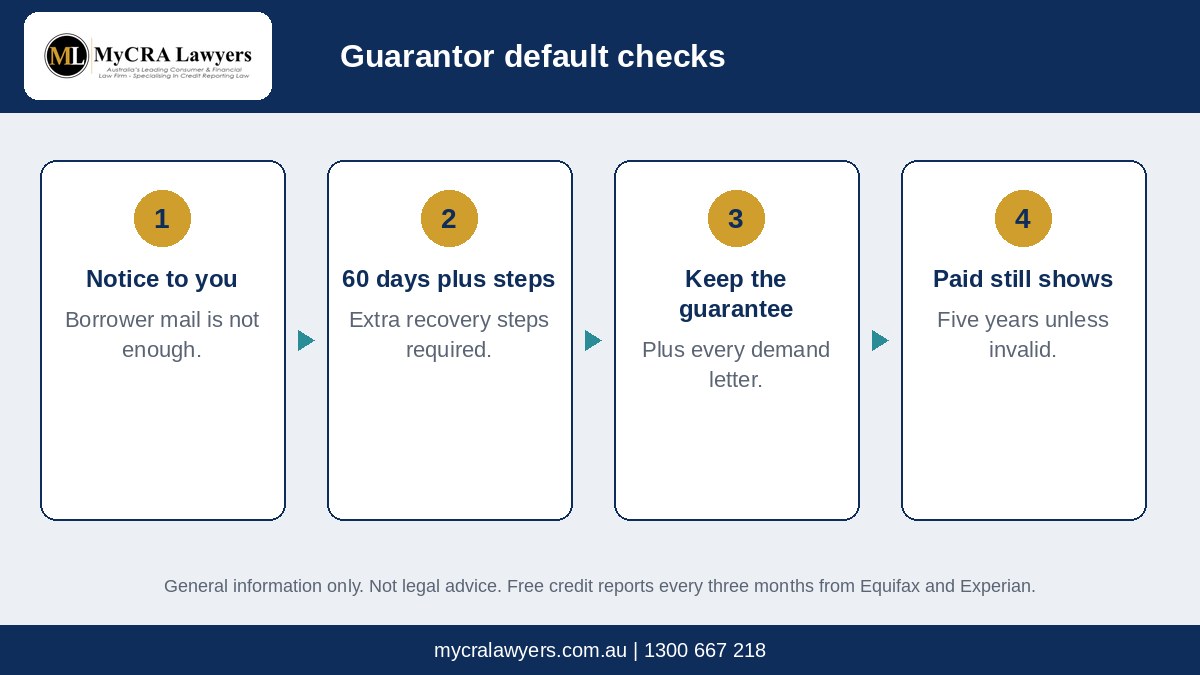
If you guaranteed someone else’s consumer credit, the borrower’s missed payments do not automatically become your default. Guarantor default information has its own Privacy Act tests: written notice of the borrower’s default that created your obligation, a request that you pay, at least 60 days since that notice, other recovery steps against you, and recovery not being statute-barred. A guarantor listing can still sit for five years and affect your own borrowing. Pull both free Equifax and Experian reports every three months and keep every guarantee document.
Hi, I’m Graham. Guarantor files are some of the hardest conversations we have. A parent, partner or sibling tried to help. The borrower fell behind. Then a default appears under the guarantor’s name and suddenly the helper cannot refinance their own home. The emotional story and the legal tests are not the same thing.
This guide explains when a guarantor default can be listed, what to check, and where repair work focuses. For the home-loan family angle, see parents as guarantors on home loans.
How is a guarantor default different from a borrower default?
Section 6Q of the Privacy Act sets separate rules for guarantor default information. In summary, listing generally requires that:
- you were given written notice of the borrower’s default that gave rise to your obligation to pay
- the notice requested that you pay the overdue amount
- at least 60 days have passed since that notice
- the provider took other steps to recover the amount from you, beyond just sending that notice
- recovery is not prevented by a statute of limitations
Those steps are about your guarantor obligation. A notice trail aimed only at the borrower is not automatically enough.
What else can appear on a guarantor’s credit file?
- Enquiries when the lender assessed you as guarantor
- The guaranteed facility showing in liability information in some reporting setups
- Your own accounts’ repayment history and any separate defaults
- Judgments if the lender sued on the guarantee
Check Equifax and Experian separately. Australians can get a free report from each every three months. Illion’s consumer bureau has been absorbed into Experian.
What should you do as soon as the borrower falls behind?
- Ask the lender, in writing, whether it has issued any default or demand notices to you as guarantor.
- Request copies of the guarantee, the borrower’s arrears position and any notices already sent.
- Update your own address and email with the lender so future notices reach you.
- Get advice quickly if you are being asked to pay, National Debt Helpline 1800 007 007 for budget help, and legal advice for the guarantee itself.
- Do not ignore mail. Guarantor timelines often run from notice dates.
When is a guarantor listing open to challenge?
Common angles include:
- no written notice to you as guarantor before listing
- fewer than 60 days between the guarantor notice and the listing
- no other recovery steps against you beyond a single letter
- notices sent to an address that was not your last known address
- wrong person, wrong guarantee, or mixed-file identity errors
- recovery already statute-barred in the relevant jurisdiction (get advice, rules differ)
AFCA can hear many disputes about member lenders and collectors. Internal dispute resolution comes first. Some credit reporting privacy issues go to the OAIC. Related reading: AFCA complaint timelines and proving the debt before a default listing.
Does paying the borrower’s debt clear your file?
If a guarantor default was listed and you later pay, the listing should be updated to paid. It generally still remains for the five-year retention period. Paying can stop further recovery, but it is not the same as removal. See paid defaults that still show.
Sometimes a commercial settlement with the lender includes a credit-reporting term. Get any such term in writing before you pay. Do not rely on a verbal “we’ll take it off”.
How does this affect your own home loan or refinance?
Brokers will see a guarantor default like any other default on your consumer file. Recent unpaid guarantor listings are especially hard for many lender policies. Even a paid one can matter inside the five-year window. If you are about to apply, pull both reports first and consider a free credit file analysis at app.FixMyBadCredit.com.au before the broker runs a formal enquiry.
If the underlying problem is the borrower’s hardship, pushing them toward a proper hardship request with their lender can be better than you silently covering instalments until your own file breaks.
Should you keep paying the borrower’s loan to protect your own file?
Sometimes a short bridge payment is rational. Often it just delays a clearer conversation with the lender about hardship, variation or enforcement. If you pay informally without documenting why, you can still face a guarantor default later if the account tips over again.
Ask the lender to confirm, in writing, how your payments will be applied and whether any default listing against you is proposed. If the borrower is in genuine hardship, push for a formal hardship process on the underlying loan rather than silent top-ups that hide the problem. Free financial counselling through the National Debt Helpline can help both households map a plan.
What if both names are on the loan rather than a guarantee?
Joint borrowers are not guarantors. If you signed as a co-borrower, the account is yours in the ordinary way and the standard consumer default rules apply. Do not assume “I only helped” if the contract names you as a borrower. Read the document before you pick a dispute pathway.
How can MyCRA Lawyers help?
If a borrower’s loan has followed you onto your Equifax or Experian file as a guarantor default, send us both reports, the guarantee and every notice you received. We will test the listing against the guarantor default rules and tell you whether a consumer dispute is open.
MyCRA Lawyers is a specialist credit repair law firm. Have your Equifax and Experian report PDFs ready and reach us through our contact form, call 1300 667 218 or 07 3124 7133, or book a 15-minute credit repair intro call. Postal: PO Box 169, Aspley QLD 4034. We quote fixed fees in writing after we assess the file, and we will tell you plainly if a listing looks like a wait-out rather than a viable dispute. On consumer defaults accepted after initial assessment, our independently audited success rate is 91.6%. From time to time we run a Money Back Guarantee offer on listings with certain creditors. Which creditors it covers changes, so ask us if one is running. No law firm can promise every listing will come off, and we don’t. Judgments on guarantees are assessed separately, see judgment removal if a court order is already on the file.
Not ready to talk yet? Pull both free reports and start with a free credit file analysis at app.FixMyBadCredit.com.au. For the bigger picture of how listings are challenged, read our credit repair lawyers Australia guide.
Frequently asked questions
Can a lender list a default on me just because the borrower missed payments?
Not automatically. Guarantor default information has extra Privacy Act requirements, including written notice to you and other recovery steps against you.
How long does a guarantor default stay on my credit file?
Default information is generally retained for five years from when the credit reporting body collected it, whether you are the borrower or the guarantor.
What documents should I keep if I signed a guarantee?
The guarantee, any variations, every notice sent to you, payment receipts and any settlement letters. They decide most disputes.
Can AFCA help with a guarantor listing?
Often yes if the firm is an AFCA member and the complaint is about the firm’s conduct. Use internal dispute resolution first.
Will paying the debt remove the guarantor default?
Paying should update the listing to paid. It does not usually erase the five-year retention period unless the listing was invalid or a written correction agreement says otherwise.
General information only. Not legal advice for your circumstances. Liability limited by a scheme approved under Professional Standards Legislation.



Leave A Comment