
Updated 23 November 2026. By Graham Doessel.
Short answer
When you ask a credit provider or a credit reporting body (Equifax or Experian) to fix something on your credit file, the Privacy Act generally gives them 30 days from the day you ask to deal with it. They can only take longer if you agree in writing. The request is free, it does not matter whether you go to the lender or the bureau first, and if they say no they have to tell you why in writing and point you to AFCA or the OAIC. Once it is fixed, pull a fresh copy of your report to check. Australians can get a free credit report from each bureau every three months, and you can also get one free after a correction decision.
Hi, I’m Graham. People ring us all the time saying “I disputed it months ago and nothing happened.” Sometimes they really did lodge a proper request and it went into a black hole. More often they rang a call centre, got told someone would look into it, and there’s no record anywhere. The 30-day rule only helps you if the clock actually started.
This guide explains how the correction timeframe works, what each side has to do inside it, and what you can do when they drag their feet.
What is the 30-day rule for credit file corrections?
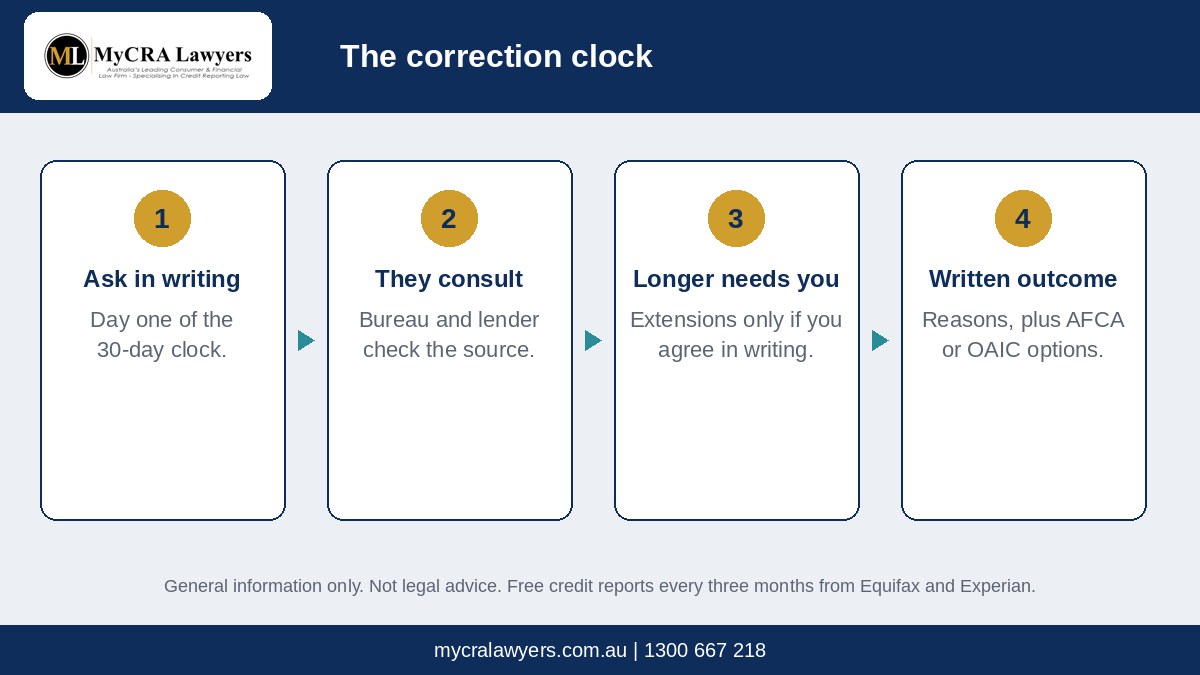
Under the Privacy Act’s credit reporting rules, if you ask a credit provider or a credit reporting body to correct information about you, they must take reasonable steps to correct it within 30 days of your request if they are satisfied it is wrong. The OAIC’s consumer guidance says the same thing: 30 days, or a longer period that you agree to.
The test is whether the information is inaccurate, out of date, incomplete, irrelevant or misleading. That covers more than typos. A listing that should never have been made can fail that test even if the debt itself was real. Our earlier guide on what creditors must do to correct credit file mistakes goes into the lender’s side of this.
Should you ask the lender or the credit bureau?
Either. The OAIC calls it a “no wrong door” approach. If you go to Equifax or Experian about a default, they have to consult the credit provider that listed it. If you go to the lender, it may need to talk to the bureaus. You do not have to do the running around between them.
In practice the lender usually holds the documents that decide the dispute, so starting there is often quicker. If the same listing sits on both bureaus, say so in your request so both get fixed. The differences between the Equifax and Experian dispute processes are worth knowing before you start.
What has to happen inside the 30 days?
The Credit Reporting Code (the CR Code) fills in the detail. In summary:
- If the organisation you asked needs to consult someone else, it should send that request within five business days.
- The organisation being consulted should reply at least five business days before your 30 days run out.
- Once they decide a correction should happen, it should be made within five business days.
- You should be told the decision within five business days of it being made. If they corrected it, the notice should include the corrected information so you can check it, and explain that you can get a free copy of your report.
- Making the request, and having the correction made, must not cost you anything.
One request can also cover several items. If a fraud left a string of enquiries for credit that was never approved, the CR Code lets you deal with them in one go, and the lender or bureau has to think about how hard it is for you to produce evidence before asking for more.
Can they take longer than 30 days?
Only if you agree in writing. If they think they can’t finish in time, they should tell you as soon as practicable, explain why, give you a realistic timeframe, ask for your agreement and tell you about your right to complain to AFCA (or to the OAIC if they are not an AFCA member).
You do not have to agree. Sometimes an extension is sensible because they are waiting on old records that might help you. Sometimes it is just a delay tactic. If you say no, they still have to respond within the timeframe they asked for.
What should a good correction request include?
- Put it in writing, by email or the bureau’s online form, so the 30-day clock has a clear start date.
- Name the exact item: the creditor, the amount, the date listed and which bureau shows it.
- Say why it’s wrong in a sentence or two. You don’t need legal language.
- Ask for the documents they relied on, such as the notices they say they sent.
- Keep copies and note the date you sent it.
If you want a starting point, our credit default dispute letter guide has a plain-English structure. Before you write anything, get both free reports and run a free credit file analysis at app.FixMyBadCredit.com.au so you know which items are worth the fight.
What if they say no, or the 30 days pass with no answer?
If they refuse, they must give you written reasons and tell you about external dispute resolution. That is your cue to escalate. Most credit providers and both bureaus are AFCA members, and AFCA is free for consumers. Some privacy issues sit better with the OAIC. Our guide to AFCA vs OAIC for credit reporting disputes explains which one usually fits.
A formal complaint is a separate process from a correction request. For credit reporting complaints, the organisation should acknowledge your complaint within seven days and give you a decision within 30 days unless you agree to longer. Silence past those dates is worth noting in any AFCA or OAIC complaint.
If the listing is tied to money stress, the National Debt Helpline (1800 007 007) offers free financial counselling while you sort it out.
How can MyCRA Lawyers help?
If you lodged a correction request and it stalled, or the answer doesn’t add up, send us both Equifax and Experian PDFs plus whatever you sent and received. A team member will read the file and tell you whether the listing is worth challenging further.
MyCRA Lawyers is a specialist credit repair law firm. Have your Equifax and Experian report PDFs ready and reach us through our contact form, call 1300 667 218 or 07 3124 7133, or book a 15-minute credit repair intro call. Postal: PO Box 169, Aspley QLD 4034. We quote fixed fees in writing after we assess the file, and we will tell you plainly if a listing looks like a wait-out rather than a viable dispute. On consumer defaults accepted after initial assessment, our independently audited success rate is 91.6%. From time to time we run a Money Back Guarantee offer on listings with certain creditors. Which creditors it covers changes, so ask us if one is running. No law firm can promise every listing will come off, and we don’t. For defaults in particular, see our default removal service page.
Not ready to talk yet? Pull both free reports and start with a free credit file analysis at app.FixMyBadCredit.com.au. For the bigger picture of how listings are challenged, read our credit repair lawyers Australia guide.
Frequently asked questions
How long does a credit bureau have to correct my credit file?
Generally 30 days from the day you made the correction request, or a longer period you agree to in writing. The same timeframe applies to credit providers.
Does it cost anything to ask for a correction?
No. Correction requests, and corrections made as a result, must be free.
Do I have to agree to an extension?
No. They must explain the delay and ask for your agreement. If you refuse, they still need to respond within the timeframe they asked for.
Should I dispute with Equifax and Experian separately?
You can ask either bureau or the lender, and they must consult each other. Mention every bureau that shows the item so all copies are corrected, then pull fresh reports to check.
What if the correction is refused?
You should get written reasons and details of external dispute resolution. You can then complain to AFCA, or to the OAIC if the organisation is not an AFCA member.
General information only. Not legal advice for your circumstances. Liability limited by a scheme approved under Professional Standards Legislation.



Leave A Comment