
Updated 17 November 2026. By Graham Doessel.
Short answer
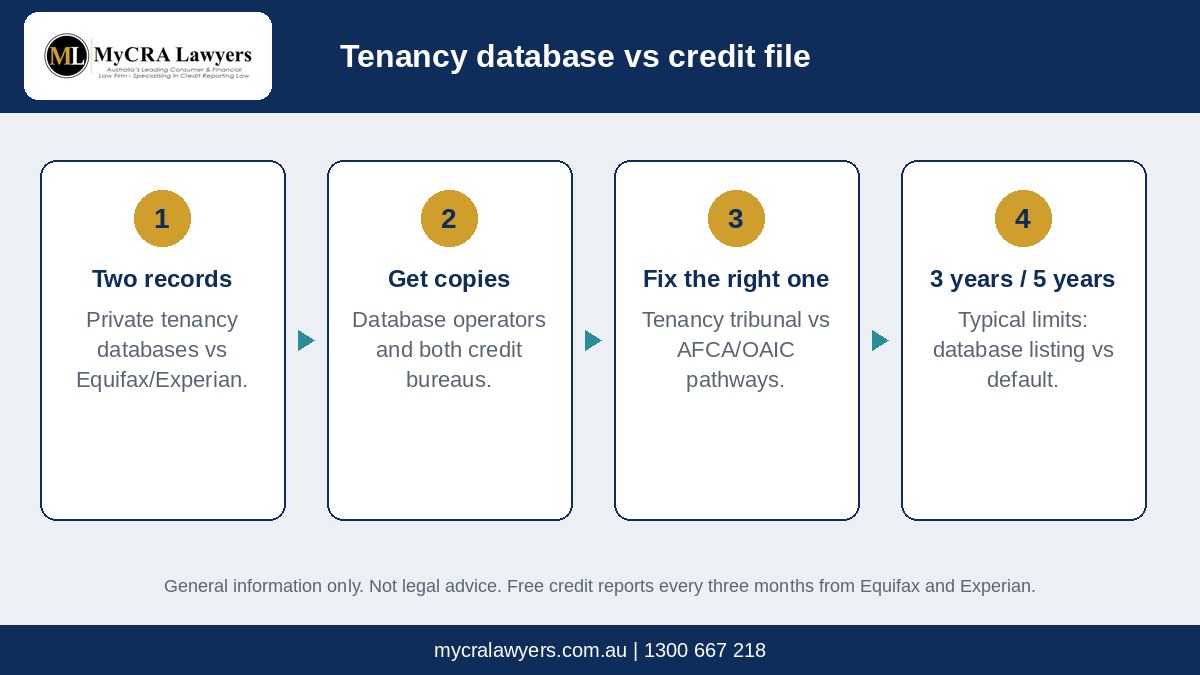
A tenancy database and a credit file are two separate records. Tenancy databases such as TICA, the National Tenancy Database and Trading Reference Australia are run by private companies and regulated by state and territory tenancy laws. Listings must generally be removed after three years, and you can ask the operator for a copy and dispute anything inaccurate or unjust, all the way to your state tribunal. Your credit file is held by Equifax and Experian under the Privacy Act, and you can get a free copy from each every three months. Real estate agents generally aren’t credit providers, so they usually can’t pull your consumer credit report the way a lender can. But a rental debt that turns into a court judgment can appear on your credit file. Work out which record is causing the problem, then fix that one.
Hi, I’m Graham. We get calls from people who have been knocked back for rental after rental and are sure their credit file is the reason. Sometimes it is. More often the problem is a tenancy database listing from an old lease, which is a different record with a different fix. Paying someone to “repair” your credit file won’t touch a tenancy database listing, so it pays to know which one you’re dealing with.
What is a tenancy database?
A tenancy database is a register of rental history that agents and landlords use to screen applicants. Sometimes they are called “bad tenant” lists. Examples include TICA, the National Tenancy Database and Trading Reference Australia. They are private businesses and access is generally limited to members who pay. Government tenancy bodies, such as the RTA in Queensland or NSW Fair Trading, don’t run them, but state and territory tenancy laws set rules for how they are used.
How is a tenancy database different from your credit file?
- Who holds it: a tenancy database is held by a private database operator. Your credit file is held by credit reporting bodies, mainly Equifax and Experian.
- What law applies: tenancy databases are governed by state and territory residential tenancy laws. Credit files are governed by Part IIIA of the Privacy Act and the Credit Reporting Code.
- What it records: a tenancy database records your history as a tenant, such as rent arrears or breaches that led to a listing. A credit file records credit applications, accounts, repayment history, defaults, judgments and insolvency.
- How long listings last: tenancy database listings generally last up to three years. On a credit file, most defaults and judgments last five years and repayment history lasts two.
- Who can look: tenancy databases are used by member agents and landlords. Credit files are mainly accessed by credit providers and certain other permitted parties.
- Where to dispute: tenancy database disputes go to the agent or landlord, then the operator, then your state tribunal. Credit file disputes go to the credit provider and the bureau, then AFCA or the OAIC.
illion’s consumer bureau has been absorbed into Experian, so Equifax and Experian are the two consumer credit reports to check.
Can a real estate agent check your credit file?
Australian credit reporting law limits who can get your consumer credit report, mostly to credit providers and some other permitted parties. Real estate agents and landlords generally aren’t credit providers, so they usually can’t pull your consumer credit report the way a bank can. Some tenant-screening apps ask for consent to run identity or other checks. Read what you’re agreeing to before you tick the box.
Your credit file can still matter in renting. A court or tribunal money order that is enforced as a judgment can appear as public record information. And if you are refinancing or buying instead of renting, your credit file becomes the main event.
When can you be listed on a tenancy database?
The rules vary by state and territory. In Queensland, for example, the RTA says a tenant can only be listed if all of the following apply:
- they are named on the tenancy agreement
- the agreement has ended
- there is a valid reason for the listing
- reasonable steps were taken to tell them about the proposed listing, within the set timeframes
Other states have similar but not identical rules. A listing made while you were still in the tenancy, or without warning, may not meet the requirements.
How long does a tenancy database listing last?
In NSW and Queensland, listings must be removed after three years. Most other states and territories have a similar limit. A listing must also be changed or removed if the agent, landlord or operator becomes aware it is inaccurate, incomplete, ambiguous or out of date. That includes when a debt behind the listing has been paid, depending on your state’s rules.
How do you check and challenge a tenancy database listing?
- Find out who holds a listing. Contact each major operator. In NSW, operators must give you a free copy of your listing within 14 days of a written request. In Queensland, you can be charged a reasonable fee.
- Raise it with the agent or landlord who made the listing, in writing, explaining why it is wrong or unjust.
- Go to the tribunal if that doesn’t work, such as NCAT in NSW or QCAT in Queensland. Time limits can apply. In Queensland, for example, the RTA says you must dispute within six months of becoming aware of the listing.
- Get free help from your state’s tenant advice service, such as Tenants Queensland or the Tenants’ Union of NSW.
MyCRA Lawyers works on credit files, not tenancy database disputes. If a database listing is your only issue, a tenancy advice service is the right first call.
What if the rental debt ended up on your credit file?
Sometimes an old rent or damage claim follows you onto the credit file:
- Court judgment: if a money order or judgment was entered and is recorded as public record information, it can appear for five years. See our judgment removal options.
- Default listed by a collector: ask exactly what credit the listing relates to. Default listings must meet the consumer credit rules, including the notice and $150 requirements, and not every debt qualifies.
Check both reports and compare the creditor names with your old lease paperwork.
How do you fix both before your next application?
- Get your tenancy database copies and both free credit reports in the same week.
- Fix the record that’s actually causing the problem.
- Keep written references from recent landlords, plus proof that any old debts are paid.
- Be upfront with agents about any past issue and show it has been resolved.
How can MyCRA Lawyers help?
If your rental troubles trace back to a default or judgment on your credit file, send us both bureau reports and your old lease paperwork. We will tell you whether the credit listing can be challenged.
MyCRA Lawyers is a specialist credit repair law firm. Have your Equifax and Experian report PDFs ready and reach us through our contact form, call 1300 667 218 or 07 3124 7133, or book a 15-minute credit repair intro call. Postal: PO Box 169, Aspley QLD 4034. We quote fixed fees in writing after we assess the file, and we will tell you plainly if a listing looks like a wait-out rather than a viable dispute. On consumer defaults accepted after initial assessment, our independently audited success rate is 91.6%. From time to time we run a Money Back Guarantee offer on listings with certain creditors. Which creditors it covers changes, so ask us if one is running. No law firm can promise every listing will come off, and we don’t.
Not ready to talk yet? Pull both free reports and start with a free credit file analysis at app.FixMyBadCredit.com.au. For the bigger picture of how listings are challenged, read our credit repair lawyers Australia guide.
Frequently asked questions
Is a tenancy database the same as a credit report?
No. Tenancy databases are run by private companies and record rental history under state and territory tenancy laws. Credit reports are held by Equifax and Experian under the Privacy Act.
How long does a tenancy database listing last?
In NSW and Queensland, listings must be removed after three years, and most other states and territories have a similar limit. Inaccurate or out-of-date listings must be changed or removed sooner.
Can a real estate agent see my credit file?
Generally not, because agents and landlords usually aren’t credit providers under credit reporting law. Some screening services ask for consent to run other checks, so read the terms.
Can unpaid rent appear on my credit file?
It can if it becomes a court judgment recorded as public record information. If a collector lists a default, check that the listing meets the consumer credit rules.
Can MyCRA Lawyers remove a tenancy database listing?
Our work is on credit files. For tenancy database disputes, contact the database operator and your state tenant advice service or tribunal.
General information only. Not legal advice for your circumstances. Liability limited by a scheme approved under Professional Standards Legislation.





Leave A Comment