
Updated 18 November 2026. By Graham Doessel.
Short answer
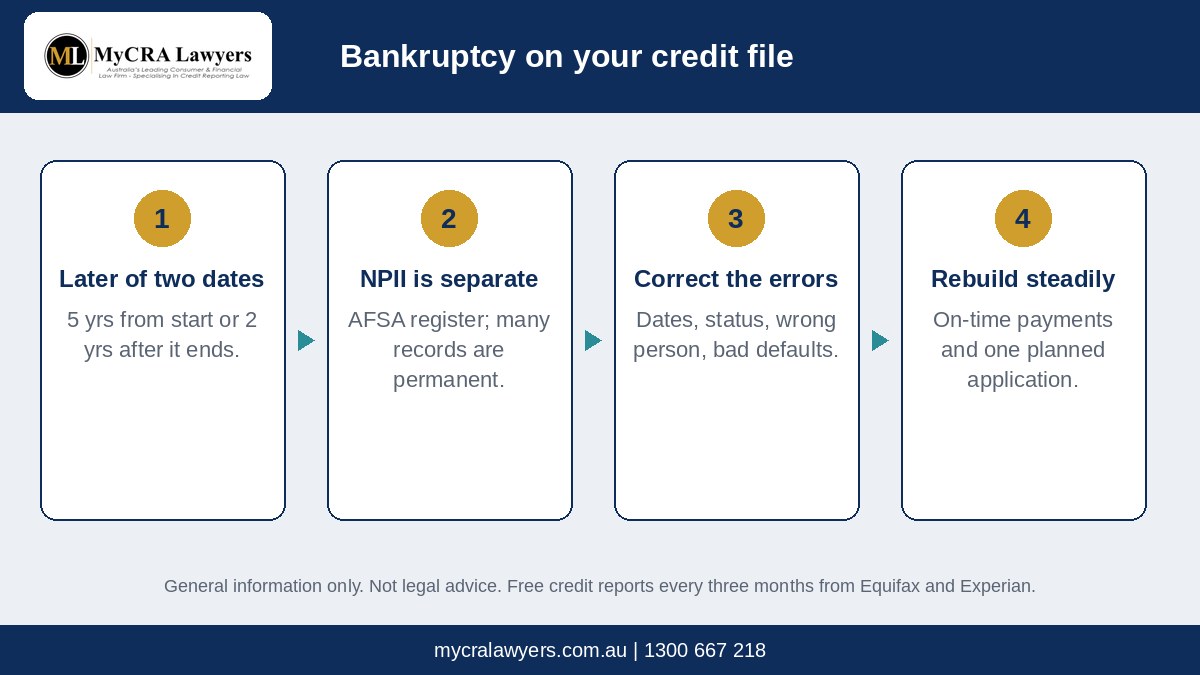
In Australia, bankruptcy stays on your credit report for whichever ends later: five years from the day you became bankrupt, or two years from the day the bankruptcy ends. Separately, your name stays on the National Personal Insolvency Index (NPII), a public register run by AFSA, and many of those records are permanent. An accurate bankruptcy listing can’t lawfully be removed early, so be wary of anyone who says otherwise. Errors can be fixed, though: wrong dates, a status not updated after discharge, information about the wrong person, or defaults that don’t meet the listing rules. Defaults listed before the bankruptcy keep their own five-year clocks. Check your free Equifax and Experian reports every three months while you rebuild.
Hi, I’m Graham. Bankruptcy is a legal reset, not a moral failure. Plenty of people we speak with went bankrupt after a business collapse, a relationship breakdown or a health crisis. What surprises them is how the credit file behaves afterwards: the bankruptcy can still be there after discharge, and some old defaults sit alongside it. Here is what is normal, what isn’t, and what you can actually fix.
How long does bankruptcy stay on your credit file?
Section 20X of the Privacy Act sets the retention period for personal insolvency information. For a bankruptcy, it is whichever of these ends later:
- five years from the day you became bankrupt, or
- two years from the day the bankruptcy ends.
A standard bankruptcy usually lasts three years and one day. So for most people, the five-year mark is the later date, and the listing drops off about five years after the bankruptcy started. If the bankruptcy was extended, for example because of an objection to discharge, the two-years-after-it-ends rule can push the listing out further.
Example: Sam became bankrupt in March 2024 and was discharged in March 2027. Five years from the start is March 2029. Two years after discharge is also around March 2029. The listing should drop off around then. If Sam’s bankruptcy had been extended to eight years, the listing would stay until two years after that later discharge.
Is the National Personal Insolvency Index the same as your credit file?
No. The NPII is a public register run by the Australian Financial Security Authority (AFSA). AFSA says many records stay on the NPII permanently, even after discharge. Your credit file is held by Equifax and Experian and follows the Privacy Act retention periods above. Lenders may search both. Once the credit file retention period ends, the bankruptcy should come off your credit report, but the NPII record stays.
What happens to defaults listed before or during bankruptcy?
Each default keeps its own retention period of five years from listing. A default listed a year before the bankruptcy will usually drop off before the bankruptcy listing does. Look out for these:
- Defaults listed after the bankruptcy date for debts that were provable in the bankruptcy. These deserve a close look. Creditors’ recovery rights change once you are bankrupt, and the listing still has to meet every default condition.
- Status lines that don’t reflect the bankruptcy, where that affects accuracy.
- Duplicate listings where a debt was sold to a collector and appears twice.
For how defaults age, see how long a default stays on your credit file.
What can be corrected on a credit file after bankruptcy?
- A wrong bankruptcy start date or discharge date
- A bankruptcy still showing as current after you were discharged
- A bankruptcy, or defaults, that belong to someone else with a similar name
- Insolvency information kept past its retention period
- Defaults that didn’t meet the listing rules, such as missing notices, an amount under $150 or a statute-barred debt
- Identity details such as addresses and dates of birth that are wrong
Ask the bureau for a correction in writing, and include AFSA documents where relevant, such as your discharge confirmation. For defaults, start with the credit provider that listed them. AFCA and the OAIC are free escalation options if the first response doesn’t fix it.
Can a credit repair firm remove an accurate bankruptcy?
No. If the bankruptcy is correctly recorded, it stays for the legal retention period. Anyone who promises to wipe an accurate bankruptcy is either misunderstanding the law or overselling. Read our guide on choosing a credit repair provider safely before you pay anyone.
A good assessment will separate what has to be waited out from what may genuinely be wrong.
How is bankruptcy different from a debt agreement?
- Bankruptcy: on your credit file for the later of five years from the start or two years after it ends, and permanently on the NPII.
- Part IX debt agreement: also personal insolvency information, but with its own retention rules. See Part IX debt agreements and your credit file.
- Informal arrangement or hardship plan with a lender: not insolvency. It may appear as financial hardship information for one year, or as repayment history.
If you are considering any of these, the National Debt Helpline (1800 007 007) offers free financial counselling, and AFSA explains the formal options on its website.
How do you rebuild after discharge?
- Confirm the file is accurate on both Equifax and Experian. Use your free three-monthly reports and diary the date the bankruptcy should drop off.
- Build positive repayment history. A modest, well-managed account paid on time shows up in repayment history.
- Avoid credit-seeking bursts. One planned application is better than several speculative ones.
- Be upfront with lenders and brokers. Many lenders have specific policies for discharged bankrupts, and surprises tend to lead to declines.
- Know your disclosure duty. While you are still bankrupt, you must tell credit providers about your bankruptcy when you seek credit above a set threshold. AFSA publishes the current amount.
Once both PDFs are in hand, a free credit file analysis at app.FixMyBadCredit.com.au gives you a structured view of what is left on the file and when each item is due to drop off.
How can MyCRA Lawyers help?
If your file still looks wrong after bankruptcy, with dates, status or defaults that don’t add up, send us both bureau reports and your AFSA paperwork. We will tell you what is correctable and what simply has to run its course.
MyCRA Lawyers is a specialist credit repair law firm. Have your Equifax and Experian report PDFs ready and reach us through our contact form, call 1300 667 218 or 07 3124 7133, or book a 15-minute credit repair intro call. Postal: PO Box 169, Aspley QLD 4034. We quote fixed fees in writing after we assess the file, and we will tell you plainly if a listing looks like a wait-out rather than a viable dispute. On consumer defaults accepted after initial assessment, our independently audited success rate is 91.6%. From time to time we run a Money Back Guarantee offer on listings with certain creditors. Which creditors it covers changes, so ask us if one is running. No law firm can promise every listing will come off, and we don’t.
Not ready to talk yet? Pull both free reports and start with a free credit file analysis at app.FixMyBadCredit.com.au. For the bigger picture of how listings are challenged, read our credit repair lawyers Australia guide.
Frequently asked questions
How long does bankruptcy stay on my credit file in Australia?
For whichever ends later: five years from the day you became bankrupt, or two years from the day the bankruptcy ends. For a standard three-year bankruptcy, that is usually about five years from the start.
Does bankruptcy come off the National Personal Insolvency Index?
AFSA says many NPII records stay permanently, even after discharge. The NPII is separate from your Equifax and Experian credit reports.
Can I remove a bankruptcy from my credit file early?
Not if it is accurately recorded. Errors such as wrong dates, a wrong person or information kept past its retention period can be corrected.
Do my old defaults disappear when I go bankrupt?
No. Each default keeps its own five-year retention period from listing. Defaults listed after the bankruptcy for debts that were provable in it deserve a close look.
Can I get credit after bankruptcy?
Many people do after discharge, depending on lender policy. While you are still bankrupt, you must disclose your bankruptcy when you seek credit above a set threshold.
General information only. Not legal advice for your circumstances. Liability limited by a scheme approved under Professional Standards Legislation.


Leave A Comment