
Updated 29 November 2026. By Graham Doessel.
Short answer
Usually not as a default. A bill for damage to someone else’s car after a crash is a claim for damages, not credit. The OAIC says a general insurer is not a credit provider, and a default can only be listed for overdue credit. The Credit Reporting Code also says court judgments that aren’t related to credit are not the kind of public record a bureau should collect. But that doesn’t make the debt go away. The insurer or its collector can still chase you, sue you in court, and enforce a judgment. So don’t ignore it. Check whether you really were at fault, ask for the evidence, get free legal advice, and if you see an accident debt on your Equifax or Experian report, ask for it to be corrected.
Hi, I’m Graham. It goes like this. A minor bump in a car park. No car insurance at the time. A few months later a letter arrives from a collector working for the other driver’s insurer. They want $6,800 for repairs, and they say if you don’t pay they’ll “affect your credit rating.”
That last line is the part people ask us about. So let’s sort out what’s true and what’s just pressure.
Is a car accident debt “credit”?
Credit reporting in Australia is about credit: loans, cards, phone plans, energy bills and other deals where you get something now and pay later. A default can only be listed for an overdue payment on consumer credit, after the right notices.
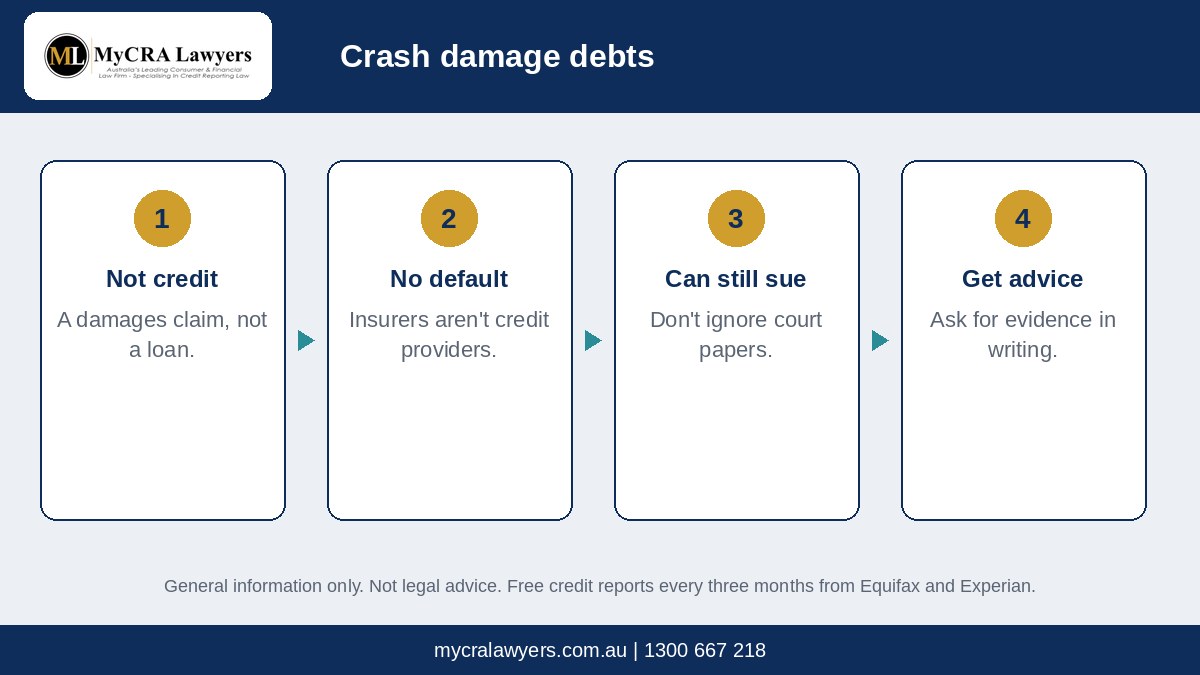
A bill for crash damage is different. You never borrowed anything. Someone says you caused damage and should pay for it. That’s a claim for damages. The OAIC’s list of credit reporting terms also says plainly that a general insurer is not a credit provider.
So in our view, an insurer or its collector should not be listing a default on your Equifax or Experian report just because you haven’t paid for crash damage. If one appears, it’s worth challenging.
What about a court judgment?
If the insurer sues you and wins, the court gives a judgment. Some judgments can appear on a credit report as court proceedings information. But the Credit Reporting Code says certain things are not the kind of public record a bureau should collect, because they don’t say anything about your creditworthiness. That includes:
- the court claim itself (the paperwork that starts the case);
- judgments where the individual’s rights have been taken over by an insurer; and
- judgments that are otherwise unrelated to credit.
A judgment for crash damage would usually sit in that last group. If you find one on your report, ask the bureau to look at it. Our guide on removing a court judgment from your credit file explains the process.
So can I just ignore it?
No. This is where people get hurt. Keeping it off your credit report is one thing. Making the debt go away is another.
- They can sue you. If you ignore court papers, the insurer can get a default judgment without you being heard.
- They can enforce a judgment. Depending on your state, that can mean taking money from your wages or bank account, or other steps through the court.
- Collectors still have rules. Whoever chases the money must follow the law on fair debt collection. No threats, no harassment, no lying about what will happen. See debt collector harassment and your rights.
Also remember that compulsory third party (CTP) insurance, the type that comes with your rego, covers injuries to people. It generally doesn’t pay for damage to someone else’s car.
What should I do when the letter arrives?
- Don’t admit fault on the phone. Ask for everything in writing.
- Ask for the evidence. Police or incident report, photos, repair quotes and invoices, and why they say you were at fault.
- Check the amount. Is it fair for the damage? Are there extra charges you didn’t agree to?
- Check your own cover. Were you really uninsured? Was someone else driving? Did another policy cover you?
- Get free legal advice. Community legal centres and Legal Aid in your state often help with car accident debts. Time limits apply to these claims and they vary by state.
- Talk money early. If you were at fault and can’t pay in one go, ask about a payment plan in writing. The National Debt Helpline (1800 007 007) offers free financial counselling.
- Never ignore court papers. Get advice the day they arrive.
What if an accident debt is already on my credit report?
Pull both reports. You can get a free credit report from each bureau every three months. See how to get your free credit report. Look for a default or judgment that matches the crash claim.
If you find one, write to the bureau and to whoever listed it. Say what it is, why you say it isn’t credit or credit-related, and ask for it to be corrected. Corrections are free and generally must be dealt with within 30 days. See the 30-day correction rule. If they say no, they must give written reasons and tell you about AFCA or the OAIC.
One more thing. If you paid for repairs to your own car with a personal loan or a card, that loan is credit. Missed payments on it can be reported like any other credit.
Want to see what your report really shows before you respond? Start with a free credit file analysis at app.FixMyBadCredit.com.au.
How can MyCRA Lawyers help?
If an accident debt, or any other debt that isn’t credit, has turned up on your Equifax or Experian report, send us both PDFs and the letters you received. A team member will read the file and tell you plainly whether the listing looks open to challenge.
MyCRA Lawyers is a specialist credit repair law firm. Have your Equifax and Experian report PDFs ready and reach us through our contact form, call 1300 667 218 or 07 3124 7133, or book a 15-minute credit repair intro call. Postal: PO Box 169, Aspley QLD 4034. We quote fixed fees in writing after we assess the file, and we will tell you plainly if a listing looks like a wait-out rather than a viable dispute. On consumer defaults accepted after initial assessment, our independently audited success rate is 91.6%. Selected consumer default work includes a Money Back Guarantee on published terms. No law firm can promise every listing will come off, and we don’t. For defaults in particular, see our default removal service page.
Not ready to talk yet? Pull both free reports and start with a free credit file analysis at app.FixMyBadCredit.com.au. For the bigger picture of how listings are challenged, read our credit repair lawyers Australia guide.
Frequently asked questions
Can an insurer list a default for car accident damage?
A default can only be listed for overdue credit. A claim for crash damage is not credit, and the OAIC says a general insurer is not a credit provider. If one appears, it is worth challenging.
Can a car accident judgment show on my credit report?
The Credit Reporting Code says judgments unrelated to credit are not the kind of public record a bureau should collect. If one shows, ask the bureau to correct it.
Does that mean I don’t have to pay?
No. The insurer can still sue you and enforce a judgment through the court. Get free legal advice and never ignore court papers.
Does CTP insurance cover damage to the other car?
CTP generally covers injuries to people, not damage to vehicles or property.
Can a debt collector threaten my credit rating?
Collectors must not mislead you about what they can do. If you’re told something you think is untrue, ask for it in writing and get advice.
General information only. Not legal advice for your circumstances. Liability limited by a scheme approved under Professional Standards Legislation.

Leave A Comment