
Updated 28 November 2026. By Graham Doessel.
Short answer
Generally, no. Under the AFCA Rules, while AFCA is considering your complaint, the financial firm must not list a default on your credit file about the debt in the complaint. It also must not take action to recover that debt, sell or assign it, or start court action about it, except in a few cases with AFCA’s consent. AFCA says firms must suspend collection once your complaint is registered. The rule only works for firms that are AFCA members, and it starts when the complaint is with AFCA, not when you first complain to the firm. It stops new listings. It does not remove a default that was already there before you lodged. If a firm lists a default while AFCA has your complaint, tell AFCA straight away.
Hi, I’m Graham. Picture this. You’ve complained to AFCA about a debt you say is wrong. Then a letter arrives saying the lender is about to list a default. It feels like they’re punishing you for speaking up. The good news is that the AFCA Rules deal with exactly this.
Let me explain what the rule says, where it stops, and what to do.
What do the AFCA Rules say about listing defaults?
AFCA is the free complaints body for banks, lenders, many collectors and other financial firms. Its rules put limits on a firm while AFCA is considering a complaint. The firm must not take any action to:
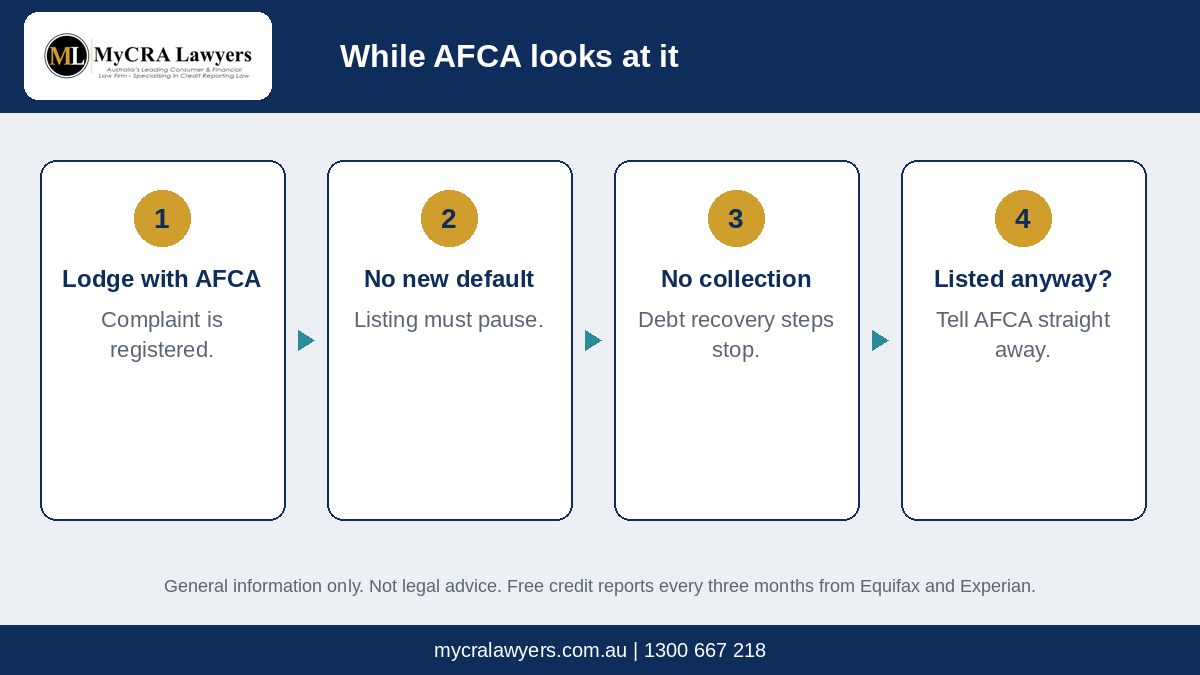
- recover the debt that the complaint is about, including enforcing a default judgment;
- protect any assets that secure that debt;
- assign (sell or transfer) the right to recover that debt; or
- list a default on your credit file.
The firm also must not start legal action about the subject of the complaint, and must not push on with court action it started before you complained, except to the bare minimum needed to protect its legal rights. AFCA’s own complaint page says firms must suspend any collection or recovery action once your complaint has been registered.
Are there exceptions?
Yes, a few, and they need AFCA’s consent. For example, a firm may be allowed to start court action if a legal time limit is about to run out, but it then can’t push that case further than needed to protect its rights. Other exceptions cover things like test cases, preserving assets, and enforcing a default judgment. Each comes with whatever conditions AFCA sets. None of them is a general green light to list a default because you complained.
When does the protection start, and when does it end?
This is where people get caught out.
- Complaining to the firm is not enough. The rule applies while AFCA is considering the complaint. A complaint only to the lender’s own complaints team (internal dispute resolution) doesn’t trigger it. That said, if you have asked for hardship help, the Credit Reporting Code separately says a lender generally can’t list a default while it is still deciding that request. See hardship arrangements and defaults.
- It has to be an AFCA member. Banks and most lenders are members. Many collectors and debt buyers are too, but not every business is. Check AFCA’s member search before you rely on it.
- It ends when AFCA’s work ends. If the complaint is resolved, closed or decided, the restrictions while AFCA is considering it fall away. What happens next depends on the outcome. Our guide on what happens to a listing after an AFCA determination covers that stage.
Does it remove a default that’s already listed?
No. The rule stops a firm adding a new default while AFCA has your complaint. It doesn’t wipe one that was already on your file before you lodged. If you want an existing default corrected or removed, that has to be part of what you ask AFCA to decide. Make it clear in your complaint: name the default, the bureau that shows it, and why you say it is wrong.
The rule also talks about defaults. It doesn’t expressly mention monthly repayment history (late marks) on an account that is still open. If late marks are part of your dispute, say so in your complaint too.
What if they list a default anyway?
- Get proof. Pull your Equifax and Experian reports and save the PDFs. Note the date the default was listed and your AFCA complaint number and date.
- Tell the firm’s complaints team in writing that AFCA is considering your complaint and the listing was made during it. Ask for it to be withdrawn.
- Tell AFCA. AFCA says to contact it if you keep getting collection contact after your complaint is registered. A listing during the complaint is something AFCA will want to know about.
- Ask for a correction. You can also ask the bureau to correct the listing. Requests are free, and generally have to be dealt with within 30 days. See the 30-day correction rule.
If collectors keep calling, our guide on debt collector harassment and your rights explains what they can and can’t do.
How do I give my complaint the best chance?
A tidy file moves faster. Our guides on AFCA complaints about credit defaults and AFCA complaint timelines list what to gather. Some privacy issues fit better with the OAIC. See AFCA vs OAIC.
Start with both free reports (you can get one from each bureau every three months) and a free credit file analysis at app.FixMyBadCredit.com.au. If the debt is causing money stress, the National Debt Helpline (1800 007 007) is free.
How can MyCRA Lawyers help?
If a default appeared while your AFCA complaint was open, or you’re about to lodge one, send us both Equifax and Experian PDFs plus your complaint letters. A team member will read the file and tell you plainly what looks worth pursuing.
MyCRA Lawyers is a specialist credit repair law firm. Have your Equifax and Experian report PDFs ready and reach us through our contact form, call 1300 667 218 or 07 3124 7133, or book a 15-minute credit repair intro call. Postal: PO Box 169, Aspley QLD 4034. We quote fixed fees in writing after we assess the file, and we will tell you plainly if a listing looks like a wait-out rather than a viable dispute. On consumer defaults accepted after initial assessment, our independently audited success rate is 91.6%. Selected consumer default work includes a Money Back Guarantee on published terms. No law firm can promise every listing will come off, and we don’t. For defaults in particular, see our default removal service page.
Not ready to talk yet? Pull both free reports and start with a free credit file analysis at app.FixMyBadCredit.com.au. For the bigger picture of how listings are challenged, read our credit repair lawyers Australia guide.
Frequently asked questions
Can a lender list a default while my AFCA complaint is open?
Generally no. While AFCA is considering a complaint, the AFCA Rules say the firm must not list a default on your credit file about the debt in the complaint, apart from limited exceptions with AFCA’s consent.
Does complaining to the lender first stop a default?
Not under the AFCA rule, which applies once AFCA is considering the complaint. A separate Credit Reporting Code rule stops a default being listed while a lender is still deciding a hardship request.
Will AFCA remove a default that was already listed?
The rule only stops new listings. If you want an existing default corrected or removed, ask for that in your AFCA complaint and explain why it is wrong.
Can a debt be sold to a collector while AFCA has my complaint?
The AFCA Rules say the firm must not assign the right to recover the debt in the complaint while AFCA is considering it, unless an exception applies.
What should I do if collectors still contact me?
Tell the firm’s complaints team in writing and contact AFCA. AFCA says firms must suspend collection once your complaint has been registered.
General information only. Not legal advice for your circumstances. Liability limited by a scheme approved under Professional Standards Legislation.


Leave A Comment