
Updated 27 November 2026. By Graham Doessel.
Short answer
If a lender has already listed a default and you then agree to new repayment terms, or you get a new loan to pay it out, the lender can report new arrangement information. It is a short statement that the terms changed or new credit was given. It stays on your credit report for two years from when the bureau first collected the default, so it often drops off before the default does. A payment plan does not remove the default. The default stays for five years, even once paid. But when you finish paying, the default must be marked as paid, and if you ask, the lender should report that within three business days. If the default itself was listed wrongly, that is a separate fight, and a payment plan doesn’t stop you having it.
Hi, I’m Graham. People often agree to a payment plan thinking it will wipe the default. It won’t. But it isn’t pointless either. It changes what your credit report says next to the default, and that can matter to the next lender who reads it.
Here’s how it works, in plain English.
What is “new arrangement information”?
The Privacy Act lets a lender report new arrangement information in one narrow situation. First, the lender has already listed a default for an overdue consumer credit payment. Then, because you were behind, either the repayment terms of that credit are changed, or you are given new credit to deal with that amount. The lender can then tell the bureau a simple fact: the terms were varied, or new credit was given.
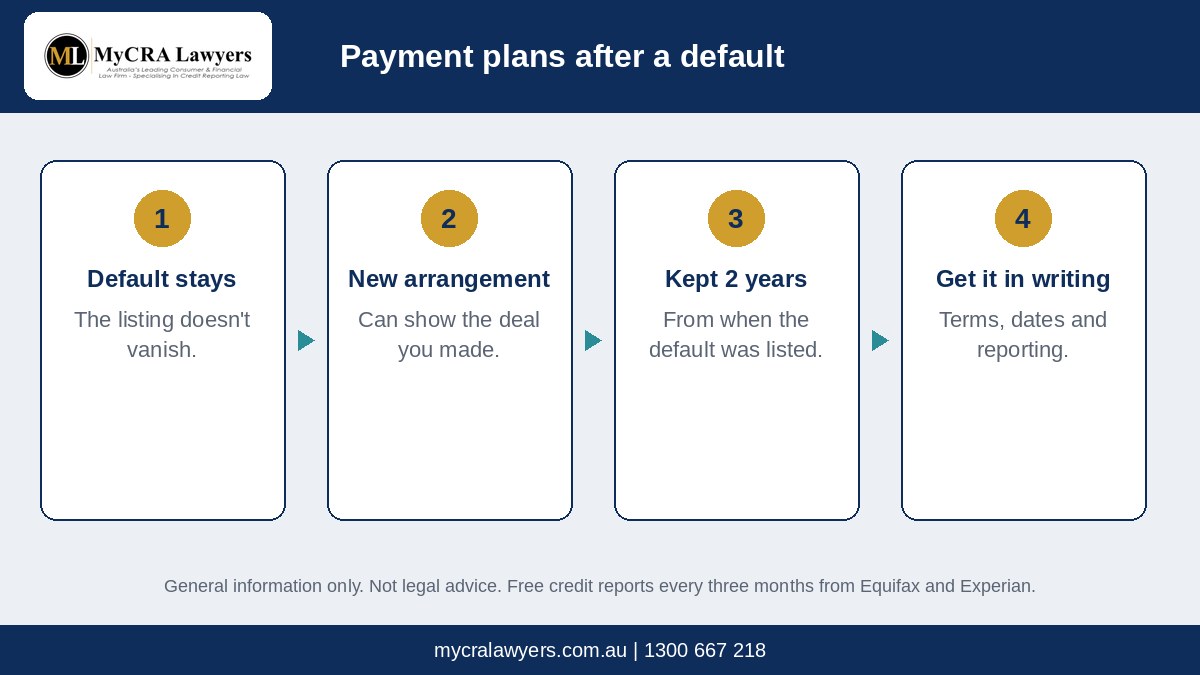
It is not a second default. It is a note that says you and the lender made a new deal after the default. A similar rule applies where a lender has listed a serious credit infringement. Whether your plan counts depends on how it was set up, so ask the lender in writing what they will report.
How long does new arrangement information stay?
Two years. The clock starts from the day the bureau collected the default, not the day you signed the plan. That means if you agree to a plan two years or more after the default was listed, the note may already be past its time limit. In most cases the new arrangement note leaves well before the default itself.
Here are the time limits that sit side by side on your report (from the Privacy Act and the OAIC):
- Default: five years from when the bureau collected it.
- Payment information (the “paid” status): stays as long as the default.
- New arrangement information: two years from when the default was collected.
- Repayment history on any ongoing account: two years for each month.
- Serious credit infringement: seven years.
Our guide on how long a default stays on your credit file covers the five-year rule in more detail.
Does a payment plan remove the default?
No. A correct default stays for its full five years, paid or not. Paying it, or agreeing to pay it, does not erase it. We explain why in paid vs unpaid defaults and why a paid default still shows years later.
What a plan can do is show the next lender that you dealt with it. Many lenders read a paid default, or a default with a new arrangement, very differently from an unpaid one that was ignored.
One important exception. If the lender listed a serious credit infringement because it said it couldn’t contact you, and it then reports payment information or new arrangement information for that overdue amount, the Credit Reporting Code says the bureau must destroy the serious credit infringement. If that applies to you, check both reports afterwards. Our guide on serious credit infringements and clearouts explains that listing.
How do I get the default marked as paid?
Under the Credit Reporting Code, a default counts as paid when one of three things happens:
- you pay the full overdue amount in cleared funds;
- you pay part of it and the lender accepts that amount in full settlement; or
- the lender waives the payment.
Then ask the lender, in writing, to report the payment to the bureaus. Once you ask, they should take reasonable steps to report it within three business days, unless they have a good reason to need longer. Keep the receipt and the settlement letter. Pull both free reports a few weeks later to check. You can get a free report from each bureau every three months.
What should I check before I sign a payment plan?
- Is the default even right? Before you agree to anything, check the notices, the amount and the dates. A default listed without the proper notices may be open to challenge. A payment plan does not take away your right to dispute a listing that is wrong. See default notice requirements.
- Who owns the debt now? If it moved to a collector or debt buyer, make sure the plan is with the right party. Our guide on assigned debts and credit listings explains the trail.
- Can you afford it? A plan you can’t keep can lead to more trouble. If you are struggling, ask about a hardship arrangement, and call the National Debt Helpline on 1800 007 007 for free financial counselling.
- Get it in writing. Ask what will be reported, and when the account will be marked paid.
If you were already asking for hardship help when the default appeared, read hardship arrangements and defaults listed at the same time. A lender generally can’t list a default while it is still deciding your hardship request.
Not sure where you stand? Pull both reports and get a free credit file analysis at app.FixMyBadCredit.com.au before you sign anything.
How can MyCRA Lawyers help?
Thinking about a payment plan, or already on one? Send us both Equifax and Experian PDFs and the plan letter. A team member will read the file and tell you whether the default itself looks open to challenge before you commit.
MyCRA Lawyers is a specialist credit repair law firm. Have your Equifax and Experian report PDFs ready and reach us through our contact form, call 1300 667 218 or 07 3124 7133, or book a 15-minute credit repair intro call. Postal: PO Box 169, Aspley QLD 4034. We quote fixed fees in writing after we assess the file, and we will tell you plainly if a listing looks like a wait-out rather than a viable dispute. On consumer defaults accepted after initial assessment, our independently audited success rate is 91.6%. Selected consumer default work includes a Money Back Guarantee on published terms. No law firm can promise every listing will come off, and we don’t. For defaults in particular, see our default removal service page.
Not ready to talk yet? Pull both free reports and start with a free credit file analysis at app.FixMyBadCredit.com.au. For the bigger picture of how listings are challenged, read our credit repair lawyers Australia guide.
Frequently asked questions
Does a payment plan show on my credit file?
It can. If a default was already listed and the terms were changed or new credit was given because you were behind, the lender can report new arrangement information. It is a statement that a new deal was made.
How long does new arrangement information stay?
Two years from the day the bureau collected the default, so it usually drops off before the default does.
Will the default come off once I finish paying?
Not by itself. A correct default stays for five years. It should be updated to show it has been paid.
How fast must a lender report that I’ve paid?
If you ask, the lender should take reasonable steps to report the payment within three business days, unless it has reasonable grounds to need longer.
Can I still dispute a default if I’m on a payment plan?
Yes. If the listing was made without the required notices or has wrong details, you can still ask for it to be corrected. Get advice before you agree to terms that admit facts you dispute.
General information only. Not legal advice for your circumstances. Liability limited by a scheme approved under Professional Standards Legislation.


Leave A Comment