
Updated 29 November 2026. By Graham Doessel.
Short answer
If a company tells you your details were in a data breach, act early. Read the notice to see what was taken. Change passwords and watch your bank accounts. Then get your free credit reports from Equifax and Experian and look for enquiries or accounts you don’t recognise. If ID documents, like your licence or passport, were exposed, or you see signs of fraud, ask for a free credit ban. A ban stops the bureau sharing your report for 21 days and can be extended. You can ask one bureau to pass the ban request to the other. If someone has used your details, contact IDCARE (1800 595 160) and ask the lenders and bureaus to correct your file.
Hi, I’m Graham. An email or text arrives: “We regret to inform you that your personal information may have been involved in a cyber incident.” Your stomach drops. What did they take? What can someone do with it?
You can’t undo the breach. But you can make it much harder for anyone to borrow money in your name. Here’s the checklist we’d follow.
What does the data breach notice tell me?
Under the Notifiable Data Breaches scheme, organisations covered by the Privacy Act must tell you when a breach is likely to cause you serious harm. The OAIC’s guidance on responding to a data breach notification says the notice should explain what kind of information was involved and recommend steps you can take.
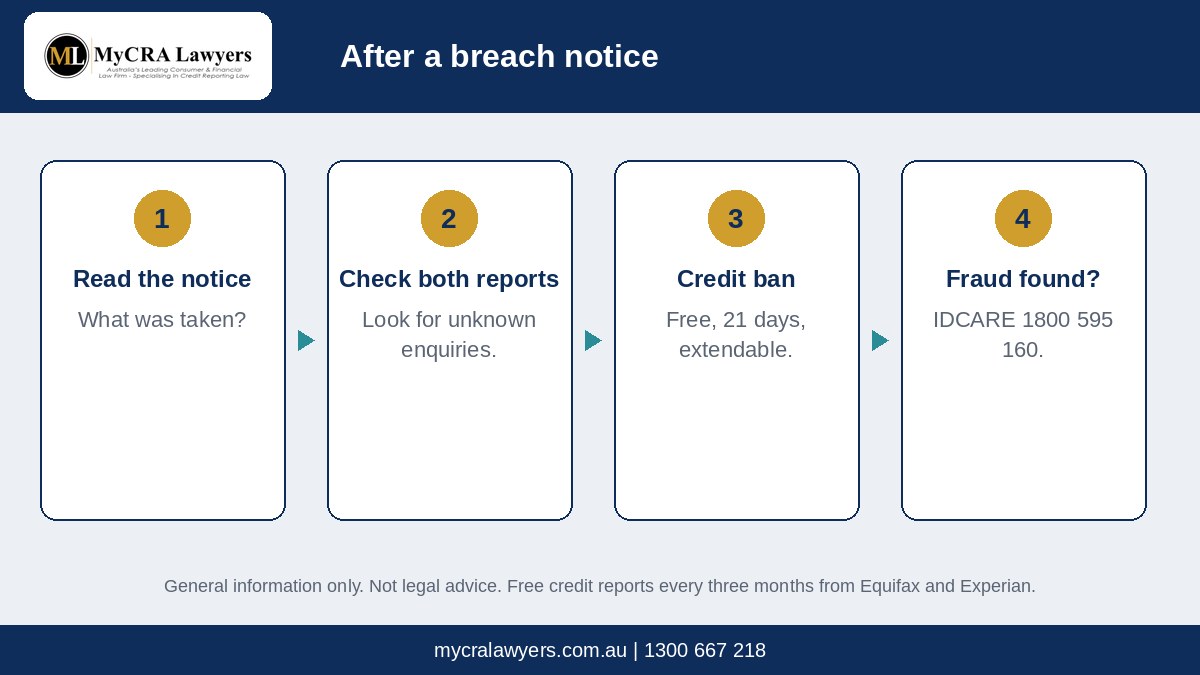
Read it closely. Your risk depends on what was taken.
- Contact details only (name, email, phone): expect more scam emails, texts and calls.
- Financial details (card or bank details): watch your accounts and talk to your bank.
- ID documents (driver licence, passport, Medicare card): this is the big one for credit fraud, because these are what lenders use to check who you are.
- Date of birth and address with any of the above: that raises the risk further.
Keep a copy of the notice and a list of what you do and when. The OAIC says this record can help later if you suffer harm.
What should I check on my credit report?
Australians can get a free credit report from each bureau every three months. See how to get your free credit report. Get both, Equifax and Experian. (illion’s consumer bureau is now part of Experian.) Then look for:
- Enquiries you didn’t make. A credit check from a lender, phone company or buy now pay later provider you never applied to.
- Accounts you don’t recognise. New cards, loans or phone plans.
- Personal details that are wrong. A new address, employer or phone number you never gave.
- Defaults or late payments on accounts you never opened.
If it all looks clean, great. Diary a reminder to check again. Fraud can show up weeks or months after a breach.
Should I place a credit ban?
If your ID documents were exposed, or you think you are, or are likely to be, a victim of fraud, a credit ban is worth considering. The OAIC’s page on fraud and your credit report explains how it works:
- it’s free;
- it lasts 21 days from your request;
- while it’s on, the bureau can’t share your credit report without your written consent (or where the law requires it);
- if a lender asks for your report, the bureau tells them about the ban, which alerts them to possible fraud;
- you can ask one bureau to pass your request on to the other;
- the bureau must remind you at least 5 business days before it ends, and you can ask to extend it as many times as needed if the fraud risk continues.
The trade-off: while a ban is on, it can be harder to get credit yourself. If you’re about to apply for a home loan or car loan, talk to your lender or broker about timing. Our guide on how to place a credit ban has the step by step.
What else should I do straight away?
- Change passwords on the breached account and anywhere you reused that password. Turn on two-step sign-in.
- Tell your bank if financial or ID details were exposed, and ask what extra protection they offer.
- Replace exposed ID where the issuing agency offers that. Follow the breached company’s notice for the steps.
- Treat every “follow-up” message with suspicion. Scammers love a data breach. Don’t click links. Contact the company using details you find yourself.
What if someone has already used my details?
- Contact IDCARE (1800 595 160), the free national identity and cyber support service.
- Report it to police through ReportCyber.
- Contact the lender that opened the account or made the enquiry. Tell them it’s fraud.
- Ask the lender or bureau to correct your credit file. Corrections are free and generally must be dealt with within 30 days. The Credit Reporting Code also lets you deal with several fraud enquiries in one request. See the 30-day correction rule.
Our guide on identity theft and your credit file covers the clean-up in more detail. If a fraud debt is causing money stress, the National Debt Helpline (1800 007 007) offers free financial counselling. Want a fresh set of eyes on your report? Start with a free credit file analysis at app.FixMyBadCredit.com.au.
How can MyCRA Lawyers help?
If a data breach has already turned into enquiries, accounts or defaults you never applied for, send us both Equifax and Experian PDFs. A team member will read the file and tell you plainly what looks worth challenging.
MyCRA Lawyers is a specialist credit repair law firm. Have your Equifax and Experian report PDFs ready and reach us through our contact form, call 1300 667 218 or 07 3124 7133, or book a 15-minute credit repair intro call. Postal: PO Box 169, Aspley QLD 4034. We quote fixed fees in writing after we assess the file, and we will tell you plainly if a listing looks like a wait-out rather than a viable dispute. On consumer defaults accepted after initial assessment, our independently audited success rate is 91.6%. Selected consumer default work includes a Money Back Guarantee on published terms. No law firm can promise every listing will come off, and we don’t. For defaults in particular, see our default removal service page.
Not ready to talk yet? Pull both free reports and start with a free credit file analysis at app.FixMyBadCredit.com.au. For the bigger picture of how listings are challenged, read our credit repair lawyers Australia guide.
Frequently asked questions
Do I need a credit ban after every data breach?
Not always. It depends on what was taken. A ban is most useful if ID documents were exposed or you think you are, or are likely to be, a victim of fraud.
How long does a credit ban last?
21 days from your request. The bureau must remind you before it ends, and you can ask to extend it if the fraud risk continues.
Do I need to contact both bureaus?
You can ask one bureau to pass your ban request to the other. Check both Equifax and Experian reports for anything you don’t recognise.
Will a credit ban stop me getting a loan?
It can make it harder while it is in place, because lenders can’t see your report without your written consent. Plan timing with your lender or broker.
What if a fraud enquiry is already on my file?
Tell the lender it was fraud and ask the lender or bureau to correct your file. Corrections are free and generally must be dealt with within 30 days.
General information only. Not legal advice for your circumstances. Liability limited by a scheme approved under Professional Standards Legislation.

Leave A Comment