
Updated 28 October 2026. By Graham Doessel.
A serious credit infringement, still called a clearout in industry slang, is not a casual late payment. It is a specific credit reporting category used when a provider believes you have moved away and cannot be contacted, among other criteria set out in credit reporting rules. It hits lending assessments hard. If one is on your Equifax or Experian file, treat it as a priority read, not a footnote.
How it differs from an ordinary default
Ordinary consumer defaults have amount and overdue thresholds and notice pathways. A serious credit infringement has its own definition and reporting rules. Lenders often read it as “we lost contact / account abandoned” style risk. Paying later may update status; it may not erase the history for the full period.
First checks
- Is the person and address history actually yours?
- Did the provider have current contact details?
- Were there hardship or complaint emails that show you were reachable?
- Does the same issue appear on both bureaus?
Pull free reports every three months (OAIC). Compare. Then write to the provider with a chronology. Even a real debt can carry a flawed listing, as we explain in how to remove a genuine default.
What usually happens next
Disputes turn on whether the listing criteria and process were met. Some clearouts are corrected. Some are lawful and must age. Anyone promising automatic deletion without reading the file is selling comfort, not law.
Framework: credit repair lawyers Australia. Related: default removal.
Talk before you apply for a mortgage
Clearouts and SCI-style listings are classic broker deal-killers. Have the PDFs ready and reach us through our contact form or call 1300 667 218. Or book a 15-minute intro call. On consumer defaults accepted after initial assessment, our success rate is 91.6%, independently audited by a chartered accountant. Our own records show 29.4% of defaults are removed within 7 days. SCI matters are assessed individually. PO Box 169, Aspley QLD 4034.
Why lenders flinch
A serious credit infringement signals contact failure or abandonment risk. Even if you later paid, many scorecards and policy overlays treat the history as high friction. That is why “I cleared it with the collector” is not the end of the lending conversation.
DIY letter outline
Date; your full identity details; account number; statement that you dispute the serious credit infringement; timeline of addresses and contact attempts; request for the evidence the provider relied on; request for correction with both bureaus; attach PDFs.
Send it in a way you can prove. Keep the reply.
When to get help early
If a broker has an auction date, or the provider refuses to produce notice evidence, or the listing is mixed with identity theft, do not wait for the five-year clock as your only plan.
Why clearouts scare lenders
A serious credit infringement signals contact failure or abandonment risk in credit reporting terms. Even after payment, many overlays stay strict. DIY letters should demand the evidence the provider relied on and seek correction on both bureaus where criteria were not met. If you are wondering whether to wait it out, read how long a default stays on your credit file.
Broker deals with clearouts need early triage, not a quiet try-another-lender plan.
Equifax and Experian: always both
Australia’s consumer credit reporting bodies are Equifax and Experian. Experian absorbed illion’s consumer bureau from 1 April 2026, so you do not need a separate illion report today. Scores rarely match. Free consumer reports are available every three months (OAIC). After a refusal, ask about free access tied to that decision. Save PDFs, not only score dials.
A simple cleanup order
- Identity and contact data
- Defaults and serious credit infringements
- Judgments
- Enquiries
- Repayment history information
- Hardship flags
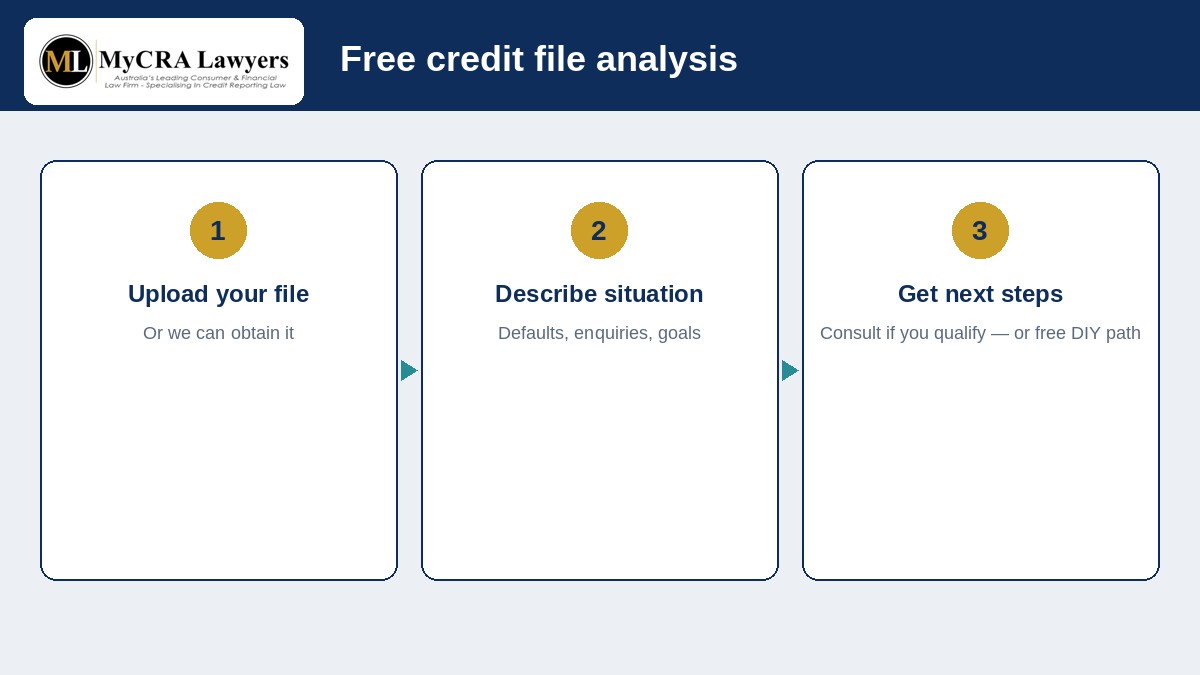
Dispute clear errors before you generate new hard enquiries. For broker deals, pause lodgement until the triage is honest. Use app.fixmybadcredit.com.au for a free file analysis once you have the PDFs.
What “good enough” looks like before you apply
You do not need a perfect file. You need an honest map of what lenders will see on Equifax and Experian, a plan for anything non-compliant or incorrect, and enough discipline to stop adding hard enquiries while that plan runs. Brokers would rather wait two weeks for a clean story than inherit four declines.
If a listing is lawful and must age, say so early. If it is challengeable, gather notices and chronologies before you phone the creditor angry. Measured files get better outcomes than chaotic ones.
Internal links worth keeping open: free credit reports, default removal guide, and the credit repair lawyers Australia cornerstone.
Free reports are the starting line
Under Australian credit reporting rules, a credit reporting body must give you a free consumer credit report once every three months (OAIC). You can also seek free access after a credit refusal within the past 90 days, or after a correction. Get Equifax and Experian. Experian absorbed illion’s consumer bureau from 1 April 2026, treat illion as history, not a current third bureau you must pull separately.
Store PDFs somewhere durable. Portal links expire. Score dials without listings are not enough for a dispute or a broker pack.
Common mistakes that keep people in Credit Prison
- Applying again the morning after a decline
- Paying a default because a collector said it would “come off”
- Hiring the loudest repair advert without checking fees or practising status
- Disputing by phone only and keeping no chronology
- Checking one bureau and assuming the other matches
- Ignoring RHI grids because there is no default yet
Most of those mistakes are fixable with process. Start with both free reports, then pick DIY, AFCA/OAIC, or a law firm based on evidence and deadlines, not panic.
How MyCRA usually scopes a file
We ask for both bureau PDFs and a short goal (refinance date, auction, car loan, cleanup). We say if chances look poor. On consumer defaults accepted after initial assessment, our success rate is 91.6%, independently audited by a chartered accountant. Our own records show 29.4% of defaults are removed within 7 days. Fixed fees in writing. From time to time we run a Money Back Guarantee offer on listings with certain creditors. Which creditors it covers changes, so ask us if one is running. Here is how our credit repair process works.
Reach us through our contact form, call 1300 667 218 or 07 3124 7133, book a 15-minute intro call, or write to PO Box 169, Aspley QLD 4034. Full framework: credit repair lawyers Australia.
FAQ
How long does a serious credit infringement stay?
Credit reporting retention periods apply (commonly years, aligned with the type of information). Confirm against your listing date and current CR Code tables.
Is a clearout the same as bankruptcy?
No. Bankruptcy and debt agreements are different public/insolvency records. Do not mix the labels.
General information only. Not legal advice for your circumstances. Liability limited by a scheme approved under Professional Standards Legislation.


Leave A Comment