
Names and identifying details in this case study have been changed to protect our client’s privacy.
Marcus didn’t know he owed anything. Years earlier he’d signed as guarantor for a business that leased computers through an equipment finance company. Then one day a debt collector rang, refused to say what it was about until he proved who he was, and hung up none the wiser.
He only understood when he went to borrow. There was a default for close to $2,800 sitting on his credit file, and his broker told him plainly that it had to go before a home loan would get through.
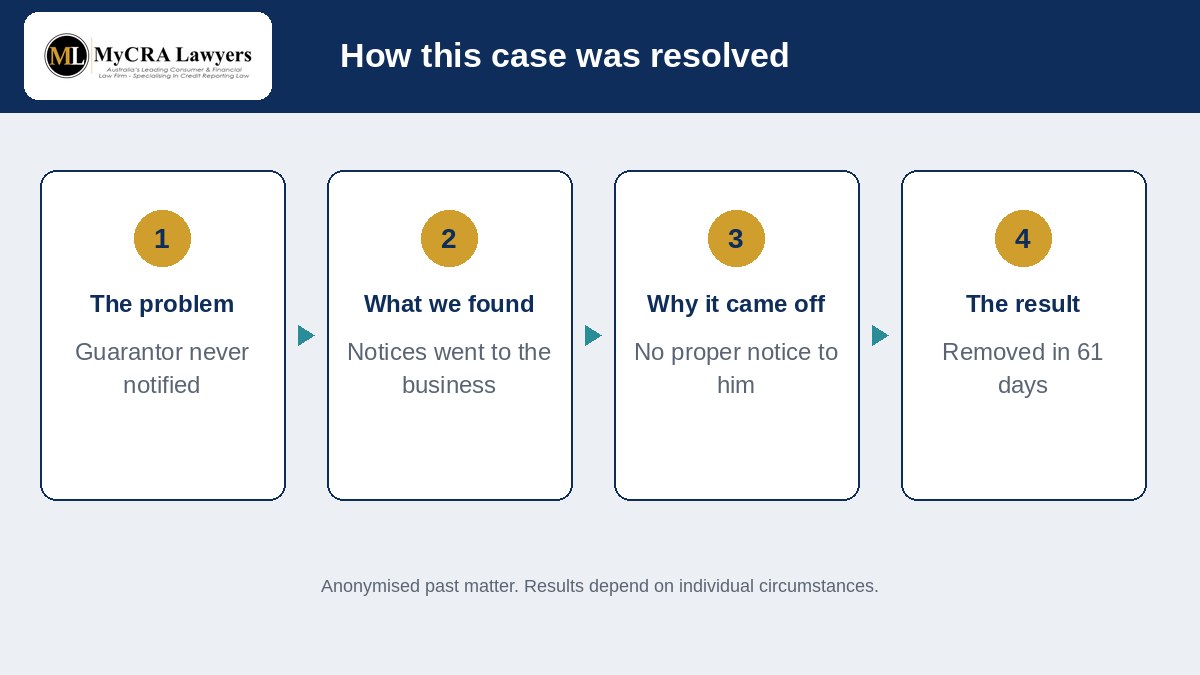
The problem with guarantees
A guarantee means you’re on the hook if the business doesn’t pay. It also means the creditor owes you the same notices it owes the business. Marcus had given his own personal postal address when he signed. That matters.
What we found
This Queensland client was referred by his mortgage broker, and the finance company responded to us promptly, which helped. Its documents told the story. Every default notice had gone to the business address. None had gone to Marcus personally, at the address he’d supplied.
We also noticed the application didn’t clearly tell Marcus the company could access his credit report if the account fell into default. That’s a second problem for a creditor that wants to rely on its paperwork.
Why it came off
The finance company couldn’t show that Marcus had been given proper notice of its intention to list the default, because of where those notices were sent. Without that, the listing couldn’t stand, and they agreed to remove it.
The result
We started on 10 March. The default was removed 61 days later, and Marcus was able to go back to his broker and apply for finance with confidence.
What this means for you
If you’ve ever guaranteed a business debt, a default can land on your personal file even when you never saw a single letter. Where the notices went, and whether you were told your credit file could be used, are both worth checking. That’s the sort of thing our credit repair lawyers dig into first.
This is a past matter. Names and identifying details have been changed to protect our client’s privacy.
Results depend on individual circumstances. Every credit file is different, and a past result doesn’t guarantee the outcome of your matter. This case study is general information, not legal advice.
Don’t spend another month stuck in Credit Prison. Call our credit repair lawyers on 1300 667 218 or book a 15-minute intro call at https://mycralawyers.com.au/15min-credit-repair-intro-call/ . If we think your chances are low, we’ll tell you straight.
MyCRA Lawyers | Australia-wide | 1300 667 218 | docs@mycralawyers.com.au | Book a 15-minute intro call

Leave A Comment