
Updated 26 November 2026. By Graham Doessel.
Short answer
When someone dies, their debts are generally paid out of their estate by the executor or administrator. Family members usually don’t have to pay from their own pocket unless they were a joint borrower, a guarantor, or put up their own asset as security. If the estate can’t cover an unsecured debt that was in the deceased person’s name only, that debt may simply go unpaid. The person’s own credit file can be flagged with Equifax and Experian, which usually want a death certificate and proof you’re authorised to act. The real credit risk is to the living: joint accounts and guarantees can put missed payments or a default on a survivor’s file. Check your own free reports (free every three months) in the months after a death.
Hi, I’m Graham. Grief and paperwork arrive together. In the middle of a funeral, a collector rings and asks when the family will be “sorting out” Mum’s credit card. People pay out of guilt or fear, often money they never owed. This guide sets out who is actually responsible, and how to stop a death turning into a credit problem for the people left behind.
It’s general information only. Estate law differs between states and territories, so get advice from the executor’s lawyer or a community legal centre for anything significant.
Who pays a person’s debts when they die?
The estate does. The executor named in the will (or an administrator appointed by the court if there’s no will) collects the assets, pays the debts and then distributes what’s left. Secured debts, like a mortgage or car loan, are tied to the asset. Unsecured debts, like credit cards and personal loans, are paid from whatever else the estate has.
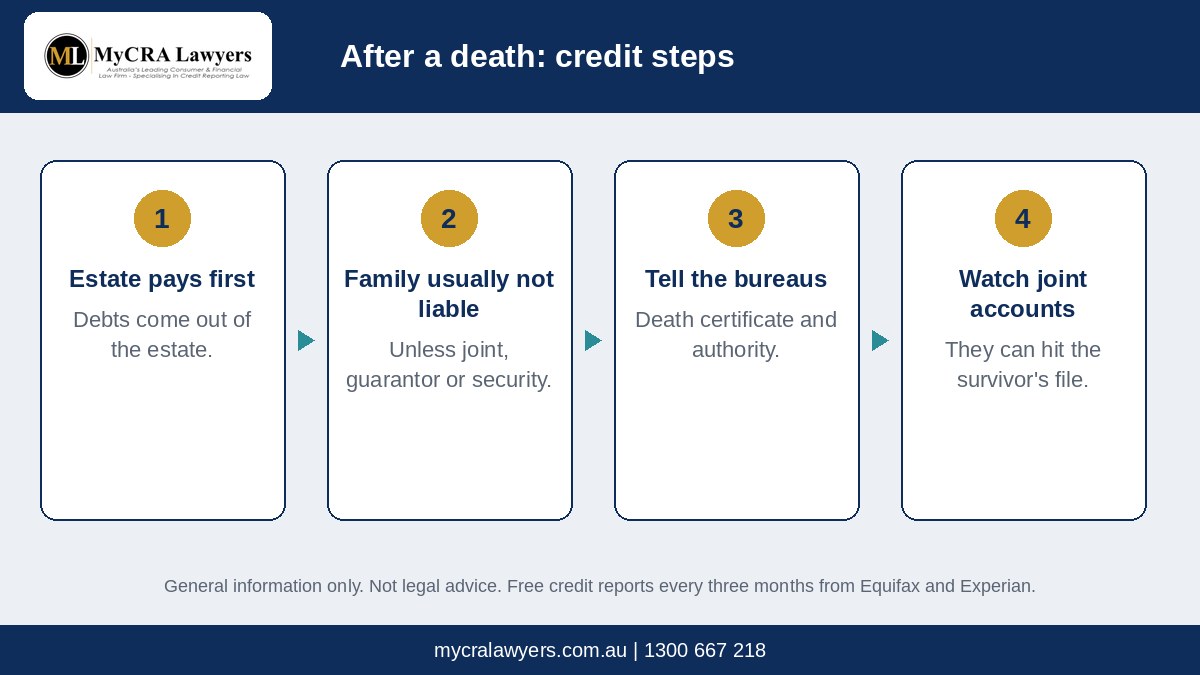
If the estate doesn’t have enough, and an unsecured debt was in the deceased person’s name only with no guarantor, it may not be repaid at all. The executor tells the creditor, and other family members don’t have to do anything.
When is a family member responsible?
Generally only if one of these applies:
- You were a joint borrower or joint account holder. You’re usually liable for the whole debt, not half.
- You were a guarantor. The lender can ask you to pay. See guarantor defaults on your credit file.
- Your asset was used as security, such as your home backing a family member’s loan.
Being an additional cardholder, a beneficiary, or the executor doesn’t by itself make you personally liable. An executor deals with debts out of estate money, not their own, although executors can get into trouble if they hand out the estate before paying known debts. That’s one reason to get advice early.
Can a debt collector chase the family?
A collector can contact the executor about the estate’s debts. What they shouldn’t do is pressure relatives to pay from their own money when they aren’t liable, or suggest they have to. If that’s happening, ask them to put everything in writing and direct them to the executor. Our guide to debt collector harassment and your rights explains the rules collectors must follow.
What happens to the deceased person’s credit file?
Their file doesn’t vanish. You can let Equifax and Experian know about the death so the file is marked. Each bureau sets its own process, but expect to provide a death certificate and evidence that you’re authorised to act, such as probate or letters of administration. Marking the file makes it harder for anyone to open credit in the dead person’s name.
Identity theft using a deceased person’s details does happen, so it’s worth doing early. Also tell the person’s banks, card providers and utilities, and cancel accounts that are no longer needed.
How can a death affect a survivor’s credit file?
This is where we see real damage. A partner is left with a joint credit card or loan while waiting on insurance or probate, payments slip, and the survivor’s own file picks up late payments or even a default. Utilities in the survivor’s name can go the same way.
- Tell every lender quickly about the death and ask what happens to joint accounts.
- Ask for hardship help in writing if your income has dropped. Our guide on financial hardship information explains how that shows on your file.
- Keep payments going on joint debts if you can, even at a reduced agreed amount.
- Pull your own free reports. Australians can get a free report from Equifax and from Experian every three months. Check them in the months after the death.
- Get financial counselling through the National Debt Helpline (1800 007 007). It’s free.
What if a default appears on your file after a death?
First work out whether you were actually liable for that debt. If you weren’t a borrower, guarantor or security provider, a default in your name is likely an error and you can ask for it to be corrected. If you were liable, look at how the account was handled: whether notices reached you, and whether you asked for hardship help that wasn’t given. Our guide to the 30-day rule for credit file corrections explains the process, and AFCA can step in if a lender won’t deal with it fairly.
A free credit file analysis at app.FixMyBadCredit.com.au will show you quickly what’s on your file and what might be worth challenging.
How can MyCRA Lawyers help?
If a partner’s or parent’s death has left a default or late payments on your file, send us both Equifax and Experian PDFs and a short note about what happened. We will tell you whether the listing looks wrong, challengeable, or simply something to manage.
MyCRA Lawyers is a specialist credit repair law firm. Have your Equifax and Experian report PDFs ready and reach us through our contact form, call 1300 667 218 or 07 3124 7133, or book a 15-minute credit repair intro call. Postal: PO Box 169, Aspley QLD 4034. We quote fixed fees in writing after we assess the file, and we will tell you plainly if a listing looks like a wait-out rather than a viable dispute. On consumer defaults accepted after initial assessment, our independently audited success rate is 91.6%. From time to time we run a Money Back Guarantee offer on listings with certain creditors. Which creditors it covers changes, so ask us if one is running. No law firm can promise every listing will come off, and we don’t. See our default removal service page for how we handle defaults.
Not ready to talk yet? Pull both free reports and start with a free credit file analysis at app.FixMyBadCredit.com.au. For the bigger picture of how listings are challenged, read our credit repair lawyers Australia guide.
Frequently asked questions
Do I have to pay my deceased parent’s credit card?
Generally not from your own money, unless you were a joint account holder, a guarantor or provided security. The debt is paid from the estate if there are enough assets.
What happens to debts if the estate has no money?
If an unsecured debt was in the deceased person’s name only and there was no guarantor, it may go unpaid. The executor tells the creditor.
How do I tell Equifax and Experian someone has died?
Contact each bureau and follow its process. Expect to provide a death certificate and proof you’re authorised to act, such as probate or letters of administration.
Can a joint loan affect my credit file after my partner dies?
Yes. Joint borrowers are usually liable for the whole debt, so missed payments can be reported on the survivor’s file. Contact the lender early and ask for hardship help.
Is the executor personally liable for the deceased’s debts?
Not usually. Debts are paid from estate assets, but executors should get advice before distributing the estate so known debts are dealt with first.
General information only. Not legal advice for your circumstances. Liability limited by a scheme approved under Professional Standards Legislation.




Leave A Comment