
Updated 26 November 2026. By Graham Doessel.
Short answer
Coerced debt is credit taken out in your name because someone pressured, tricked or controlled you, or used your details without real consent. It can leave you with defaults and late payments for debts you never wanted. The Credit Reporting Code, rewritten in late 2024, recognises domestic abuse as a circumstance beyond your control that you can raise when asking for a default, late payment or hardship listing to be corrected. It isn’t automatic, but it gives you a clear basis to ask. A financial counsellor or community lawyer can deal with lenders and bureaus for you with your written authority. Safety comes first: if you’re in danger call 000, and 1800RESPECT (1800 737 732) is free and open 24/7.
Hi, I’m Graham. Some of the hardest files we see aren’t about one bad year. They’re about a relationship where someone else ran the money. Cards opened in her name. A car loan he “had to” sign. Phone plans for the whole family under one person’s details. The relationship ends and the credit file still tells the abuser’s story.
If that’s you, it isn’t your fault, and there are better tools now than there were a few years ago.
What is coerced debt?
It’s a form of economic or financial abuse. Common examples include:
- being pressured or threatened into signing a loan, credit card or guarantee
- a partner using your identity, login or signature to open accounts
- being made the only name on bills and phone plans that someone else uses and won’t pay
- being stopped from seeing statements, so missed payments go unnoticed until there’s a default
Some of these are fraud, some are joint debts you technically agreed to, and some sit in between. That matters for how the credit file side is handled, which is why it’s worth getting advice before you contact lenders.
What does the credit reporting system now recognise?
The Credit Reporting Code was rewritten in late 2024, and the current 2025 version names domestic abuse, along with natural disaster, bank error and fraud, as circumstances beyond your control. If a default, payment information, financial hardship information or certain repayment history exists only because of the unavoidable consequences of abuse, you can ask for it to be corrected on that basis. The lender or bureau has to consider whether the information is inaccurate, out of date, incomplete, irrelevant or misleading, and consult the lender that reported it.
It doesn’t promise an outcome. Each case turns on the facts and what evidence you can safely provide. Our guide to the 30-day rule for credit file corrections explains how requests are handled once lodged.
Where accounts were opened using your identity without your knowledge, treat it as fraud as well. The Credit Reporting Code lets you deal with several fraudulent enquiries in one request, and a credit ban can stop new credit being opened in your name while you sort it out.
Can someone else deal with the bureau or lender for you?
Yes. The OAIC says third parties can act for you if you’re experiencing domestic or family violence. You sign a written authority, and the credit bureaus and lenders recognise it. Financial counsellors (through the National Debt Helpline on 1800 007 007) and community legal centres do this every day, for free.
That can make a huge difference if talking to a bank about the relationship is too much, or if you’re worried about the abuser finding out.
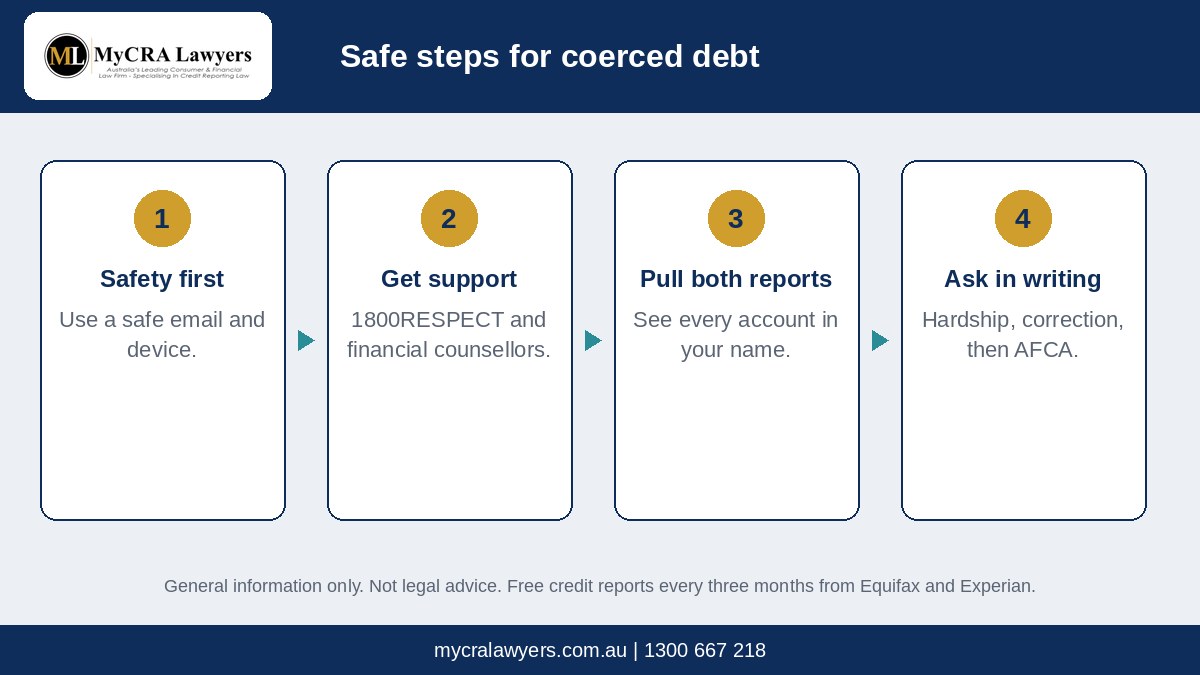
What are some safe first steps?
- Use a safe device and email the other person can’t access. Change passwords on banking apps.
- Pull both credit reports. Australians can get a free report from Equifax and from Experian every three months. Look for accounts and enquiries you don’t recognise.
- Update your contact details with each lender so notices don’t go to an address the other person controls. Ask lenders to note family violence on your file and ask how they protect your details.
- Ask for hardship help in writing on debts you’re stuck with. Many banks have specialist family violence teams.
- Get support before you confront anyone. 1800RESPECT (1800 737 732) can help with safety planning.
What about joint debts?
If you’re a joint borrower, each of you is usually responsible for the whole debt, not just your half. That’s why the other person’s missed payments can show on your file. Lenders can agree to hardship arrangements, and AFCA can look at how a lender handled a joint facility where family violence is involved. Our guide on credit files after separation covers the practical side, and guarantor defaults explains the rules if you were pushed into a guarantee.
Where does MyCRA fit?
We don’t replace support services or financial counsellors, and we’d always suggest starting with them if your safety or money is at risk right now. Where we help is the credit file itself: reading each listing, working out whether it was reported properly, and challenging the ones that shouldn’t be there. A free credit file analysis at app.FixMyBadCredit.com.au is a private first step you can take on your own device.
How can MyCRA Lawyers help?
When you’re ready, send us both Equifax and Experian PDFs from a safe email address, with as much or as little background as you’re comfortable sharing. We’ll keep it confidential and tell you which listings look worth challenging.
MyCRA Lawyers is a specialist credit repair law firm. Have your Equifax and Experian report PDFs ready and reach us through our contact form, call 1300 667 218 or 07 3124 7133, or book a 15-minute credit repair intro call. Postal: PO Box 169, Aspley QLD 4034. We quote fixed fees in writing after we assess the file, and we will tell you plainly if a listing looks like a wait-out rather than a viable dispute. On consumer defaults accepted after initial assessment, our independently audited success rate is 91.6%. From time to time we run a Money Back Guarantee offer on listings with certain creditors. Which creditors it covers changes, so ask us if one is running. No law firm can promise every listing will come off, and we don’t. See our default removal service page for how we handle defaults.
Not ready to talk yet? Pull both free reports and start with a free credit file analysis at app.FixMyBadCredit.com.au. For the bigger picture of how listings are challenged, read our credit repair lawyers Australia guide.
Frequently asked questions
What is coerced debt?
Debt taken on in your name because someone pressured, threatened, tricked or controlled you, or used your details without real consent. It is a form of economic abuse.
Can a default caused by domestic abuse be removed?
It may be possible. The Credit Reporting Code recognises domestic abuse as a circumstance beyond your control that can support a correction request. It isn’t automatic and depends on the facts and evidence.
Can a financial counsellor contact Equifax or Experian for me?
Yes. With your written authority, a third party such as a financial counsellor or community lawyer can deal with credit bureaus and lenders for you.
Am I responsible for a joint loan my ex stopped paying?
Usually, yes. Joint borrowers are generally each liable for the whole debt. Ask the lender for hardship help and get advice on your options.
Who can I call for help with economic abuse?
1800RESPECT (1800 737 732) for support and safety planning, the National Debt Helpline (1800 007 007) for free financial counselling, and 000 in an emergency.
General information only. Not legal advice for your circumstances. Liability limited by a scheme approved under Professional Standards Legislation.



Leave A Comment