
Updated 30 November 2026. By Graham Doessel.
Short answer
When you come home after years overseas, your Australian credit file may look very different. Good repayment history only stays for 2 years, and closed accounts drop off 2 years after they end, so a long time away can leave your file thin or almost empty. Your overseas history generally doesn’t count here. At the same time, old bad marks can still be there: defaults stay for 5 years and serious credit infringements for 7. Bills sent to your old address can turn into defaults you never knew about. Get your free Equifax and Experian reports first, update your address, challenge anything that’s wrong, and rebuild slowly with one or two modest accounts paid on time.
Hi, I’m Graham. We hear this story a lot. Someone moves to London, Dubai or Auckland for six years. They do well. They come home, apply for a car loan or a credit card, and get knocked back. “But I’ve never missed a payment in my life!”
That may be true. The problem is usually one of two things. Either your Australian file has gone quiet, or something happened at your old address while you were gone.
Does my overseas credit history count here?
Generally not. Equifax and Experian hold information about credit in Australia. (illion’s consumer bureau is now part of Experian.) Your perfect record with a bank in the UK generally doesn’t come with you. Some lenders have their own policies for people coming home and may ask for overseas statements, so it’s worth asking.
Why does my Australian file look so empty?
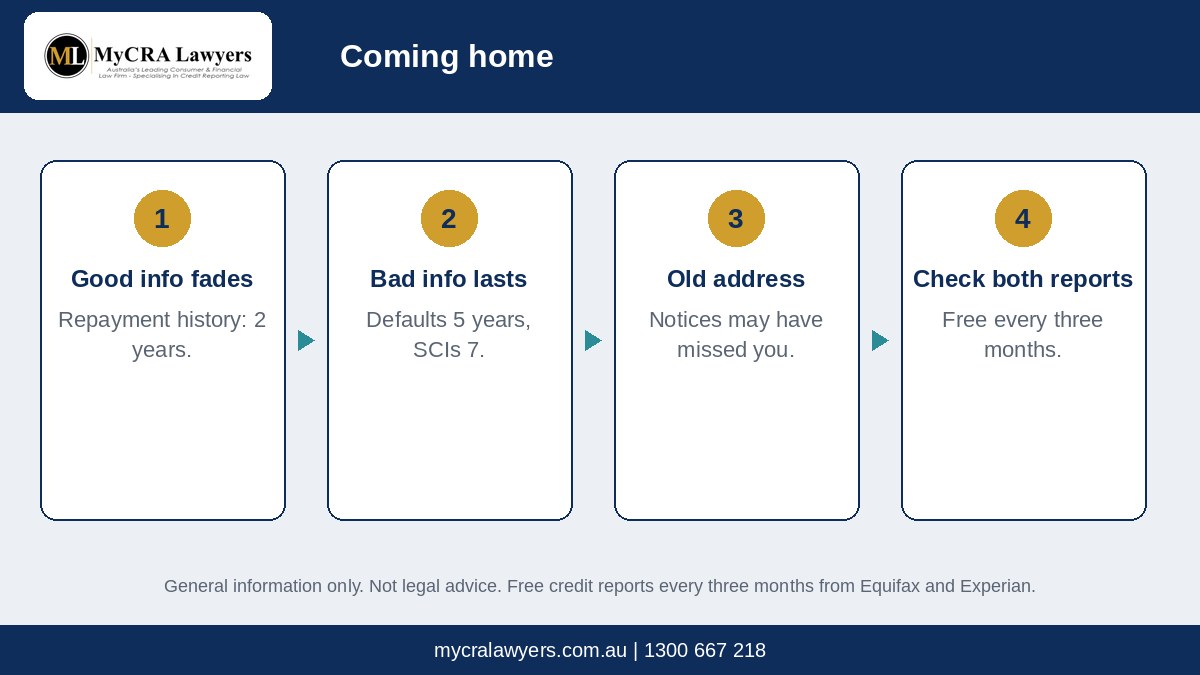
Because good information fades. The OAIC explains how long information stays on a credit report. In short:
- Repayment history: 2 years.
- Accounts: 2 years after the account is closed.
- Credit enquiries: 5 years.
So if you closed your cards and loans before you left and you’ve been away five or six years, there may be very little left. The bureau may not even be able to give you a score. If that happens, the Credit Reporting Code says it must explain why and tell you what information it would need.
A thin file isn’t a bad file. But it gives lenders less to go on. Our guide on thin credit files explains what lenders see.
Could bad marks still be there?
Yes. Negative information lasts longer than the good stuff:
- Defaults: 5 years from when they were listed.
- Serious credit infringements: 7 years.
- Court judgments: 5 years.
And here’s the trap for people who’ve been away. A final phone bill, an energy account you forgot to close, a credit card with a small balance. The bills go to your old address. Nobody pays them. Default notices go to the same old address. A default gets listed and you never hear a word.
It can be worse. If a lender couldn’t reach you for at least 6 months after taking reasonable steps, and thinks you’ve walked away from the debt, it may list a serious credit infringement. See our guide on serious credit infringements.
Was the default listed properly?
Not always. Before listing a default, a lender must send the right written notices to you and wait the required time. The notice usually goes to the last address they had for you. Whether that was good enough depends on what they knew. For example, did you give them a new email or overseas address? We’ve seen defaults removed where the notices clearly couldn’t have reached the person. Read our guides on defaults sent to the wrong address and default notices sent to an old address, and this case study about a client stranded overseas.
What should I do first?
- Get both credit reports. You can get a free credit report from each bureau every three months. See how to get your free credit report.
- Check your personal details. Old addresses are normal. A wrong name or date of birth isn’t.
- Look for defaults, judgments or infringements you didn’t know about. Note who listed each one and when.
- Update your contact details with every lender, phone company and energy provider you still deal with.
- Challenge anything wrong. Corrections are free and generally must be dealt with within 30 days. See the 30-day correction rule.
How do I rebuild after coming home?
Slowly and steadily. One or two modest accounts with lenders that report repayment history, paid on time every month. Avoid a flurry of applications. Each one can leave an enquiry on your file for 5 years. Our guide on rebuilding your credit has more tips. If old debts have come back to bite, the National Debt Helpline (1800 007 007) offers free financial counselling.
Not sure what your file is telling lenders? Start with a free credit file analysis at app.FixMyBadCredit.com.au.
How can MyCRA Lawyers help?
If you’ve come home to a default, judgment or infringement you didn’t know about, send us both Equifax and Experian PDFs. A team member will read the file and tell you plainly what looks worth challenging.
MyCRA Lawyers is a specialist credit repair law firm. Have your Equifax and Experian report PDFs ready and reach us through our contact form, call 1300 667 218 or 07 3124 7133, or book a 15-minute credit repair intro call. Postal: PO Box 169, Aspley QLD 4034. We quote fixed fees in writing after we assess the file, and we will tell you plainly if a listing looks like a wait-out rather than a viable dispute. On consumer defaults accepted after initial assessment, our independently audited success rate is 91.6%. Selected consumer default work includes a Money Back Guarantee on published terms. No law firm can promise every listing will come off, and we don’t. For defaults in particular, see our default removal service page.
Not ready to talk yet? Pull both free reports and start with a free credit file analysis at app.FixMyBadCredit.com.au. For the bigger picture of how listings are challenged, read our credit repair lawyers Australia guide.
Frequently asked questions
Does my overseas credit history count in Australia?
Generally not. Equifax and Experian hold information about credit in Australia. Some lenders may ask for overseas statements, so it’s worth asking.
Why is my credit file empty after years away?
Repayment history only stays for 2 years and closed accounts drop off 2 years after they end. After a long time away there may be little left.
Can a default be listed while I was overseas?
Yes. If bills and default notices went to your old address and the debt wasn’t paid, a default may have been listed without you knowing.
Can I challenge a default if the notices went to my old address?
Possibly. It depends on what the lender knew about how to reach you. Ask for copies of the notices and challenge it if they weren’t sent properly.
How do I check my credit file from overseas?
Equifax and Experian offer free online requests. You can get one free report from each every three months.
General information only. Not legal advice for your circumstances. Liability limited by a scheme approved under Professional Standards Legislation.




Leave A Comment