
Updated 27 November 2026. By Graham Doessel.
Short answer
A credit score drops when something on your credit report changes. The usual causes are a new credit application (an enquiry), a payment that was 14 or more days late, a default, a brand new account, or old good history dropping off. Sometimes it is a mistake, or someone else’s account mixed into your file. Each bureau (Equifax and Experian) uses its own formula, so the scores won’t match. The fix starts with the report, not the number. You can get a free credit report from each bureau every three months, and the bureau has to tell you which types of information affect your score the most.
Hi, I’m Graham. “My score went down 80 points and I didn’t do anything.” We hear that every week. Most of the time something did change. It just wasn’t obvious from a number in an app.
A score is only a summary. The real story sits in the report behind it. So let’s go through the 8 most common reasons a score falls, and how to find which one is yours.
What actually makes a credit score go down?
Equifax and Experian each work out a score from the information in your credit report. The OAIC describes a credit score as a number that shows your creditworthiness, calculated from that report. When the report changes, the score can change. Here are the usual suspects.
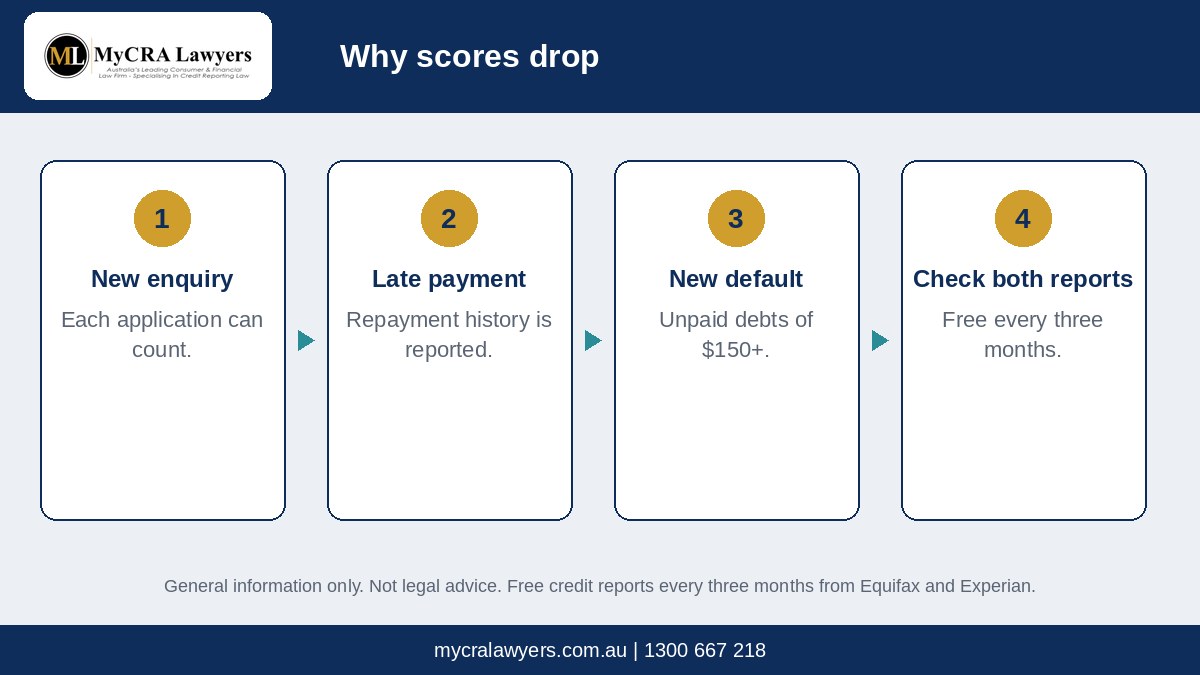
- A new credit enquiry. Every time you apply for credit, the lender’s check is recorded as an enquiry. That includes a phone plan, a car loan, a credit card or some buy now pay later accounts. A few applications close together can pull a score down fast. Our guide on how credit enquiries affect your score explains why.
- A late payment. Banks and other licensed lenders report repayment history each month. A payment usually only shows as late once it is 14 or more days overdue. One late mark can move your score. See repayment history information (RHI).
- A default. This is the big one. A default can be listed once an amount of $150 or more is at least 60 days overdue and the right notices have been sent. It stays for five years, even after you pay it.
- A new account. Opening a new loan or card can lower your score for a while, because it adds new debt and lowers the average age of your accounts.
- Old good history dropping off. Repayment history only stays for two years. A closed account stays for about two years after it ends. When years of on-time payments age off, the score can dip even though you did nothing wrong.
- A higher credit limit or more debt. Lenders and bureaus look at how much credit you have access to. More limits can mean more risk in their eyes. Our guide on credit card limits on your credit file covers this.
- A mistake. A wrong late mark, a default you never got notice of, a debt that isn’t yours, or the wrong date of birth or address can all drag a score down.
- Fraud. If enquiries or accounts appear that you never applied for, someone may be using your identity. Act on this one the same day.
Why are my Equifax and Experian scores different?
The two bureaus use different formulas and different scales. They may also hold slightly different information, because not every lender reports to both. So one score can fall while the other barely moves. That is normal. Our guide on why Equifax and Experian scores don’t match goes deeper. The key point is simple. Check both reports, not just one score.
How do I find the real reason my score dropped?
Start with the full report from each bureau. Score apps are handy, but they don’t always show every line a lender sees. Our guide to credit score apps vs full bureau reports explains the gap.
- Get both free reports. Australians can get a free credit report from each bureau every three months. See how to get your free credit report.
- Look at the newest items first. Check enquiries, new accounts, repayment history for the last few months, and any default or court judgment.
- Read the score explanation. Under the Credit Reporting Code, when a bureau gives you your credit rating it has to place you in a band and explain the types of information that usually have the biggest impact on scores in that band. It also has to say what people in that band can do to improve. That explanation is a free clue.
- Write down anything you don’t recognise. Note the lender, the date and the amount.
Good news if you’re on a hardship arrangement: the bureau must tell you that financial hardship information was not used to calculate the score it gives you.
Does checking my own credit score lower it?
No. Checking your own report or score is not a credit application. It does not leave an enquiry that lenders see, and it does not lower your score. We wrote about this in checking your own credit score won’t lower it. So check as often as you like.
When is a score drop worth disputing?
If the drop comes from something true and fair, like a real late payment, the score usually recovers as you build fresh on-time history. If it comes from something wrong, you can ask for it to be corrected. That includes:
- an enquiry for credit you never applied for;
- a late mark for a month you paid on time;
- a default where you never got the required notices, or the amount or date is wrong;
- an account that belongs to someone else.
Correction requests are free. The lender or bureau generally has 30 days to deal with it. Our guide on the 30-day rule for credit file corrections walks through the steps. If you see fraud, read how to place a credit ban after identity theft first.
Want a second opinion before you write to anyone? Pull both reports and start with a free credit file analysis at app.FixMyBadCredit.com.au. If money stress is behind the late payments, the National Debt Helpline (1800 007 007) offers free financial counselling.
How can MyCRA Lawyers help?
If your score fell and the report shows something you don’t recognise or don’t think is fair, send us both Equifax and Experian PDFs. A team member will read the file and tell you plainly whether anything is worth challenging.
MyCRA Lawyers is a specialist credit repair law firm. Have your Equifax and Experian report PDFs ready and reach us through our contact form, call 1300 667 218 or 07 3124 7133, or book a 15-minute credit repair intro call. Postal: PO Box 169, Aspley QLD 4034. We quote fixed fees in writing after we assess the file, and we will tell you plainly if a listing looks like a wait-out rather than a viable dispute. On consumer defaults accepted after initial assessment, our independently audited success rate is 91.6%. Selected consumer default work includes a Money Back Guarantee on published terms. No law firm can promise every listing will come off, and we don’t. For defaults and late marks, see our default removal and repayment history information service pages.
Not ready to talk yet? Pull both free reports and start with a free credit file analysis at app.FixMyBadCredit.com.au. For the bigger picture of how listings are challenged, read our credit repair lawyers Australia guide.
Frequently asked questions
Why did my credit score drop when I didn’t do anything?
Old good history can age off, a lender may have reported a late payment, a default or enquiry may have been added, or there may be a mistake. Check your full Equifax and Experian reports to find what changed.
How long does a late payment affect my credit score?
Repayment history stays on your report for two years. Its effect usually fades as you add newer on-time payments.
Does applying for buy now pay later lower my score?
An application for credit can be recorded as an enquiry, and enquiries can lower a score. Check your report to see what was recorded.
Can I get my credit score for free?
Yes. Each bureau must let you get your credit report and credit rating for free every three months.
Can a wrong listing that lowered my score be fixed?
Yes, if it is inaccurate, out of date, incomplete, irrelevant or misleading. Ask the lender or the bureau in writing. Corrections are free and generally must be dealt with within 30 days.
General information only. Not legal advice for your circumstances. Liability limited by a scheme approved under Professional Standards Legislation.






Leave A Comment