MyCRA Specialist Credit Repair Lawyers

Tag: repayment history information

  • How To Understand Your Equifax Repayment History Information (RHI) – Did You Know Series 102

    How To Understand Your Equifax Repayment History Information (RHI) – Did You Know Series 102

    [fusion_builder_container hundred_percent=”no” equal_height_columns=”no” menu_anchor=”” hide_on_mobile=”small-visibility,medium-visibility,large-visibility” class=”” id=”” background_color=”” background_image=”” background_position=”center center” background_repeat=”no-repeat” fade=”no” background_parallax=”none” parallax_speed=”0.3″ video_mp4=”” video_webm=”” video_ogv=”” video_url=”” video_aspect_ratio=”16:9″ video_loop=”yes” video_mute=”yes” overlay_color=”” video_preview_image=”” border_size=”” border_color=”” border_style=”solid” padding_top=”” padding_bottom=”” padding_left=”” padding_right=””][fusion_builder_row][fusion_builder_column type=”1_1″ layout=”1_1″ background_position=”left top” background_color=”” border_size=”” border_color=”” border_style=”solid” border_position=”all” spacing=”yes” background_image=”” background_repeat=”no-repeat” padding_top=”” padding_right=”” padding_bottom=”” padding_left=”” margin_top=”0px” margin_bottom=”0px” class=”” id=”” animation_type=”” animation_speed=”0.3″ animation_direction=”left” hide_on_mobile=”small-visibility,medium-visibility,large-visibility” center_content=”no” last=”no” min_height=”” hover_type=”none” link=””][fusion_text columns=”” column_min_width=”” column_spacing=”” rule_style=”default” rule_size=”” rule_color=”” hide_on_mobile=”small-visibility,medium-visibility,large-visibility” class=”” id=””]

    Welcome to “How To Understand Your Equifax Repayment History Information

    in the MyCRA (Specialist Credit Repair) Lawyers “Did You Know” Series.

    This series of Hints, Tips, and (Legislation) Snippets will Reveal The Truth behind Credit Reporting Legislation, Privacy Legislation and Credit Repair.

    You will discover:

    1. ways you can help your clients (without the need to engage us)
    2. ways clients can help themselves
    3. Pitfalls to avoid

    Tip 102 (Credit Reporting Bodies)

    They say knowledge is power but I believe the true power is in applying that knowledge.

    How To Understand Your Equifax Repayment History Information (RHI) in 2019

    Quick Background (condensed)

    • March 2014 saw the introduction of Repayment History Information (RHI) within the Privacy Act (1988)
    • Information to be recorded when you pay your bills more than 14 days late
    • July 2018 saw legislation to force Licensed Credit Providers (LCP) to supply RHI

    Proposed Purpose

    • Offer greater transparency as to the creditworthiness of individuals
    • Reduce LCP [new client] risk by identifying consistent slow payers
    • Offer lower rates and better terms to individuals that pay on time
    • A slight reduction in credit score

    Anecdotal Result (to date)

    • Inconsistent information being provided by LCP to Equifax (and others)
    • RHI alone being the cause of Home Loan / Finance declines
    • Significant reduction in credit scores
    • Confusion over how to understand the RHI tables

    I have included a table below (which is a slightly modified version and a combination of data published by Equifax and others), explaining how to understand your Equifax Repayment History Information (RHI) in 2019.

    Please comment below if you have additional information about RHI that you think will help.
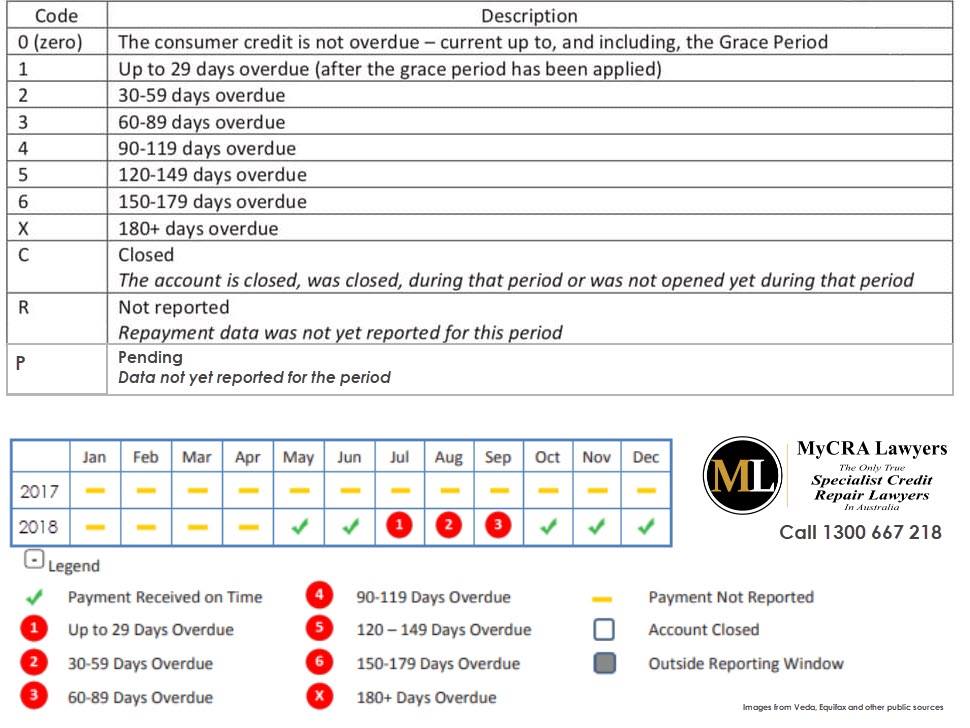
    MyCRA Lawyers - Equifax Repayment History Information (RHI) Legend - Call Now 1300 667 218


    What Now?

    If your Credit Rating is polluted with black marks, and if those black marks (Judgments, Defaults, Enquiries) are the reason you can’t get finance, and if your life would be easier (and better) with a clean, sparkling, and shiny credit file you can be proud of, then you deserve a second chance, don’t you?

    If you do deserve a second chance, call MyCRA Lawyers now on 1300 667 218
    (Mention this particular post for a Free Initial Consultation (Valued at up to $440) with our Specialist Credit Repair Lawyers or their assistants.)

    Click HERE or more in this “Did You Know” series


    Here’s a little more Info, Case Studies, and Reviews etc.

    Click here to check out a few more reviews like…
    [ Just in case the link above doesn’t work, copy and paste it into your browser
    https://www.ekomi.co.uk/review-fc055e2cb9baab91cc850f5c7ae05c29.html ]

    and check out our Google Reviews


    20190227-boostreview-nicholas-nand-google


    20190227-boostreview-michelle-hassell


    20190227-boostreview-verified-customer-2


    20190227-boostreview-ayman-khatib


    20190227-boostreview-mark-marino


    20190227-boostreview-david-shire


    20190227-boostreview-alexis-kotis


    20190227-boostreview-dwayne-kelly


    20190227-boostreview-verified-customer


    20190227-boostreview-david-mcpherson


    20190227-boostreview-elizabeth-narrier


    Actual Credit Repair Case Studies

    Have a look at a few previous success stories (Case Studies), and once you’ve made the decision to call us now on 1300 667 218,

    we’ll step you through our unique systems and processes (all designed to make it stress-free and easy for you), so you can get started today too…

    *************************************

    [/fusion_text][/fusion_builder_column][/fusion_builder_row][/fusion_builder_container]

  • Late payment grace period extended to 14 days

    grace period 14 daysAn application by the Australian Retail Credit Association (ARCA) to extend the 5 day ‘grace period’ to 14 days for late payment information  on credit reports was approved by the Information Commissioner late last week. The amendment to the Credit Reporting Privacy (CR) Code will mean consumers will have more time to pay their credit card or loan account before they cop the new type of bad credit a ‘late payment’ notation. We look at the details of this important change and what this means for you and your credit rating.

    By Graham Doessel Non-Legal Director of MyCRA Lawyers

    Since 12 March 2014, Australian credit reports can include a range of new information available to lenders, including repayment history information. Up until last week, repayment history information could be recorded on licenced credit account which was more than 5 days late.

    But following widespread concern across the community that a 5 day grace period was not long enough to ensure simple forgetfulness or mistakes didn’t see consumers hit with a black mark on their credit report, Attorney-General, George Brandis requested a change. ARCA submitted an amendment to Office of the Information Commissioner (OAIC) to extend the grace period to 14 days, which was approved last week. Consumer advocates (including myself) had argued that the original 5 days late was not long enough to indicate significant credit risk.

    “Given the concerns raised by the community and reflected by the Attorney General on this matter, we agree that a 14 day grace period is an appropriate compromise before a late payment is recorded as Repayment History Information,” ARCA CEO Damian Paull stated in a media release after making the submission to the OAIC.

    He says Repayment History Information helps improve the accuracy of predicting the credit risk of consumers, and consumers need to understand the difference between late payments and defaults.

    “One late payment on your credit report is less serious than a default. Any of us can be on holidays or forgetful, and a late payment can be offset by an overall positive history of paying most accounts on time. Defaults on the other hand are always more serious,” he said.

    I am encouraged that the grace period has been extended to 14 days, and I understand that one late payment on a consumer’s credit report should be much less serious than a default. But at the same time, I fail to see how exactly consumers are meant to understand the differences between a late payment and a default.

    We know the process of assessing credit worthiness is a matter for each lender to determine and given this, consumers have been given no information or examples from lenders in which to garner any understanding on the differences between how a default and a late payment will be treated.

    As someone experienced with seeing the effects of bad credit, I can only make assumptions based on how most mainstream lenders have treated other ‘black marks’ on credit reports. In the past, a client with a default has most often been refused credit with mainstream lenders, too many credit enquiries on the client’s credit report within a certain time frame has also in the past meant credit refusal. Consumers with these black marks who have not been out and out refused credit have alternatively been offered a higher interest rate than someone with a clean credit file.

    I predict that late payment notations will probably be treated the same way. A certain number within a certain time frame could mean credit refusal, a certain number could also mean a higher interest rate for the prospective borrower. So what’s the magic number? I guess we’ll have to wait and see.

    Image: David Castillo Dominici/ www.FreeDigitalPhotos.net

  • Why you really don’t want to be late with your credit card

    repayment history informationDo you have a credit card that you regularly let loose on? If you have trouble paying it back, you need to know that big brother may be watching YOU! Australia’s credit laws have just had a major overhaul. One of the biggest changes affecting you will be that your repayment history on accounts such as your credit card may show up on your credit file. This could impact you and your ability to obtain credit. We look at what you need to know about your repayment habits, and give you some tips so that you may be less likely to be caught out with bad credit.

    By Graham Doessel, Non-Legal Director of MyCRA Lawyers.

    The lowdown on the new laws…

    From March 12 2014, your repayment history on licensed credit accounts (this includes your loans and also your credit cards) may show up on your credit file and remain there for 2 years.

    An account of this type more than 5 days late could be recorded late by your credit provider, if they decide to take up the new credit system.

    Here is some information on repayment history information, set out on the Office of the Information Commissioner’s website:

    What is repayment history information (RHI)?

    RHI is information about whether you have met your consumer credit payment obligations. Consumer credit is credit that is intended to be used primarily for personal, family or household purposes.

    RHI includes information about whether you have made a payment on time or whether you have missed a payment. If you only pay part of the amount owing, you are taken to have missed a payment.

    RHI includes the day on which a payment is due, and if you made a payment after that day, the date on which you paid. Therefore, RHI can include both positive and negative information about your credit history.

    It does not include the amount of any missed payment — only the fact that you have made or missed a payment.

    What types of payments could be included in my RHI?

    RHI can include information about any consumer credit payments that you make, or fail to make, to a credit provider that holds an Australian Credit Licence.

    This means that RHI will usually reflect made or missed payments on a loan or credit card.

    When can credit providers begin collecting RHI?

    RHI can only relate to payments that you have made or missed from December 2012. Then from March 2014 licenced credit providers can pass your RHI on to credit reporting bodies.

    How will my RHI affect my ability to obtain credit?

    From March 2014, credit reporting bodies can disclose your RHI, along with other credit-related personal information, to licenced credit providers. Those credit providers may use this information to help determine your eligibility to be provided with credit.

    This means that if you fail to make the full amount of a payment on time from December 2012 it may affect your ability to obtain credit in the future.

    How far back will my RHI go?

    Information about any particular payment cannot be held for more than two years from the date it was due.

    However, RHI will not include information about any payment that was due before December 2012.

    How will I know if a credit provider will pass my RHI on to a credit reporting body?

    When a credit provider collects your RHI it should notify you of certain matters, including the name and contact details of any credit reporting body to whom it is likely to disclose the information.

    So whilst not every licensed credit provider will be taking comprehensive credit reporting on board, and some will take a while to apply the changes, it is really important to start implementing better credit habits NOW to ensure you’re not caught out with bad credit.

    Here’s our top tips to make sure you stay on top of your credit card and avoid a late payment notation and also defaults:

    1. Pay on time, every time.

    It doesn’t have to be a big account to have an impact on you. Accounts for as little as $150 which go unpaid can see you defaulted and banned from mainstream credit for five years. Paying on time, every time is your first line of defence against bad credit, especially following the introduction of late payment history.

    2. If you can’t pay for it – let your Credit Provider know.

    If you run into money troubles – the WORST thing you can do is pretend like it’s not happening. If you lose your job, or run into temporary financial difficulty – the smart thing to do is contact your Credit Provider to work out alternative arrangements to bridge the gap. Asking for a financial hardship variation may save your credit file even if you are struggling to make payments.

    3. Tie up all financial loose ends when you move or go overseas

    A really common way people can find themselves in trouble with their credit file – sometimes without even knowing it – is when they move house or go overseas for extended periods. Typically an account gets sent to your previous address and remains unpaid and then listed as such on your credit file. This can occur frequently with electricity accounts. If you move around a lot, consider a P.O. Box for all your mail or an alternative address. Likewise, make sure you contact your Credit Providers to inform them of your new address when you move – or if going overseas, have someone keep an eye on your mail.

    4. Check your credit statements and order a credit report.

    Many people of all age groups have the mistaken view that if something wasn’t right with their credit accounts or something was listed incorrectly on their credit file – that someone would inform them. This is seldom the case. It is your responsibility to check that your accounts are running right by checking your statements when they come in. Review each phone bill. Query anything you’re not sure of.

    In addition to this, you should also regularly check what is being seen by lenders by ordering a copy of your credit file. It is free once every year from Australia’s credit reporting agencies – and you should order it annually to make sure everything reads as it should.

    5. You have a right to correct mistakes

    Every Australian needs to know that mistakes can happen on credit reports. Likewise, bad credit can be listed on credit files unknowingly.

    A credit listing that you feel is inaccurate or unfair should be tested against the appropriate legislation for its validity and its accuracy. The process of dispute is not easy, but Creditors should be called to account for any inconsistencies. You should also know Creditors have a legal obligation to remove a listing which was placed incorrectly.

    Image: Stuart Miles/ www.FreeDigitalPhotos.net


  • Credit reporting and the year ahead

    credit reporting and the year aheadSome significant changes will be appearing this year due to Australia’s credit reporting legislation overhaul in March. These changes could impact all Australians, and especially those involved in the credit industry…Find out the 5 significant changes we’ll be watching in 2014, and decide what action you need to take for your business or for your own finances.

    By Graham Doessel, Non-Legal Director MyCRA Lawyers

    Are you ready for the year ahead in credit reporting?

    Below is my guest post in The Adviser this week ‘Credit reporting and the year ahead‘ .

    In this post, I discuss the 5 big changes we’ll be watching closely in 2014.


    Credit reporting and the year ahead (The Adviser)

    13 January 2014 | Graham Doessel

    2014 will bring some heavy changes to Australian credit reporting following the implementation of the Privacy Act 1988 (Cth) Amendments in March.

    What are the 5 big changes that we’ll be watching closely this year which could impact all involved in the credit industry?

    1. Repayment History Information (and specifically ‘late payment’ notations).

    The introduction of repayment history information (RHI) to Australian credit reports means there is going to much more data available to lenders in which to make their serviceability calculations from.

    One of the pieces of credit reporting data which could be a deal breaker for many prospective borrowers – is any late payment notations. Separate from defaults, a consumer’s RHI will show any late payments made on licenced credit – e.g. loans and credit cards and the date the payments were made.

    That information has been collected from December 2012 – but largely consumers are unaware of this important change. From March this year, it will show up on consumer credit reports across the country – and it will be interesting to see how many people have these new notations against their names.

    It remains to be seen how lenders will treat this information (as all serviceability calculations are so subjective), and precisely how the information will impact credit worthiness.

    We don’t know yet how many days late will be too late, and we won’t know this information until a new Credit Reporting Code of Conduct is registered. It has been proposed a repayment more than 5 days late will see you with one of these notations against your name.

    Another uncertainty is how many will be too many and mean the lender’s computer says ‘no’ or the lender’s computer says ‘yes’ but at a higher interest rate.

    2. New obligations on credit reporting bureaus

    With the registration of a new Credit Reporting Code of Conduct (CR Code), will be a new requirement on credit reporting bureaus such as Veda, Dun & Bradstreet, Tasmanian Collection Services and new entrant Experian, to audit the compliance of credit providers.

    The new CR Code requires CRB’s to monitor credit providers, and to determine those that pose the greatest risk of non-compliance with their core obligations under the Privacy Act. The Code determines these “at risk” credit providers would be subject to audits.

    We will be interested to see precisely how this obligation is metered out to credit reporting bureaus, and whether an independent overseer will be appointed to ensure objectivity. We hope this change will improve the accountability of credit providers. We also hope it will solidify the two entities as being ‘separate.’ We have found in the past during credit disputes, a client-type relationship tends to exist between agency and credit provider, at the exclusion of consumers.

    Further to this, it was proposed in the draft Code of Conduct, that CRB’s should also publish on their website an annual report by 30 June each year outlining information relating to credit report correction. The information would relate to the number of correction requests received, the number of successful correction requests, and the number of complaints received.

    This information has previously never been supplied to the Australian public from our credit reporting agencies (because there has never been a requirement to). If implemented as part of the new CR Code, this information will give Australia a much more accurate picture of the depth of credit reporting issues as they exist.

    3. The ‘open’ credit score

    Currently, Australia’s largest credit reporting agency, Veda is offering consumers the opportunity to purchase their ‘Veda score’ so they can see the number that lenders have been able to see when requesting credit information from Veda.

    With the Privacy changes will bring an obligation on those agencies providing a credit score, to provide information on how it is calculated. Veda has made moves to do this already.

    In addition to Veda, U.S. giant ‘FICO’ has said it would also like to offer open credit scoring to the Australian public.

    FICO currently offers its data analytics services and credit scoring to lenders for internal use in Australia, and has been doing so for many years. It is reportedly used in 90% of consumer lending decisions in the U.S.

    So if it does provide an alternative to Veda’s “VedaScore” it will be interesting to see the differences in the scores, and which one is more accurate reflection of lender serviceability calculations.

    4. “Improved” ability to correct consumer credit reports

    Creditors can and do make mistakes when placing listings on credit files, and the onus is on the consumer (or someone acting on their behalf) to identify and address those inconsistencies.

    But up till now, it has very much been a case of David and Goliath – with some consumers finding they are lumbered with listings that just shouldn’t be there due to not having the extensive skills and knowledge required to address their complaints in the appropriate way.

    The new laws around complaints correction have promised to streamline the correction and complaints process for credit reporting as well as force the credit provider to justify credit listings and actually substantiate the information it reports on credit files.

    These are significant changes which we look forward to putting into practice on behalf of the many clients we act on behalf of in credit dispute cases.

    5. New powers for the Privacy Commissioner

    New Privacy Laws provide that civil penalties can be issued by the Privacy Commissioner for a breach of certain provisions of the Privacy Act, and including the Credit Reporting Code of Conduct. They can also be imposed for serious or repeated breaches. These can be up to $220,000 for an individual or $1.1 million for an organisation.

    Finally there is some real incentive for credit providers to take due care with adding listings to credit files. The Privacy Commissioner has said he will not be taking a soft approach when it comes to breaches of the Privacy Act, and we will be watching with interest to see if this also applies with the same gusto to credit reporting breaches covered under this legislation.

    All in all, this year could bring some really positive changes to Australia’s credit system, but with it will be some teething problems resulting in confusion for some consumers. If nothing else, there’s going to be some really interesting times in credit reporting, and in finance in the months ahead.

    ________________________________________________________________

     GD COLOUR HEAD SHOTGraham Doessel is the Non-Legal Director of MyCRA Lawyers.

    MyCRA Lawyers advocates for individuals in matters of credit file dispute.

    An early pioneer in credit repair, over recent years Graham has become a frequent consumer spokesperson for issues impacting credit reporting, and is the Secretary and Spokesperson of the Credit Repair Industry Association of Australasia (CRIAA).

    Graham also founded and is the Non-Legal Director of Armstrong Doessel Stevenson Lawyers.


  • How will the changes to the Privacy Act coming in 2014 affect borrowers?

    Privacy Laws March 2014Recently I was asked to participate on a panel of finance and credit experts, answering consumer questions on aspects of credit impacting credit card users. The question, ‘How will the changes to the Privacy Act coming in 2014 affect borrowers?’ is a really important question – but one which many Australians don’t think to ask. Thankfully someone did. Read what our panel of experts has to say about how the changes can impact you and your credit rating.

    By Graham Doessel, Founder and CEO of MyCRA Lawyers.

    This interesting article has been extracted from creditcardoffer.com.au website – a subsidiary of Credit World.

     Ask An Expert: How will the changes to the Privacy Act coming in 2014 affect borrowers?

    Written by Kalianna and posted on November 28, 2013

    Expert Opinion: In our inaugural ask-an-expert question, we asked about a serious change to credit reports that we know will affect a wide range of credit card applicants;

    How will the planned changes to the Privacy Act commencing March 2014 affect someone applying for credit? Will people be labelled as bad credit who were not before? 

    There are some changes coming in March 2014 that will impact everyone in Australia with a credit file – especially those looking to apply for a new credit card or loan in the next few years – so most adults aged 18-55. For a start, lenders will be able to see much more information than they can now when they request your credit file after you apply for a new card or loan.

    Australia is moving towards a ‘positive’ credit reporting environment, where a good history with repayments and signs that you are reducing your overall debt will be rewarded and viewed positively by lenders. At the moment, lenders can see ‘negative’ information on a credit file. This includes:

    • Accounts that have been applied for (but not, for example, credit limits on credit card applications all of the time)
    • Defaults – where a payment is more than 60 days late
    • Default judgments or bankruptcy where a person has been the pursued through the courts in a debt collection action

    The system will be similar to what exists in the United States, and the third credit reporting agency to enter Australia, Experian, may also have an impact. In general Australia’s credit reporting agencies have stated that they believe it could take around 12 months before the same level of data is reported on Australian borrowers as what the US FICO system provides for borrowers there.

    Members of our expert panel agreed that those who want to apply for new credit in 2014 will be most affected by the changes, rather than those who already own their own home etc, though applications for refinancing or adding to your existing debt will not be immune to credit checks.

    If you are wondering whether you might be considered ‘bad credit’ from next year, then pay close attention to the advice given below and start doing your research into ways to improve your credit file and keep your score high enough to get approved for the amount you want when it comes time to borrow. Our experts have highlighted areas to watch, and what lenders will be interested in so you know where to concentrate your efforts.

     Graham Doessel

    Non-Legal Director,  MyCRA Lawyers

    Someone applying for credit after March next year will have more information about them shown to lenders who request a copy of their credit report.

    There will be five new data sets available to lenders,

    1. repayment history information;
    2. the date on which a credit account was opened;
    3. the date on which a credit account was closed;
    4. the type of credit account opened;
    5. and the current limit of each open credit account.

    Quite possibly there will be more people considered to have ‘bad credit’ after March 2014, once new laws are implemented. The most significant credit rating damage could come from repayment history information.

    Australian consumers are currently under the microscope with their repayments. Since December 2012, individuals who are more than 5 days late in repaying licenced credit (eg credit cards and loans) have a late payment notation marked against their name. This information will be available to lenders on the individual’s credit report from March 2014. This is in addition to the current default information which is shown after repayments fall more than 60 days in arrears.

    While many have argued that only a pattern of late payment notations would hinder access to credit, I have maintained that even one or two late payment notations could at least affect the interest rate an individual is offered.

    This change could trip up many Australians and mean people are unnecessarily banned from credit due to simple billing mistakes, lost paperwork and other payment mishaps.

    A history of applying for the ‘wrong’ type of credit could also be detrimental and possibly pull down any credit score calculated on the individual.

     Nick Vamvakas

    Chief Risk Officer, ME Bank

    With the introduction of the privacy act more information will be recorded about a person’s credit history. This includes positive credit behaviours, which were never previously recorded and some negative behaviours that weren’t previously recorded such as late credit card repayments (previously only credit card defaults were recorded). Overall this new, more complete, approach gives credit providers a better picture of a person’s credit history and has significant benefits for people applying for credit. Their credit history will be more accurate and provide a truer and fairer reflection of their ability to manage the credit for which they’ve applied.

     Dominique Bergel-Grant

    Founder, Leapfrog Financial

    Without doubt there are changes around the corner that will significantly impact all those applying for credit after March 2014.  The changes to the Privacy Act will enable prospective lenders to know more about you than you probably even do.  From details about account repayment history, types of accounts and detailed credit information about the account status.

    This is far more detail than what they currently have access to and will ensure nothing unwanted slips through.  A big difference is the repayment history of up to 24 months being provided is a significant increase to the typical 3-6 months most lenders currently require.  So being well behaved with your credit will be even more important than ever otherwise you will find yourself needing to explain any inconsistencies which could lead to a loan application being declined.

     Heidi Armstrong

    CEO, State Custodians

    The changes to Australia’s credit reporting system will have a greater impact on those applying for credit. Not only will credit providers be able to see any repayment defaults, bankruptcies or past credit applications, but they will also have access to the past 24 months of your credit repayment history going back as far as December 2012.

    This can be either a good or bad thing, depending on your financial situation. If you are diligent with your repayments and always pay bills on time, it could help improve your chances of success when applying for credit. However, if you have been late or missed repayments in the past 24 months, lenders will be able to see this and may factor this into their decision whether to approve or decline your credit application. Therefore, it is more important than ever to make an effort to keep your repayment history clean.

     Steve Brown

    Director, Consumer Risk Solutions at Dun and Bradstreet

    The changes to Australia’s credit reporting system will improve the detail and accuracy of the information used to assess applications.

    For those applicants with a history of sound financial management, the additional information will provide a more detailed view of their creditworthiness. The addition of repayment history data will also allow individual’s with a previous credit slip-up to demonstrate they have rectified their credit position by making regular and on-time repayments.

    Equally, with provisions to record payments made five-or-more days late, changes to Australia’s credit reporting system mean that those people who regularly make late repayments will become more visible to credit provider.

    If you would like to know more about upcoming Privacy Law changes, visit our blog www.mycra.com.au/blog.

    Image: Stuart Miles/ www.FreeDigitalPhotos.net

  • Your home on the line: be vigilant with bills this Christmas.

    Media Release

    repayments ChristmasYour home on the line: be vigilant with bills this Christmas.

    28 November 2013

    Australian consumers need to be extremely careful with their repayments over the Christmas period as paying even ONE DAY late on some accounts could mean their credit rating is weakened, warns a consumer advocate for accurate credit reporting.

    Graham Doessel, Non-Legal Director of MyCRA Lawyers, a national firm which helps clients dispute their credit rating, says regardless of the size of the Christmas credit card bill – delaying payment on licensed credit could prove to be a long term credit disaster and reduce the chances of securing a home loan.

    “The majority of Australian consumers seem unaware that as of December last year if you default on making a licenced credit payment by the due date, it is noted, and from March 2014, this information will show as part of your credit history for two years,” he warns.

    This new data set of repayment history information (RHI) is part of amendments to the Privacy Act 1988 (Cth) and is intended to capture those individuals who are at risk with credit.

    Mr Doessel says it is unclear the weight lenders will give to RHI when assessing credit worthiness.

    “We don’t know precisely how many notations will be too many and mean credit refusal.  We also don’t know if having as little one late payment notation will move the individual to a higher ‘risk’ category with lenders, which will mean they are charged more in interest,” he says.

    March 2014 will see a new Credit Reporting Code of Conduct come into force, which will include a probable grace period of 5 days for late payments, but until the time frame is set – there is no room for mistakes.

    5 Tips For Saving Credit File Over Christmas

    1. Watch out for identity theft.
    Be aware fraudsters are out in full force at Christmas. Don’t be lax with personal information, and take care online to minimise the risk to your credit rating from misuse by identity thieves.

    2. Stay organised.
    With the busy lead up to Christmas, repayment of your accounts should still remain a priority. Develop a system so you don’t forget – or you will pay the price later. Try to pay at least a couple of days before the due date to allow for any systemic delays with banks or BPay.

    3. Pre-pay your bills before you go away.
    Don’t get caught out with a bill sitting at home unpaid while you’re away – pre-empt any bills which may come up during that time period.

    4. Spend within your budget.
    Whilst using credit at Christmas fosters the ‘pay later’ mentality – remember that you will pay at some point for what you spend now -so consider what you can really afford.

    5. Police your Credit Provider.
    Credit Providers can also be affected by Christmas. The volume of transactions may increase while staff decrease, putting pressure on systems.Check statements – make sure they are correct, and also keep abreast of which bills are due and when. If you notice you haven’t received a bill and you believe it’s due, you should chase it up.

    Christmas is also a good time for people to check their credit rating, to ensure the accuracy of their information.  They can request a copy of their credit file at no charge, from one or more of the credit reporting agencies and a credit report will be sent within 10 working days. Contact MyCRA Lawyers on 1300 667 218.

    About MyCRA Lawyers: MyCRA Lawyers is an Incorporated Legal Practice focused on credit file consultancy and credit disputes. MyCRA Lawyers means business when it comes to helping those disadvantaged by credit rating mistakes.

    /ENDS.

    Please contact:

    Graham Doessel – Non-Legal Director MyCRA Lawyers Ph 3124 7133

    Lisa Brewster – Media Relations  media@mycra.com.au

    www.mycra.com.au  www.mycra.com.au/blog

    MyCRA Lawyers 246 Stafford Rd, STAFFORD Qld Ph 07 3124 7133

    Links:
    http://www.oaic.gov.au/privacy/privacy-resources/privacy-fact-sheets/credit-and-finance/privacy-fact-sheet-16-credit-reporting-repayment-history-information
    http://www.austlii.edu.au/au/legis/cth/num_act/pappa2012466/sch2.html

    Image: “repayments Christmas” – Naypong/www.FreeDigitalPhotos.net

  • Access to credit will fall with introduction of new credit reporting data – and it’s being collected now

    Press Release

    default listingAccess to credit will fall with introduction of new credit reporting data – and it’s being collected now.

    27 June 2013

    Credit numbers are expected to decline when more data is reported about Australian credit habits in March next year, and a consumer advocate for accurate credit reporting warns, some simple mistakes may mean it is your credit worthiness on the line.

    CEO of MyCRA Credit Rating Repair, Graham Doessel says this is an important time to know about Australia’s credit laws, and to be careful with how you use and repay credit.

    “Australian consumers are currently under the microscope with their repayments, and if they are more than five days late with their repayments to licenced Credit Providers, that is going on their credit record now for two years and will show up as of March next year,” Mr Doessel advises.

    “In my opinion, this is going to trip up many Australians. With only a 5 day grace period proposed, it may mean many Australians are unnecessarily banned from credit due to simple billing mistakes, lost paperwork and other payment mishaps,” he says.

    The prediction of reduced credit numbers has been echoed by Dun & Bradstreet CEO, Steve Brown at a recent Australian Banking and Finance Conference.

    Publication Banking Day reported Mr Brown as telling the conference that a contraction in consumer credit will take place following the introduction of comprehensive reporting in March.

    “Lenders will start to learn things about consumers that they did not know before, such as the number of late payments they make,” Brown says.

    And so say Citigroup.

    “Citigroup Australia’s country risk director for consumer, CLN Murthy, agreed that there would be a tendency to reduce credit limits after comprehensive credit reporting came in,” Banking Day reports.

    Repayment information will be part of five new data sets to show up on your credit report as part of wide-sweeping amendments to Australia’s Privacy Act, which includes a new Credit Reporting Code of Conduct.

    “Prospective lenders will be privy to your repayment habits – and the word is out that more and more information may be on the table going forward,” Mr Doessel warns.

    Banking Day recently reported that Mr Brown and others in the consumer finance industry will be pushing for even more data to be included in the future.

    “Brown said Dun & Bradstreet would like to see the inclusion of account balance data in credit files,” Banking Day reports.

    The long term plans with respect to repayment history information is to be able to offset good repayment history against a default listing. The conference predicted that products and pricing structures could be developed for these borrowers.

    In the meantime, Mr Doessel says there are some simple things credit-active Australians can do to make sure their credit-worthiness remains in-tact:

    1. Pay on time, every time. Pay within five days of your bill’s due date to avoid a late payment notation. It doesn’t have to be a big amount to impact you. Too many late payment notations will probably mean you’re refused credit, or offered only a high interest rate.  

    2. If you can’t pay, actively seek help. There are new laws to help prevent you from being defaulted if you are under financial hardship, provided you get in early with your Credit Provider. So there is a new incentive to get in and work it out prior to letting your accounts go into arrears and copping a default listing.

    3. Seek cautions credit limits. If you’re not using it, don’t have it is the general adage. If you take out a credit card or other line of credit, it’s probably not wise to opt for a lofty limit, but ask for an amount closer to what you intend to use.

    4. Consider identity theft risks. Understand how lucrative your personal information is and take steps to keep abreast of how it can be at risk. New laws will allow you to place a ban period on your credit information if you believe you may be at risk of identity theft. Acting quickly may prevent credit file misuse.

    5. Check your credit file regularly. With the new information available, it will be more important than ever to check your credit file. Many people don’t know you can do this for free annually through the Australia’s credit reporting agencies and a copy is sent within 10 working days.

    6. Correct credit information which you believe is inaccurate, inconsistent or unfair. To offset the new information, new laws will make it fairer for those disadvantaged individuals to access and correct their credit report.

    But Mr Doessel says there will still be a requirement to work within and have knowledge of credit reporting law when disputing an inaccurate or unfair credit listing.

    “It is important to note, that Credit Providers and Ombudsman must act impartially and cannot advocate for you,” he warns.

    He says you can start by contacting your Credit Provider yourself to alter incorrect information, or you can put your case for dispute in the hands of an advocate.

    “You should take steps to rectify mistakes before the information has any bearing on a credit application you may make in the future,” Mr Doessel says.

    “You should take steps to rectify mistakes before the information has any bearing on a credit application you may make in the future,” Mr Doessel says.

    /ENDS.

    Please contact:

    Graham Doessel – CEO Ph 3124 7133

    Lisa Brewster – Media Relations media@mycra.com.au

    Ph 07 3124 7133 www.mycra.com.auwww.mycra.com.au/blog

    MyCRA Credit Repair 246 Stafford Rd, STAFFORD Qld

    MyCRA is Australia’s number one in credit rating repairs. We permanently remove defaults from credit files. CEO of MyCRA Graham Doessel is a frequent consumer spokesperson for credit reporting issues and is a founding member of the Credit Repair Industry Association of Australasia.

    Image: Victor Habbick/ www.FreeDigtalPhotos.net


  • Struggling to pay your mortgage or loan? Your bank says they want to help.

    financial hardshipIt may be a foreign concept to some people to turn to their bank when they are experiencing financial difficulty, but asking for help from your bank could be the most savvy thing you can do for your finances, and ultimately your credit file if you are in trouble. New financial hardship laws which came into effect in March 2013 have been embraced by banks, and the Australian Bankers’ Association (ABA) has today announced a package which is designed to help make the process clearer for consumers who are experiencing temporary financial difficulty. We look at the package in detail, what it means for your credit file and your ability to obtain credit when you recover financially.

    By Graham Doessel, Founder and CEO of MyCRA Credit Rating Repair and www.fixmybadcredit.com.au.

    As a Cancer survivor, I know all too well what it’s like to be in a worrisome financial situation. When you have to take time out from your business or employment to recover your health, the bills can pile up. I remember trying to talk to my bank at the time about freezing my mortgage so I had one less worry. But that was a difficult thing to do – especially for someone whose small business used credit accounts. In my experience, my bank wasn’t eager to offer the hardship, and when they did, it was under terms too difficult for me to accept. So I borrowed my way out of trouble, and luckily – I recovered quickly and was able to get back on my feet again. But many people in the past have not been so lucky. They have run into real trouble, and banks may have been criticised for not being open with the existence of their hardship policies, or willing to vary credit terms unless the customer could jump through the right hoops to secure it.

    But with new legislation Consumer Credit Legislation Amendment (Enhancements) Bill 2012 being passed this year, there have come new rights for those in temporary financial trouble. Now the banks are taking a proactive stance on encouraging open communication and variations to the original credit contract of those consumers ‘doing it tough.’

    The ABA and banks in consultation with consumer and community groups have developed a package of initiatives that are proposing to promote good practice, clearer hardship processes and provide useful information to support their customers in dire financial circumstances.

    This is reportedly in response to concerns raised by stakeholders around a general lack of awareness about hardship assistance offered by banks.

    Steven Münchenberg, Chief Executive of the ABA, says research shows only one out of four bank customers know that banks offer hardship assistance.

    “If customers find themselves in financial difficulty, they need to take some action because money troubles don’t usually go away on their own. Don’t ignore the problem and talk to your bank as early as you can. Customers can also call an independent financial counsellor or ask your bank for a referral to an independent financial counsellor,” he said in a media statement.

    The ABA estimates that over 135,000 customers have been provided with hardship assistance by the main retail banks over the past year.

    Banks have reported that the number of customers who take advantage of financial hardship arrangements increases when economic conditions deteriorate. The key driver of hardship assistance is reduced income due to unemployment.

    Banks have also reported that customers have benefited from temporary assistance following a natural disaster. However, assistance during these times does not have a significant impact on the overall number of customers who are provided with hardship assistance.

    Mr Münchenberg also says illness, injury or a relationship breakdown can cause financial difficulties.

    The ABA’s consumer factsheet on hardship variations (pdf) explains what some of the hardship assistance options could be:

    Hardship arrangements cover the time between when your circumstances change and when you can start repaying your debts in full or varied as agreed.

    In most cases, people just need some temporary help to get them through the tough times and arrangements of between three and six months are generally suitable.

    The arrangements available will depend on your personal circumstances and financial situation. Somemeasures may include:

    • deferring or reducing loan repayments

    • restructuring and consolidating loans

    • altering loan repayments to interest-only

    • changing limits on lines of credit

    • waiving penalties for early withdrawal of a term deposit

    • freezing loans in exceptional circumstances, such as after an emergency event or natural disaster

    providing a moratorium on collections action • providing alternative banking arrangements.

    When considering the type of assistance that might be appropriate, banks will assess the situation on a case-by-case basis and consider your specific circumstances, such as your overall financial position and whether assistance would genuinely be able to help you.

    Banks also have to factor in business considerations, such as whether providing the assistance is consistent with their internal policies, commercial costs and management practices.

    If your financial situation has permanently deteriorated and you can’t meet regular repayments over the long term even with your bank’s help, you might need to consider other options and make some difficult decisions.

    While people rarely have to face this situation, if it occurs you may have to sell your property, refinance your business or consider bankruptcy or insolvency arrangements.

    How will asking for a hardship variation impact my credit file?

    We see the emphasis on hardship variations as a positive change for consumers to be able to talk to their bank and actively get help to improve their circumstances. One of the main differences between asking for and obtaining an official variation in your credit obligations compared with simply not paying your bills is that you avoid the bank placing a default listing on your credit file (provided you meet the new obligations that is). There is a big incentive to come to try to come to an arrangement with your bank prior to being in default (60 days in arrears) – as any arrangements made after that time will be recorded on your credit file as well as your default.

    Secondly, there is also an incentive to put your hand up and ask for help in the early days – prior to being even one payment cycle behind in your repayments. Any time you fail to make a repayment with your bank on time, the late payment will be recorded on your credit file – so for example if you are unable to make this month’s mortgage repayment by the due date, that will be recorded on your credit file, along with the date you made the payment. Although lenders won’t see this data until March 2014, it is being recorded now.

    Any person who makes an official hardship variation which is accepted by their bank will be spared from being recorded as in default, but may not be spared from the late payment notations which are incurred prior to the acceptance of the hardship variation. So the incentive really is there to get in as early as possible if you are experiencing temporary financial difficulty and speak with your bank to make new arrangements to suit you.

    Where do I go from here?

    You can get assistance through the ABA’s Doing It Tough website, or you can contact your bank or building society directly and ask to speak with the Financial Hardship Variation Team. Using the words ‘financial hardship’ will help make it clear to the people you speak with at the bank about what it is you need. Ideally, act before you fall into arrears on your account – to save your credit file when you recover from this difficult time.

    For additional advice, visit ASIC’s Money Smart Website Trouble with Debts.

    To check what is being seen by lenders about you, it is a good idea to get a copy of your credit file. This is free once every 12 months from Australia’s credit reporting agencies, and will be sent within 10 working days. If there is anything on your credit report which you are unsure about, or which seems inaccurate or inconsistent, you do have the right to have the information rectified. Contact MyCRA Credit Rating Repair for more information on disputing a credit listing or to obtain a free copy of your credit report 1300 667 218.

    Image: imagerymajestic/ www.FreeDigitalPhotos.net

  • It’s never been more important to check your credit file

    repayment history informationWe’ve been talking about it for a while now, but the warnings have been coming thick and fast over recent weeks about the new data sets which may impact your credit rating. Fresh warnings have been issued over the important change to repayment history information, which will take effect from March next year.

    We keep talking about this important issue for you and your credit file.

    By Graham Doessel, Founder and CEO of MyCRA Credit Rating Repair and www.fixmybadcredit.com.au

    If you struggle to pay your bills on time, you might find it harder to get finance. But the other issue is – if you experience a mistake in reporting this information from your Creditor – then it is more important than ever to know about it before you apply for finance, so you can take steps to rectify it.

    While defaults will still be recorded on your credit file (these are issued if your account is more than 60 days in arrears) licenced Credit Providers will also be able to issue late payment notations after payments are 5 days late – and that is being recorded now.

    A recent story in the Newcastle Herald ‘Late payers are running out of time’, features thoughts on the new laws by Katherine Lane of Consumer Credit Legal Centre NSW, who says the changes will likely mean late payers will pay higher rates of interest on loans than people who pay on time, and warns it may not always be fair.

    Lane says five days overdue is too short a period to put on people’s records.

    ”What if [fusion_builder_container hundred_percent=”yes” overflow=”visible”][fusion_builder_row][fusion_builder_column type=”1_1″ background_position=”left top” background_color=”” border_size=”” border_color=”” border_style=”solid” spacing=”yes” background_image=”” background_repeat=”no-repeat” padding=”” margin_top=”0px” margin_bottom=”0px” class=”” id=”” animation_type=”” animation_speed=”0.3″ animation_direction=”left” hide_on_mobile=”no” center_content=”no” min_height=”none”][the missed payment] is because of a bank error or the house is flooded or someone has stolen your mail?” she says.

    ”There needs to be a concept of fairness when it is not your fault.”

    She says individuals could be punished if banks take a month to correct an error. ”Why should a missed payment that is not your fault reflect on your creditworthiness?” she says.

    We recommend you ensure you are in the habit of making payments on time, but also that you make a habit to check your credit report regularly – especially after March 2014.

    And how will late payments impact on lender’s credit decisions?

    Dun & Bradstreet director of consumer risk solutions Steve Brown says it is unlikely a credit provider will rely entirely on a credit report to make a lending decision.

    ”Lenders are looking at a range of issues and one of them is whether someone has got the capacity to repay,” he says.

    Brown says that under the new regime, credit providers would be able to much better assess the repayment capacity of those seeking credit. Someone might have defaulted three or four years previously after losing their job and credit providers would be able to see that payments were being made on time, Brown says.

    Want to see what is written on your credit report? You can do this for free. Order your free credit report and make sure everything that’s recorded against your name is true and correct. If there’s anything on there you’re not sure about – give us a call and we can help.

    Image: Kittikun Atsawintarangkul/ www.FreeDigitalPhotos.net[/fusion_builder_column][/fusion_builder_row][/fusion_builder_container]

  • Privacy Law Reform To-Do List: Privacy Awareness Week 2013

    privacy law reform to do listIn our last post for Privacy Awareness Week 2013, we set out some actions you can take now for your family to get you up to speed and ready for important changes to the Privacy Act 1988 (Cth) which will impact you. We include the specific things you can to do to support your ability to obtain credit and have your credit file looking its best when changes come into effect on March 2014.

    By Graham Doessel, Founder and CEO of MyCRA Credit Rating Repair and www.fixmybadcredit.com.au.

    PrivacyWeek-Banners-R1 - 2013-3

    What can you do to support your credit file and ensure you look your best to Credit Providers? It will be essential from now and going forward to be mindful of what may constitute bad credit. Although as a consumer you are not privy to your credit ‘rating’ score, a Credit Provider will be provided with a number based on your credit habits – and this will be used to help calculate your credit worthiness. Whilst it is not disclosed by credit reporting agencies the specific items which lower your score and how much by, traditionally there are some things you can do to which will help keep your credit-worthiness in check. We look at good credit habits, and what things you need to do when our Privacy Laws change in March 2014:

    1. Pay on time, every time.

    Your repayment history information is being collected now. It is imperative you make repayments on accounts by their due date to avoid having late payment notations recorded on your credit file and shown after the March 2014 implementation.

    If you can’t pay on time, seek alternative arrangements with your lender – but be advised these new arrangements will be recorded on your credit file. This would always be preferable to a default listing though – especially if you can show good repayment history at those new terms – so there is a new incentive to get in and work it out with your lender prior to letting your accounts go into arrears and copping a default listing.

    2. Check your credit file regularly.

    Make a habit of checking your credit file regularly. You can do this for free annually through the Australia’s credit reporting agencies. There will be five new data sets of information available to Credit Providers who request a copy of your credit report. These will be:

    – repayment history information;

    – the date on which a credit account was opened;

    – the date on which a credit account was closed;

    – the type of credit account opened; – and the current limit of each open credit account.

    It is essential that you take responsibility for the accuracy of your credit file information and even more so when the above new sets of information becomes available to Credit Providers.

    3. Correct credit information which you believe is inaccurate, inconsistent or unfair.

    If there is anything on your credit report which you believe rings untrue, or shouldn’t be there, you have the right to request this information be rectified. You will need to contact your Credit Provider to alter this information. You should do this before the information has any bearing on a credit application you may make in the future. You may contact a credit repair company to assist you with this if the change is a significant one, or if you expect resistance to the request. After March 2014, if your Credit Provider disagrees with your request to correct your credit information, you can have your dispute noted on your credit file and this would be worthwhile requesting if you believe your listing shouldn’t be there.

    4. Take precautions when applying for credit.

    You may not realise, but the volume of credit you apply for and the type of credit you apply for can hinder any future credit application you may make. Whilst it is a great idea to research credit before applying – you should only ever make a credit application you have full intention of pursuing. Too many credit applications will mean you are refused credit. And from March 2014 this will be clearly displayed on your credit report. Likewise, if you apply for too many ‘high interest’ or ‘bad credit’ loans – you could be penalised with a lender if you apply for a mortgage – especially with a credit ‘scoring’ method which may shave points off your score through this type of credit application.

    5. Seek cautions credit limits.

    You may have a credit limit of $10,000 – but only have used a quarter of that. This may not be to your advantage. If you’re not using it, don’t have it is the general adage. If you take out a credit card or other line of credit, it’s probably not wise to opt for a lofty limit. You could try to get it closer to what you intend to use. A Credit Provider will only see the credit limit and not the actual amount you have utilised on that limit. As with credit applications, any credit ‘score’ may be reduced by credit limits which are too high.

    6. Make information security paramount.

    Understand how lucrative your personal information can be in the wrong hands, and take steps to keep abreast of how it can be at risk from things like identity theft. Identity theft can lead to the stealing of credit through the fraudsters accessing your credit file. Victims can end up with defaults on their credit file and a ban on obtaining credit for 5 years. The Office of the Information Commissioner (OAIC)’s factsheet Ten Steps To Protect Your Personal Information gives you some guidance on how to do that. New laws will allow you to place a ban period on your credit information if you believe you may be at risk of identity theft, which can prevent fraudsters from accessing credit in your name – so if you do feel you may be at risk – acting quickly may save your credit file from misuse.

    Image 1: Rawich/ www.FreeDigitalPhotos.net

    Banner: Courtesy of OAIC


  • Your credit check is soon to reveal all your bad habits: Privacy Awareness Week 2013.

    repayment history informationPress Release

    Your credit check is soon to reveal all your bad habits: Privacy Awareness Week 2013.

    29 April 2013

    Australians are urged to be more diligent with paying all of their bills on time, every time or face a black mark against their name as part of privacy law reforms on their way in March 2014 – and a consumer advocate for accurate credit reporting warns consumers that late payment information is being collected now.

    CEO of MyCRA Credit Rating Repair, Graham Doessel says it is important for all credit active individuals to rethink their repayment habits, or potentially face a series of late payment notations which could mean they are banned from credit in the future.

    “The time to change is now. Ensure that every bill is being paid on time – not two days late, or a week late – as come March next year – our history of paying bills late from December 2012 onward will show up when we apply for credit,” Mr Doessel warns.

    His warning comes as part of Australia’s Privacy Awareness Week 2013 which is run from 29 April to 4 May, aimed at educating individuals and businesses on matters of privacy. 2013’s theme is Privacy Law Reform – a campaign to educate Australians about changes to the Privacy Act (1988) passed on November 29 2012, which will be implemented on March 12, 2014.

    Repayment history information (RHI) is part of five new data sets which will appear on Australian credit reports, from March next year – meant to afford a more accurate picture of someone’s suitability to service a loan.

    The other four data sets are: the date on which a credit account was opened; the date on which a credit account was closed; the type of credit account opened; and the current limit of each open credit account.

    “I think late payments will be looked on pretty unfavourably when this information becomes available to lenders, along with other factors such as applying for too much credit; applying for credit too often; or applying for the ‘wrong’ type of credit,” Mr Doessel says.

    He says it is not known how much weight repayment history will be afforded on its own, but predicts lenders will be reluctant to lend to someone who presents with too many late payments – even if there are no defaults present.

    “If lenders are deciding between an application which has no late payments and one with a few scattered here and there, they’d probably choose the clear one,” he says.

    Mr Doessel says when the legislation was passed in late November, many – including himself were up in arms that RHI could be included after an account was one day late.

    “This didn’t allow for any wiggle room, and put those using systems like direct debits and BPay at risk if payments didn’t go through right on time,” he says.

    But a draft Credit Reporting Code of Conduct which will underpin the changes to the Privacy Act now allows for a 5 day grace period before RHI is recorded.

    “I am thankful that those drafting the CR Code have taken these concerns into consideration and adopted the 5 day rule for individuals – making it fairer for all,” he says.

    Mr Doessel says come March 2014, it will be more important than ever for individuals to be vigilant with checking their credit file.

    “With all the new information about people available to lenders, it is pretty crucial that it reads accurately. You can check your credit file at no charge annually by applying with Australia’s credit reporting agencies,” he says.

    Go to http://bit.ly/My-Free-Credit-File for more help to obtain your credit report.

    “Thankfully, if there are issues of inaccuracy on credit reports from March – there will be more support within the Privacy Act amendments to allow for ease of correction,” Mr Doessel says.

    PrivacyWeek-Banners-R1 - 2013-3

    /ENDS.

    Please contact:

    Graham Doessel – CEO Ph 3124 7133

    Lisa Brewster – Media Relations media@mycra.com.au

    Ph 07 3124 7133 www.mycra.com.au www.mycra.com.au/blog

    MyCRA Credit Repair 246 Stafford Rd, STAFFORD Qld

    MyCRA is Australia’s number one in credit rating repairs. We permanently remove defaults from credit files. CEO of MyCRA Graham Doessel is a frequent consumer spokesperson for credit reporting issues and is a founding member of the Credit Repair Industry Association of Australasia.

    Top image: FrameAngel/ www.FreeDigitalPhotos.net

  • Are you lying to yourself when it comes to credit?

    money liesIn this week’s ‘Make Credit Work For You’ post, we look at the lies we tell ourselves which see us taking on too much credit, or see us run into trouble with our credit file. Those lies can end up leaving us unable to pay, and blacklisted from credit for years to come. What should you be honest with yourself about when it comes to borrowing money? This post is inspired by David Koch’s recent article ‘Money lies you need to stop telling yourself’ featured on news.com.au. 

    By Graham Doessel, Founder and CEO of MyCRA Credit Rating Repair and www.fixmybadcredit.com.au.

    According to Kochie, telling yourself financial lies is pointless. He says it’s time to toughen up and stop the lies, as these can cost us big time in the future.

    So, what things can we lie to ourselves about, that could cost us our good credit rating down the track?

    * As long as my job pays well, it’s OK if I hate it.

    Kochie says staying in a job that you hate, even if it pays well, means you don’t have your heart in it, there will be no commitment, no passion and your boss will eventually latch on.

    “Inevitably, you’ll be the first one to go in any redundancies and the one overlooked for any promotions,” he says.

    So before you apply for credit, especially major credit like a home loan – it’s important to understand the long term commitment, and consider whether the career you’re in is going to fulfil you for at least several years to come. In the early years of a loan, your repayments will be at their highest and it will be essential to put your head down and pay off as much as possible.

    Kochie says success comes easiest to those who love their job. So if you don’t – it might make sense to spend some time getting settled in a job you do love, before you apply for major credit.

    However, if you are unhappy in your job and are currently paying off a mortgage or other significant loan – it’s important you are really smart about how you change careers. Consider your loan first and foremost before you make any drastic career changes. You don’t want to be caught out unemployed and unable to pay your loan.

    * If I turn a blind eye, somehow my finances will work themselves out

    Burying your head in the sand is never a solution to your financial issues. They only snowball.  At this point in time in Australia, paying bills even one day late may directly impact your credit file, through licensed Creditors recording your repayment history information. Paying them later than 60 days will see you defaulted.

    The government has made changes to credit laws in order to assist consumers in financial difficulty, but you need to put your hand up and own your financial problems, and you need to have a plan.

    To begin with, stop lying to yourself about how much money you actually have. To get any help, or to help yourself, you first need to know exactly how much you have left at the end of the week – or even how much you are in the red.

    If you know you can’t make your credit repayments, work out how much you can pay from what you have, and give this information to your Creditors to negotiate a financial hardship plan which may see your repayments reduced for a period of time. For more information on financial hardship variations, visit ASIC’s MoneySmart website.

    If you are not in dire straits yet, don’t wait till you’re there to do something about it. Kochie recommends starting with a plan that involves either cutting back expenses or earning extra income to balance the books. Make a goal, make a plan and get yourself there.

    * I should buy a home because that’s what grown-ups do

    Despite the ethos that everyone in Australia has the right to own their own home, buying a home is not right for everyone. Kochie argues that for some, renting and investing your savings can be a better financial option.

    For others, they may see more results being able to buy a home and focus on paying down the mortgage (creating equity) as their investment strategy.

    And some people just won’t be able to meet the big financial commitment that a home loan entails, even if they want to, and even if on paper, they look like they could. If this is you, consider that for now, you may be better off learning more about how to make credit work for you, to gain more money skills and adopt a different attitude towards money and credit before you take the plunge.

    * If I dip into my savings now I can always make up for it later

    Kochie advises it’s way more productive to leave your savings untouched and earn extra to pay for the item or experience. If you are saving for a home or business loan, then more savings means cheaper credit.

    * If I get approved for a loan or credit limit increase, I can afford it

    Kochie says this is probably the most dangerous of all lies. “Forget what the bank is offering in terms of increased credit card limits or loan amounts, only you really know what you can afford,” he says.

    Remember, the bank doesn’t have to pay your loan back – you do.


    Some other lies you can tell yourself about credit which you shouldn’t:

    * No news is good news when it comes to bills.

    No its not! If you think you should have received a bill and haven’t, the best thing you can do is chase it up. Nine times out of ten your Creditor thinks you should have received it, and you accrue days in arrears, meaning they may default you anyway whether you received the bill or not. This is especially important if you change addresses.

    *If I love someone, money doesn’t matter.

    Money still matters and when it comes to credit accounts, love may be blind but your Creditors are not. You need to keep your head in money matters when love is good and when love goes bad. Sometimes joint credit accounts can land you in hot water. Cover yourself and your credit file against the worst.

    * Someone else will tell me if my credit file is not accurate.

    No they won’t, it’s up to you to be proactive. There is an avenue for complaint if you think your credit file is inaccurate, but the responsibility for finding out whether everything is correct rests which the individual credit file holder. So it is really important that you do an annual credit check (which is free) through Australia’s credit reporting agencies. Don’t leave it until you’re applying for a home loan to find out you have defaults or other credit listings you don’t think should be there.

    To find out more about credit file accuracy, visit our main site www.mycra.com.au or call a Credit Repair Advisor tollfree on 1300 667 218.

    Image: Teerapun/ www.FreeDigitalPhotos.net

  • Buying a home? 5 things you need to know about Australia’s new credit reporting laws before you apply for finance.

    Media Release

    Buying a home? 5 things you need to know about Australia’s new credit reporting laws before you apply for finance.

    Some major changes have occurred to Australia’s Privacy Laws, and home buyers need to know about them before they apply for finance. A consumer advocate for accurate credit reporting warns potential home buyers they need to get up to speed with some of the main changes to credit reporting which could see more people refused a home loan in the coming months and years ahead.

    CEO of MyCRA Credit Rating Repair, Graham Doessel says some simple mistakes made with repayments now, could see people blacklisted from credit even before the Privacy Amendments (Enhancing Privacy Protection) Bill 2012’s March 2014 deadline for implementation.

    “Potential home buyers need to know that from this point on, they need to make every credit repayment on time to avoid having late payment information show up on their credit history and potentially ruin their chances of getting the home they want,” Mr Doessel says.

    Mr Doessel explains more about this change, and other factors in Australian credit reporting which impact your credit rating:

    1. Repayment History Information

    From December 2012, whether or not a credit account was paid on time will be part of your credit history and will be used when a lender is assessing your suitability for a home loan.

    The notation will remain as part of your credit history for 2 years.

    The Government intends for these reforms to decrease levels of over-indebtedness in the market.[fusion_builder_container hundred_percent=”yes” overflow=”visible”][fusion_builder_row][fusion_builder_column type=”1_1″ background_position=”left top” background_color=”” border_size=”” border_color=”” border_style=”solid” spacing=”yes” background_image=”” background_repeat=”no-repeat” padding=”” margin_top=”0px” margin_bottom=”0px” class=”” id=”” animation_type=”” animation_speed=”0.3″ animation_direction=”left” hide_on_mobile=”no” center_content=”no” min_height=”none”][i]

    But Mr Doessel is worried it could push more borrowers into higher interest rate loans due to being refused credit with mainstream lenders.

    “Many people pay bills late, for a variety of reasons – this doesn’t necessarily mean they intend for the account to go into default. But these late payers could find they end up refused credit, or charged thousands more in interest due to these notations,” he explains.

    2. Types of credit

    The new laws will now allow information on the type of credit accounts you have, and when they were opened and closed to be shown on your credit history. This will give lenders more ability to determine the relevance of each listed credit account for your specific situation.

    3. Credit limit of each account.

    The credit limit on each credit account will be used to assess the potential volume of credit the potential borrower could have access to.

    But there will be no way of telling what level of debt you actually have only what you could potentially redraw to.

    “It may be worth reducing unnecessary credit limits on your accounts before you make your application,” Mr Doessel says.

    4. Beware excess credit enquiries.

    Whenever a person other than you makes an enquiry on your credit history – that enquiry is recorded on your credit file.

    Mr Doessel says some lenders will decline a finance application due to too many credit enquiries, such as two enquiries within thirty days or six within the year.

    “By all means ask questions, and do your research on the best home loan for you, but when it comes to giving over your details, and making applications, leave that until you have decided which lender suits you best, to avoid being disadvantaged,” he says.

    5. It will still be up to you to ensure your credit file is accurate.

    With all of the new information available to lenders about your credit history, it is more important than ever for that information to be accurate.

    You can apply for your credit report for free every year by making a request to Australia’s credit reporting agencies – Veda Advantage, Dun & Bradstreet and Tasmanian Collection Services (if in Tasmania).

    “It is up to you to ensure your credit file reads accurately,” Mr Doessel says, “and the saving grace for this legislation is the improvements set to be implemented in 2014 around access and correction of your credit file.”

    From March 2014, Creditors will be forced to justify disputed credit listings. Notably, your Creditor will have to substantiate the information they report on your credit file if you dispute it.

    “This change is crucial, considering the power the Creditor has to impact your ability to obtain credit for years to come. Up till now, there has been little obligation within the legislation for the Creditor to justify credit listings, nor remove incorrect data,” Mr Doessel says.

    If the dispute escalates, you can complain directly to the Creditor’s Ombudsman, and in some instances may have a right to remedy under the direction of the Privacy Commissioner.

    “Finally there is some real incentive for Creditors to take due care with adding listings to credit files and we as credit repairers ultimately have a better avenue to help our clients remedy their credit rating errors,” Mr Doessel says.

    /ENDS.

    Graham Doessel – PH 3124 7133

    Lisa Brewster – Media Relations media@mycra.com.au

    Ph 07 3124 7133 www.mycra.com.au www.mycra.com.au/blog

    246 Stafford Rd, STAFFORD Qld. 4053
    MyCRA Credit Rating Repair is Australia’s leader in credit rating repairs. We permanently remove defaults from credit files.

    ——————————————————————————–

    [i] http://www.attorneygeneral.gov.au/Media-releases/Pages/2012/Fourth%20Quarter/29November-2012-FamiliestobenefitasprivacyreformspasstheParliament.aspx

    Image: vichie81/ www.FreeDigitalPhotos.net[/fusion_builder_column][/fusion_builder_row][/fusion_builder_container]